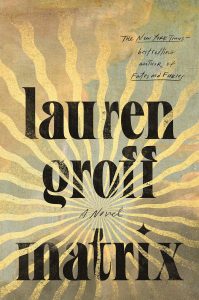
 Summary: A historical fiction book about Marie de France, a nun and author in the late 12th century.
To say that we don’t know much about Marie de France is an understatement. There are four writings that are probably from her, but other than that, there is basically no documentation. Even her name is only taken from one of her writings that is basically, I am Marie and I was born in France. Contextually it is assumed that she was born in France but spent most of her life in England as a nun. She was highly educated and there is speculation that she is the half sister of King Henry II, but that is in part trying to make sense of how she was educated.
Matrix is the third historical fiction book about medieval nuns I have read recently. The first two were Illuminations: A Novel of Hildegard von Bingen by Mary Sharratt and Revelations: A Novel by Mary Sharratt about Margery Kempe. But both of those were about women that there was much more historical data. Margery Kempe wrote what is probably the first autobiography of a woman in English. And Hildegard had much more contemporary writing and writing about her. And even so the fiction part of the historical fiction required a lot of creative imagination to create a readable story. But with Matrix the historical is almost nonexistent and it is all fiction because even what we know about Marie de France is mostly speculative.
One of the potential problem of historical fiction is writing the main character as a modern person who happens to be more advanced socially or culturally than those around them. In some cases that may be historically accurate because there was an “advance” that the person was responsible for innovating. But generally, most people are people “of their time” in the sense that they were culturally similar to those around them. I am not completely new to the era. Beth Allison Barr is a historian of the era and included good discussion of the role of women in that era as part of her evidence about how the modern gender role discussion is a modern invention. And a lot of discussion about mysticism is about the medieval era. So I have some context of women in the mediaeval era, although I am far from an expert.
There are choices that I think will irritate a lot of readers. Marie is framed as a child of rape who grew up on her mother’s estate and then came to run the estate for several years as a teen after the death of her mother because women did not have inherence rights and the estate would be taken over by a distant relative if it were known that her mother had died. This (fictional) background justifies her experience in estate management and running a monastery as a woman in her early 20s. That is a very neat solution to why she became Abbess (or Matrix) of the house.
Early in the book, after she was removed from her estate, she came to the court of Eleanor of Aquitaine and lived there for a while. But she was so tall and ugly (and independent) that Eleanor decides that she is only fit for being a nun and not marriage. The other reason that marriage is not suitable isn’t really discussed, but underlies the rest of the book, is that Marie is a lesbian, having an affair with her maid in the court and having a crush on Eleanor that runs throughout the book. I am not going to suggest that there were no lesbians in convents in mediaeval world, but this feels like a too-easy category for a modern author to use to frame the book.
What I do like about the book is that it handles faith fairly well. Part of what we know about Marie from her writing is that she had mystical visions. So making her a mystic is required. But that doesn’t mean that there is no human agency in her role as abbess or that faith was a pure given. Some of her “visions” were about protecting the women in her care and giving a vision for expanding the house and pressing people around the house to give to its care. But other visions were real gifts from God. The reader can see that pride and vanity were responsible for Marie not always being able to distinguish between her desires and the Holy Spirit, but that is also true of many of us. Actual faith was not particularly important to her prior to becoming a nun, but over time, she develops real faith. That progression is handled well.
Overall, I am not disappointed that I read the book, but I also don’t think it was nearly as good as the two novels by Mary Sharratt. It was on Obama’s best books he read on 2021 list and want a number of awards, but I thought it was just okay. I checked the audiobook out of the library, but read the kindle edition, which was on sale, for most of the book. The audiobook was fine, but it felt better in print to me.
Matrix: A Novel by Lauren Groff Purchase Links: Paperback, Kindle Edition, Audible.com Audiobook