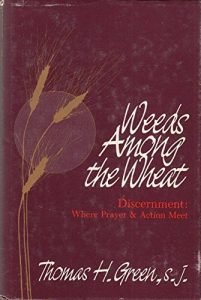
 Summary: Exploration of discernment from a Jesuit.
This was my second reading of Weeds Among the Wheat. I read it the first time as part of my spiritual direction training. I think it is really what started me thinking of spiritual direction as significantly oriented toward developing discernment. That isn’t the only role of spiritual direction, but I think it is a significant part of the role of spiritual direction.
(I remember one person telling me that spiritual direction was really only helping people learn to pray. I know that some spiritual directors have an emphasis and focus and I probably have a tendency to over emphasize discernment, but I think I do that in part to counteract some other spiritual direction trends.)
Thomas Green passed away in 2009. He became a priest in 1963 and spent almost all of the rest of his working in the Philippines. Much of it working at San Jose Seminary. Over his career he wrote nine books. I have only read this one and Friend of the Bridegroom.
Weeds Among the Wheat is not a book I would recommend to introduce discernment. He assumes too much familiarity with both Christianity as a whole and Ignatian discernment to use as an introduction. It is one of those books that I would consider a 301 level book. It is not introductory level, it is more than the 2nd level 201 book. But it is also too introductory to be an upper level book. More than anything else, I think it is helpful because of the metaphors that he uses. Three in particular are what I walk away with.
The first is in the title, Weeds Among the Wheat. This referencing Jesus’ parable in Matt 13. Green explores this as justification for teaching discernment. If the world was only made up of wheat (good people working for God) then there would be no need of discernment. But both the world and the church have tares. We should discern the tares, but we can’t assume that we can remove all the tares because doing so would end up destroying some of the wheat in the process. So there is a dual metaphor here. Not just discerning the difference between the wheat and the tares, but also discerning when the tare should be removed because it is harming the wheat and when removing the tare would harm the wheat.
He does not directly address the church abuse crisis, but I read this discussion with that in mind. I think some of the problems of allowing abuse to continue unchecked was about a lack of discernment about how abuse harms. I don’t want to ever condone abuse, but there does also need to be discernment and a process in dealing with abuse investigations in ways that minimize harm. So we can’t overreact to lack of discernment about abuse by also having a lack of discernment about responding to abuse.
The second metaphor that I think is helpful is his metaphor about buying a tie for his father. He was shopping with his mother for a Christmas present for his dad (as an adult) and realized that buying a tie was an exercise in discernment. There is generally better ties and less good ties, but once you get good quality ties, the actual design and color are not about quality, but about knowing the person who is going to wear the tie. Some people only like particular colors or designs. Some people like quirky or highly specific themed ties. Some people wear ties associated with their past schools or jobs. The way to be discerning about the purchase is to know the person better. The process of discernment isn’t only about a process, but it is about a relationship. His mother will always be better at picking out a tie that his dad will like than he as the son will because she knows her husband better. As a son that only saw his father every couple of years (because he was living in the Philippines) he just didn’t know his father’s tastes as well as his mother did. He could learn something about ties and that would help get a good quality tie, but it wouldn’t help get the right tie if he didn’t know the wearer well.
The third metaphor that was really helpful in the book is that God is the father and we should think of God as a father, but a father (or parent) of adult children, not infants or toddlers. I listened to a podcast interview with the authors of The Myth of Good Christian Parents. Part of what they were pointing out is that much of the parenting advice was oriented toward shaping children into perfection, not helping children to mature into independent adults. Children always have autonomy, even as very young children. If a child refused to do something, the only real option is to force them to do it through violence or other coercion, or to get them to want to do it through reason and understanding or some version of bribery. The myth that the book explores is that presentations of parenting as “if you do A, B will result.” If you spank children they will instantly and willingly comply. And once they comply they will continue to always do right. But there was almost never discussion of helping children to learn to discern the why of right behavior. When children are allowed to discern for themselves, they will make bad choices sometimes. But they also will be making the choices out of internal motivation, not fear of disappointing God or punishment.
The metaphor of God of adult children, not God of toddlers or infants is that we have autonomy (as actual adults) to make choices. We will make bad choices sometimes. And we will suffer consequences of those bad decisions. But God is not waiting around to spank us, but loves us and desires for us to be shaped into the type of person who is internally motivated out of virtuous character, not fear of punishment. One of the reasons that I have emphasized that discernment is not just a process of decision making but also character development and virtue is because the decisions making is the back end of discernment. The first part is the character and virtue that is used to make the decisions.
I think some teaching about discernment that is primarily focused on the decision making can be similar to many parenting books that teach a type of prosperity gospel “if you do this, then God guarantees you that” approach. Discernment isn’t a formula or a recipe. It is an art or a journey. You can have tools for the journey or develop skill with the art process, but the end result is not guaranteed the first time. It will require practice and development of “muscle memory” of virtue.
On the whole Weeds Among the Wheat is a book that I need to keep revisiting every few years. I have underlined large chunks of the book, primarily in the sections of exploring what discernment is and why we need to both need to do it and teach it, but also in the section of exploring the “weeds” and why we are in a world that has weeds and the gift that those weeds can be to our faith and life. The how-to sections are probably less helpful to people who have not explored Ignatian rules of discernment because they do not give enough detail on what is being referenced. But if you have some background on the rules of discernment, then this is a good upper level book on the how to parts of discernment.
For people that are new to discenrment, especially if you are Protestant, I think the best introduction is Hannah Anderson’s All that is Good.
Weeds Among the Wheat by Thomas H. Green Purchase Link: Paperback
1 thought on “Weeds Among the Wheat by Thomas H. Green”