 Summary: A very good introduction to discernment, mostly from the Ignatian perspective.
This is the second book I have read by Trevor Hudson, and the second that the Renovare Book Club has done. The last book connected Ignatius and Dallas Willard, so I knew that Hudson was familiar with Ignatius and that he was a spiritual director, primarily leading the Spiritual Exercises.
I was happy to read In Search of God’s Will and now have a new book that I will strongly recommend when thinking about discernment. I went back and looked and I have read more than 35 books directly or indirectly about discernment over the past few years so I have some perspective on what discernment is and how it should be discussed. In Search of God’s Will checks most of the boxes of what I want. I still recommend All that is Good as a starting place, but then this is the book I would recommend after that.
One of my complaints about discernment teaching is that it is often reduced to a spiritualized decision making system. Hudson avoids much of both by the way he defines discernment and how all encompassing the discussion is toward the whole of life.
According to Hudson, “Discerning what God wants, therefore, involves paying careful attention to what God is doing and saying and to what we think and feel about the choices we are facing.” That is just a nicely rounded definition. It accounts for it being a spiritual activity, it pays attention to the fact that we need to understand our own desires and needs as part of the discernment process, that feelings are essential, not just some type of abstracted knowledge, and that we have autonomy to make choices, not just be directed in a deterministic method.
Ignatius puts a lot of emphasis on learning to see God’s presence around us as a basis for discernment. Hudson expands on his definition to say, “…discernment involves recognizing God’s active presence and voice so we can respond to what God is doing and saying and bring our lives more into harmony with God’s dream for our world. This can only happen when we are aware of how and where God is calling us in our daily experiences and events.” The paying attention to God is essential, but also Hudson is noting that there is a purpose for the paying attention, to become who God has created us to be. Part of why I think that discernment is so important is that, rightly done, it is an essential part of recognizing our creation and embracing both our limitations as human beings, but also the particular gifting and make up that God as uniquely created within us.
One of the helpful parts of In Search of God’s Will, and one of the parts that will mostly be skipped over, is that the book is full of exercises to practice what Hudson is talking about. He walks the reader through what he means by discernment and steps the reader through exercises designed to help understand the larger process.
He has a nice piece of advice that he was given, and that I am going to steal. “Always remember, Trevor, that we do not learn from experience; we learn when we reflect on experience.” He expands on that piece of advice:
Why is the practice of reflecting on our circumstances important? Remember, there is one central conviction on which discernment is based. Here it is again: The Bible witnesses to God’s active presence in every experience, every encounter, and every event. There is no place in our everyday lives where God is absent. We must resist any kind of split spirituality that separates our lives into spiritual and nonspiritual compartments. The divine footprint is present in all our circumstances. God wants to meet us in all the realities of our daily lives. However, we will only discern how God is present and active in these things when we reflect on them. This is how discernment works. We reflect on the outer landscape of our lives to catch glimpses of how God has been present and active in those events. While we often cannot see God coming, it is easier to look back and discern how God has been with us. Learning to recognize God’s activity in our lives makes it possible for us to respond to God more faithfully as we go forward. It helps us purposefully align our own decisions and choices with God’s action in and around us. By fine-tuning our antennae to “hear” God’s voice speaking through our circumstances, we build the foundation for a life of faithful discipleship.
In my avoidance of reducing discernment to a spiritualized decision making toolkit, I can sometimes deemphasize that part of the point of discernment is making decisions. And Hudson rightly balances that by reminding us that, “Discernment without decision-making remains incomplete.” (I contend that the real point of discernment is formation into Christlikeness, but we are formed in part by the decisions that we make as part of discernment.)
Discernment is a lifetime project. I think we need to start by orienting ourselves toward what is good, not just avoiding what is wrong (which is why I think most people should start with Hannah Anderson’s All that is Good). But the next step is starting to pay attention to both ourselves and the work of God around us. And In Search of God’s Will does a very good job of orienting us to do both. Discernment is easier for people who are introspective. But all people can build skills of discernment even if some find it easier than others. This book is a good place to start.
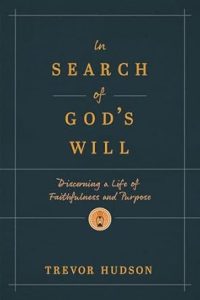
In Search of God’s Will: Discerning a Life of Faithfulness and Purpose by Trevor Hudson Purchase Links: Paperback, Kindle Edition, Audible.com Audiobook