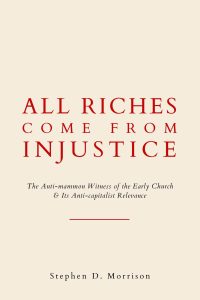
 Summary: A look at the early church’s view of wealth.
I would not have picked this up except it was part of a book group. I was not completely new to the topic. I have read Peter Brown’s book on the early church’s view of wealth. And I have read a bit of the early church fathers and general Christian histories and was broadly aware of the early church’s teaching against wealth.
The oversimplification of the early church’s teaching was that if you had wealth, it was for the purpose of caring for others. So if you hoarded wealth, then it was a misuse of wealth, and therefore sin.
The main task of the book is to document that not only hoarded wealth, but many of the aspects of our modern capitalistic system were viewed as either sin or at least it was viewed skeptically by the early church. I think broadly that point is well made. Although it is a bit repetitive because it uses the same or similar quote multiple times to make slightly different points.
The author is an democratic socialist who started out to write a Christian book against capitalism and thought it better to separate out the early church’s view into its own book. While I have read socialist and marxist arguments before, I think those aspects were less successful. The last two chapters were a defense of using marxist analysis and the need for creating a new imagination about the possibility of alternatives to capitalism. I think The Economics of Good and Evil does a better job looking at the different ways that economics and morality have been understood to work together over time and that type of book would be more helpful for a skeptical audience than this one.
I also think Tom Holland’s Dominion makes a good case for why care for the poor and vulnerable is an important feature of Christianity without needing to bring in marxist theory. (Rodney Stark also makes similar arguments in several of his books as well.)
I also think that part of the problem with the framing of this book is that more work needs to be done to look at the differences in how our economics works from the early church. The economics of the Roman era did not tend to charge interest except in predatory ways. So the early church’s opposition to interest and usury isn’t exactly the same as taking out a loan to buy a house or get student loans. Interest can absolutely be predatory and inappropriate. But interest is also a means of cooperation and there is little nuance here to understand how the different economics systems impact the way the economic morality works.
I am all for a more highly regulated economy that is designed to more explicitly protect the vulnerable and the poor. I would not consider myself a neo-liberal globalist. But I also know that we live in a capitalist system and there are ways to think about how to act with Christian morality in that system.
A project like this that helps to recover Christian origins of understanding the morality of economics can be helpful. I am glad that I read it, but I also think it is a bit dry and repetitive so I won’t strongly recommend it.
All Riches Come From Injustice: The Anti-mammon Witness of the Early Church & Its Anti-capitalist Relevance by Stephen Morrison Purchase Links: Paperback, Kindle Edition