Glamorous Powers by Susan Howatch

Summary: An Abbot feels he receives a call from God to leave his order and return to the world.

I am working my way back through Susan Howatch’s Church of England series. This six book series is about four different Church of England clergy told from five different main characters (one is told from the perspective of a mistress) over 30 year period.

Glamorous Powers was probably my least or second least favorite of the series on the first reading. But I discovered a lot more depth on a second reading. The first time I read this on kindle, this time I switched to audiobook.

As with all of Howatch’s writing, I think there is too much melodrama. But the melodrama makes a lot of sense to the story here. Jon Darrow is an Anglian monk. He is Abbot of one of the houses of the Fordite order (the order is fictional, but according to Wikipedia there are about 2400 Anglican Monks or Nuns around today.)

Darrow is the spiritual director from Glittering Images, the first book in the series. In the first book, Darrow was a near perfect figure, always knowing what to do, in near perfect communion with God and using his psychic abilities for spiritual direction. But several years after the first book he receives a vision that he interprets is a sign from God to leave the order and re-enter the world.

Read more

America’s Pastor: Billy Graham and the Shaping of a Nation by Grant Wacker

Summary: An evaluation of Billy Graham’s place in history.

I have been reluctant to read biographies of living people recently. Sometimes it just feels like we need more distance to be really able to understand  a person’s contributions, and when that person is beloved, their weaknesses as well.

So I was not planning on reading America’s Pastor. I have read Billy Graham’s own, way too long and detailed without being all that interesting autobiography(-ish), Just As I Am. And I figured that was probably enough for the next decade or so. But after two pretty positive reviews by Mark Noll and Ted Olsen and then the same day being offered a review copy, I decided to pick it up.

And I am glad I did. America’s Pastor is not a biography. There is a fairly short overview of Graham’s life at the beginning, but the rest of the book is chapters focused on different aspects of Graham’s work, image or legacy. The eight chapters are: Preacher, Icon, Southerner, Entrepreneur, Architect, Pilgrim, Pastor and Patriarch.

Read more

Practice Resurrection: A Conversation on Growing Up in Christ by Eugene Peterson

Summary: The church is where we we can learn to grow up as Christ intends.
A bit over 4 years ago I first read Practice Resurrection. It affected me then and affects me now. I picked it up again and intentionally re-read it with Glittering Images.

The two books, at different times, are two of the books that have most impacted me since I started Bookwi.se.

Practice Resurrection, the final of a five book series on practical theology by Peterson, is a long exploration of Ephesians as an illustration of why the Christian life is at root a means of allowing us to practice being like Christ (and central to that practice, why that  must be done in context of church.)

Peterson uses the illustration of practicing to remind us that no one is suddenly saved and holy. Yes from conversion we are saved and viewed as righteous in God’s eyes. But the rest of our life is practice on how we can become more like Christ.

Read more

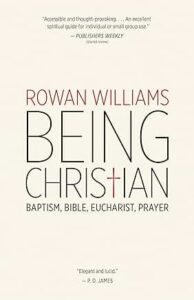
Being Christian: Baptism, Bible, Eucharist, Prayer by Rowan Williams

Being Christian cover imageSummary: Quick look at four universal Christian practices. 

Many people have a lot of respect for Rowan Williams. He was the Archbishop of Canterbury for ten years before retiring three years ago. He is still fairly young (64), and he is still publishing a ton. So, I keep meaning to read some of his books—this one I picked up free with some promotional credit from Audible.

Being Christian was originally a series of Holy Week lectures adapted into a short book. The focus is on four universal practices among Christians, regardless of theological stream or denomination.

Considering the short length and the ubiquitousness of the practices, it would have been easy to be filled with clichés. But Williams both stayed true to the essence of the practices and brought a unique presentation to them so the book did not feel stale.

Read more

Still: Notes on a Mid-Faith Crisis by Lauren F. Winner

Still: Notes on a Mid-Faith CrisisTakeaway:  Loneliness is often a spiritual disease, which is a profound insight for a country that has more people living by themselves than ever before.

I have been sitting on this book for over a week.  Normally I write my reviews almost immediately after I finish the book, read through them a couple of times and publish them.  But I am not sure how to review this book (and officially the book did not release until today).  It is not because I didn’t like it.  I really did like it.

It is more because I am not sure how to describe the book.  This is not a straight forward memoir, or standard prose Christian Living book.  Parts of it are more like diary entries.  There are chapters that are just a single quote.  It is a book intended to take a while to work your way through.  It is the taking the reader through the arc of pain and spiritual loneliness that the author went through.

Read more

Glittering Images (Church of England Series #1) by Susan Howatch (Second Reading)

Takeaway: One of the best examples of how fiction is important to give form to important ideas.

Almost exactly two years ago, while on vacation I first read Susan Howatch. That first reading started me down a path which helped shift me theologically, I am now much more Anglican (or at least sacramental). I have found a spiritual director and been meeting with him for nearly 18 months. And I have started thinking of the spiritual life much more as an ongoing work in progress than I did previously.

Glittering Images is the start of a six novel series set in the 1930s (first four) and the 1960s (second two) and then a spin off trilogy set in the 1980s (that I haven’t read yet).

Charles Ashworth is a young professor and Anglican priest who is sent by the Archbishop of Canterbury Lang (actual person) to spy on the Bishop Jardine of Starbridge (fictional town). Bishop Jardine, as many of Howatch’s characters are, is based on a real bishop. And as the original bishop did, Jardine has spoken out about the need to liberalize England’s divorce laws.

Charles Ashworth attempts to investigate Jardine’s personal life to see if there is anything to the rumors about Jardine’s womanizing. What follows is a mix of straight melodrama, serious theological discussion, and some of the best fictional portrayals of spiritual difficulty I have read.

Read more

The God Of The Mundane: reflections on ordinary life for ordinary people by Matt Redmond

Summary: God is God of all of us, not just the extraordinary that get the world’s attention.

I think I am in a season where I want to re-read books that have impacted me.  As I am drafting posts today, three of the four books I am writing about are books that I am re-reading. (My original review of God of the Mundane.)

Re-reading a book a couple years later is something I try to do regularly because often good books have more content than can be absorbed in a single reading. And several years later, you are in a different place and different things are impactful.

This time I suggested that my small group read this book together for discussion. The length is perfect as a discussion book, there are 15 chapters in less than 100 pages. Even slow readers can read 2 or 3 chapters in 20 or 30 minutes.

Read more

5 Most Read Reviews in Feb 2015

The most read review of the month was not of a book but of the Scribd ebook/audiobook subscription service.

I am a fan of the service, although it does not work with my Kindle Paperwhite, which is my prefered device. But it does have a lot of audiobooks, which is what I have been using it for more than anything else.

The second most read review was about the areas that I think Scribd needs to improve. A few of them have already had updates since I posted (and I have updated the post where the improvements made a difference.

Lifehacker mentioned Scribd as one of the five best audiobook services last week.

Continue reading the main Scribd review or the areas for improvement

Summary: A readable, recent introduction for those new to Anglicanism.

The Anglican Way is a fairly recent book that is still spreading by word of mouth. I saw last week that it was the best selling Anglican book on Amazon.

If you are interested in the concept but don’t want to read the book, you might be interested in McKenzie’s podcast of a five week teaching of the main content of the book. I listened to all of it and while there was certainly overlapping content, the podcast had enough new material and questions from the audience that it was well worth listening to.

Continue reading the full review of The Anglican Way by Thomas McKenzie

Read more

Learning to Walk in the Dark by Barbara Brown Taylor

Summary: We need to be able to see God in the Dark as well as the light.

Barbara Brown Taylor is a beloved memoir writer. I know a number of people that she speaks to deeply. But this is the second book of hers that just didn’t connect.

Learning to Walk in the Dark is about embracing the dark parts of life as well as the light, about seeing that God loves us when we can’t figuratively or literally see anything around us.

Thematically I think Taylor is right, but I couldn’t finish the book. Much of the book seems very literal. Taylor talks about being terrified of the dark as a child. She talks about the beauty of the night in the country, about being alone in a dark cabin for the night. Almost all of her stories of darkness are about literal darkness. But she then tries to make the connection to spiritual darkness and the connection, at least for me, seems to fall flat.

Read more

Disquiet Time: Rants and Reflections on the Good Book by the Skeptical, the Faithful, and a Few Scoundrels

Summary: 45 Reflections on how the bible pushes us toward disquiet.

I am not a devotional guy. I rarely read devotionals and I even more rarely find them helpful. It is not that I am against them as a concept, but that they just don’t work well for me. I read too much and am too disorganized to find short devotional reading useful.

But every once in a while I try again. I have been occasionally using Disquiet Time as a devotional over the past three months. I have read a chapter two or three times a week most weeks before bed. This is one of the better devotional books I have read, in part because it is attempting to disquiet and not quiet.

The main focus of the book is to ask a WIDE variety of writers to reflect on what is disquieting about scripture. And the results are quite diverse and almost universally good. Amy Julia Becker (blogger at CT and author) talks about how we all cherry pick verses. Karen Swallow Prior (English Professor and author) writes about how our bibles tend to leave out or hide all of the sh*t in scripture. Caryn Rivadeneira (church staff and author) talks about the scandal of being made in God’s image.

Read more