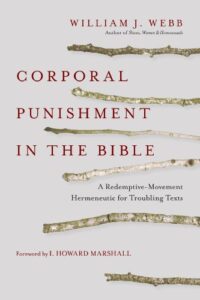
Corporal Punishment in the Bible: A Redemptive-Movement Hermeneutic for Troubling Texts by William Webb

Corporal Punishment in the Bible: A Redemptive-Movement Hermeneutic for Troubling Texts cover imageSummary: A useful book to work through Hermeneutical issues (biblical interpretation) in modern culture, and worth reading as a book on parenting.

One of the things I am most thankful for is the fact that I was able to be a full-time nanny for my two nieces over a five-year period.  From about eight weeks after the birth of the oldest, until they both started preschool last year, I saw them almost every day, and most of the time I loved being a nanny.

Part of my thankfulness is because I am not going into parenting blind.  My wife has been a teacher for 17 years and is better at classroom management than pretty much anyone I know. Part of her job as an Academic Coach is to mentor other teachers and help them work through both their own professional development and to problem-solve with particular children who have not been identified as special education but are not being reached with standard approaches.

I feel we are fairly well prepared to parent our new daughter.

I have been aware of William Webb’s books for a while, but just have not ever gotten around to them.  They fit in with my focus on hermeneutics a couple of years ago, but I think I found out about them after I was getting a bit tired of the subject. Re-reading Mark Noll’s The Civil War as Theological Crisis and thinking through issues of culture and race as a Christian pushed these books back up to the front of my list. William Webb is probably better known for his earlier book Slaves, Women & Homosexuals: Exploring the Hermeneutics of Cultural Analysis. (later review) I am sure I will read that eventually, but Corporal Punishment in the Bible is both intended to be a more popular-level treatment, and it is focused on parenting which I have been thinking a lot about lately.

William Webb is interested in something that is called a Redemptive-Movement Hermeneutic. In simple terms, Webb suggests that God speaks down to us as humans, accepts where we are, and speaks to us there. Over time (both in scripture and in culture), there is a progressive movement that refines God’s instructions to us and points in a progressive understanding of revelation and obedience. The idea of this is pretty uncomfortable for many Christians, especially Evangelicals who like to think of God as unchanging. But Webb is not suggesting that God is changing, but that the way God speaks to us changes as our culture changes.

Read more

Fahrenheit 451 by Ray Bradbury

Fahrenheit 451 by Ray BradburyTakeaway: Society has a responsibility for its own maintenance.

Unlike most of the rest of the world, I did not read Fahrenheit 451 in high school.  (I didn’t read most books that people seem to have read in high school.)

The story is set in the near future (written in 1953, but still feels near future.)  Guy Montag is a fireman.  In a world where all the homes are fireproof, it is firemen’s jobs to set fires, not put them out.  When people are found to have illegal books, it is the firemen’s job to burn the houses including the books after the people have been arrested.

After Guy meets and begins a friendship with 17 year old free thinking Clarisse, he starts questioning his life. Eventually he steals some of the books he is supposed to be burning and reads them.  He starts questioning society and why no one reads or remembers.  (Part of the subtext is that there is always noise and video and pictures so that people no longer want to read.)

Read more

The Triumph of Christianity by Rodney Stark – Favorites of 2012

The Triumph of Christianity: How the Jesus Movement Became the World's Largest ReligionSummary: An essential book for debunking historical myths about Christianity.

Christian history is am important, but undervalued subject for Christian education.  We are pretty good at teaching bible (or at least valuing it).  We are pretty good about teaching application of Christian values and ethics and evangelism.  We are getting better at teaching the importance of social ministry.  But Christian history is usually something that we leave people to learn on their own.

The Triumph of Christianity is written by Rodney Stark (historian and sociologist) specifically to counter a lot of myths and bad assumptions about Christian history.  This is really a summary of his three previous books: God Battalions (on the Crusades), Cities of God (rise of early Christianity) and Victory of Reason (on the rise of Western culture).  I have only read God’s Battalions, but I think Triumph of Christianity is the book to start with.

Read more

Red to Black by Alex Dryden

Red to Black by Alec DrydenSummary: A spy story with the feel of John le Carré.

If you like spy stories that feel like they could be real, with a healthy dash of paranoia and conspiracy theory thrown in then you might like Red to Black.

Released in 2009, it is set from 1999 to 2006.  Finn is a British spy stationed in Moscow.  Anna is a young KGB agent tasked with trapping him.  But Finn is well aware of her task.  And she is well aware of his knowledge of her task.

The story unfolds very slowly.  This is a book that requires paying attention and being willing for the story to take years (at least on the page) to unfold.

Alex Dryden is a pseudonym for an unknown British journalist.  And it is clear why (she/he) wants to remain anonymous, because this is a screed against the very real Putin.  And only a little less against Western European governments that work with him.

The story is about how the KGB (which used to be headed by Putin) is syphoning off tons of money into Western Europe for unknown projects.  Finn is trying to find out what they are and build the case.  But none of the official channels want him to.  And Anna is playing a dangerous game both in actually loving Finn and in trying to satisfy her own superiors.

I

Read more

3 Giveaways

There are three giveaways the I thought readers of Bookwi.se might be interested in. Sarah Beesley one of the bloggers at a Deeper Story is giving away five copies of her new book Jesus Feminist.  I have a copy and will review it later this year.  It has had very good reviews so far. GoodEreader, … Read more

Embracing Shared Ministry: Power & Status in the Early Church and Why It Matters Today

Embracing Shared Ministry: Power and Status in the Early Church and Why It Matters TodayTakeaway: Shared Ministry (not single head pastor) is both the biblical model and a more healthy form of leadership.

Embracing Shared Ministry: Power and Status in the Early Church and Why It Matters Today is a long title.  But it is very descriptive of both the style and point of the book.

Embracing Shared Ministry has three parts.  The first part is background on Roman culture and society.  The main point is that Roman culture was very focused on status and honor.  It was not a mobile culture, people that were born low status, stayed low status.  People that were born high status mostly stayed high status.  And not completely unlike today a very small portion of the society controlled a very large portion of the wealth.

In today’s culture, efficiency and wealth creation are highly valued.  But in Roman culture it was honor.  Government was small and rich individuals donated much of the infrastructure and entertainment to the cities (aqueducts, fountains, stadiums, festivals, etc) not to generate common good, but to produce honor.  If you gave away the most stuff to the city, you had the highest honor.  And nothing was done anonymously, everything had long inscriptions giving all of the titles and honors of the one that donated it.

Read more

Most Read Reviews in October

The six most read reviews in October The Book of Common Prayer: A Biography by Alan Jacob Divergent by Veronica Roth Year Zero by Rob Reid The Conscience of a Liberal by Paul Krugman The Apostles of Reason: The Crisis of Authority in American Evangelicalism by Molly Worthem Allegiant by Veronica Roth

Ender’s Game by Orson Scott Card (Comparing Versions)

Ender's Game by Orson Scott CardSummary: A comparison of the difference in storyline between Ender’s Game and Ender’s Game Alive.

After I listened to Ender’s Game Alive last week (a radio-styled audio drama) I decided to re-read Ender’s Game in print.

Ender’s Game is a story that has had lots of versions.  It was originally a short story.  Then Card expanded it into a full length book.  Then Card revised it to the ‘Author’s Definitive Version’.  And now there is Ender’s Game Alive and the Ender’s Game movie.

In addition there have been a number of short stories that have expanded on scenes from the book or provided background.  There is a whole book that was falls between the last two chapters of Ender’s Game and a whole series that starts by telling this same story from a different character’s perspective.

So when I listened to Ender’s Game Alive and commented on my disappointment with the abridgement I got a little push back.  I was going to re-read Ender’s Game anyway.  But I read it with an eye to see the places that were handled differently.

Having read both within a couple days of each other, I agree, Ender’s Game Alive is really a different version of the story more than an abridgement.  But I stand by the fact that I think it does not give enough character development to Ender.  (Stop reading now if you don’t want any spoilers.)

Read more