 Summary: Spiritual reflections on the life of Howard Thurman.
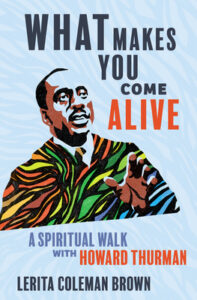
I have been reading books by or about Howard Thurman for about six years. I started with Jesus and the Disinherited, which I have read twice. I have also read three collections of sermons as well as an audiobook collection of recordings of Thurman, his memoir, and two biographies. I have much more to read because we are in a renaissance of interest in Thurman, like James Baldwin, Thurman is more relevant today than ever. I went to a book launch event with Lerita Coleman Brown hosted by Chanequa Walker-Barnes when What Makes You Come Alive first came out. But other things came up, and I never started the book until about a year later, when I saw that the Ignatius House (a local Catholic retreat center) was hosting a weekly book club discussing What Makes You Come Alive, and I joined.
This was the first in-person book club that I have ever joined. About 20 different people were involved, with about 15 on any given week. Because the book club met on Tuesday mornings at 10:15 AM, I was unsurprised that the group was mostly retirement-age women (one other man). I was the only new member of the group. Most had been meeting together for years, but I was very much welcomed to the group. I coincidentally knew two members because they used to work as teachers for my mother-in-law. Only a handful of people in the group had previously read anything by Howard Thurman. Most who did know of Thurman, were introduced to him by Richard Rohr’s writing. Because most were cradle Catholics, I was not surprised that there was not a deep familiarity with the Black Church.
The book opens with an anecdote about the author going to speak at the Wild Goose Festival (a progressive Christian conference) about Howard Thurman. Lerita Coleman Brown is a spiritual director and a retired psychology professor. Her grappling with Thurman as a Black woman, often in predominately white spaces (such as the Wild Goose Festival), matters clearly to the book’s thrust. As an all-white book group (most of whom grew up in still legally segregated South), I was somewhat skeptical of the group’s ability to discuss the book well. There were times when the background of the group left it a bit ignorant of areas that I would have liked it to discuss. On the other hand, first-hand knowledge of segregation made it more aware of other issues the book brought up.
Read more

 Summary: Dalgliesh, recovering from surgery and a misdiagnosis of cancer, Adam heads to the coast to visit a family friend only to find that he had recently died.