Busman’s Honeymoon by Dorothy Sayers

Busman's Honeymoon cover imageSummary: Lord Peter and Harriet finally get married and go on their honeymoon, only to have it be a ‘working vacation’ as they solve a murder. 

I have very slowly been working through the Lord Peter Wimsey mystery series. I noticed when looking for something else that Audible had a copy of the old Ian Carmichael audiobook as part of their free audiobook library for members, and even though I have not read Gaudy Night, which is before Busman’s Honeymoon in series order, I needed a fiction audiobook, and I jumped at it.

When I started Dorothy Sayers’ books, I had already read Rhys Bowen’s Royal Spyness series for a couple of years. Regularly I have noticed places where, even though I am reading Sayers after Bowen, I can tell that Bowen was paying homage to Sayers in her books.

I did not look it up until I finished this book, but a busman’s holiday is the idea of a bus driver going on vacation by riding a bus somewhere. It isn’t a vacation to do what you usually do for work, as a vacation. Lord Peter and Lady Harriet have decided to honeymoon at a small country house that Harriet has purchased to have as a place to get away from the pressures of their lives. I will not give away the plot, but as you would expect in a cozy mystery series, a body appears, and there is a murder to solve.

Read more

Reparations: A Christian Call for Repentance and Repair by Gregory Thompson and Duke Kwon

Reparations: A Christian Call for Repentance and Repair cover imageSummary: A biblical case for why reparations is a Christian concept using the example of Black Americans. 

This is a second reading (original post) of Reparations. This reading was with a book discussion group. I first read Reparations almost a year ago, and much of my thoughts are similar in this second reading.

I appreciate the careful definitions and the narrow focus on reparations for an evangelical Christian audience by looking at only the case for reparations for Black Americans. Kwon and Thompson are calling for reparations for “…the threefold theft wrought by White supremacy: not only the theft of wealth (as is generally understood) but the theft of truth and the theft of power as well.” (p18). However, while this generally argues the case for a large-scale reparations project, I think it is easier to make a case for reparations on an even narrower basis. For instance, reparations for the denial of Black soldiers and sailors’ access to the GI Bill after WWII. I believe in the case for a large conception of theft of White supremacy that is made in this book. But I also think that part of the resistance to reparations is the intangibility of that theft. It is easier to point to particular people and say, “you were denied the educational or housing support you were due.”

The lack of shared history is part of the greatest need. For example, many people falsely believe that affirmative action is a reparations program because they believe that Black students receive free education. As detailed by Angela Parker in her book If God Still Breathes, another professor accused her of taking his job at a professional conference. He thought that the job should have been his and that she only got the job because she was black and a woman. Her response, I think, details part of the disconnect between reality and perception.

When the gentleman told me I took his job, I replied, “Oh, really? Tell me what you teach.” My interlocutor began to regale me with courses that are strictly historical-critical or in the vein of “White male biblical scholar.” I proceeded to ask him if he taught Womanist or feminist interpretations of the Bible, to which he responded in the negative. I also asked if, perhaps, he integrated critical social theories into his biblical interpretations. Again, he answered negatively. At that juncture I responded that I teach and engage those modalities, and therefore I did not take his job, since my institution needed those classes, that training, for its students. (p68)

Read more

Lord of the Rings Trilogy by JRR Tolkien

Takeaway: Genre defining book, theologically more revealing than I think Tolkien intended. 

There is nothing that I can really write that hasn’t been already written, and written better, about the Lord of the Rings trilogy. I am not a superfan. I have read the Hobbit three times I believe, but I think this is only my second reading of the trilogy and my previous reading was more than 20 years ago.

I decided to start the series because the Andy Serkis narrated audiobook was on sale at Audible. I had previously listened to the Rob Inglis version of The Hobbit, but several friends have raved about Serkis’ version. Inglis’ version is excellent, but I do think that Serkis’ version is probably a little bit better. My only complaint about the Serkis version is that when listening with headphones, which is how I tend to listen, the dynamic range was a bit too broad. I understand why the dynamic range is wide, but I tend to listen when I am walking or doing chores around the house, and changing the volume is annoying.

I alternated between audio and kindle. I listened to good portions of the first and third books while reading the second almost exclusively. Song is so much a part of the writing that I am tempted to say that the books should be listened to primarily, but audiobooks do take longer than reading. I don’t know how they prepared for the songs, but the singing portions were very well done with appropriate melodies and emotion. It does communicate a very different culture and I think that is part of why the songs are so important to the books.

I was musing on Twitter that war is my least favorite part of the trilogy. And by the end, there are far fewer battle scenes than I had remembered, probably because the battle scenes are so memorable from the movies. It is the quest and friendships that make the story, not the battles.

As I said I am not a Tolkien scholar. I have never read a biography of Tolkien and I have never read a commentary book on the Lord of the Rings, although I do have Fleming Rutledge’s book and plan on reading that one. But I have understood that Tolkien did not think he was writing a “Christian” story and did not like people suggesting that there were Christian allegories in the books. That being said, I think that there is a lot of theology. Christian obligation and calling to do good and work toward justice, even if it is personally difficult is throughout. The concept of the way sin breaks not just personal, but social systems is very well illustrated. And the way that even good people with real virtue can be corrupted by access to power. The right use of power and the corruption that power brings is a very significant theme. I think there is some irony to Tolkien talking so openly about power and systems in the trilogy and the fact that there is so much controversy about the “Marxist” roots of that discussion today. There is also a nearly Christian sense of providence or election throughout the books without any referenced God or prophecy that was directing.

Read more

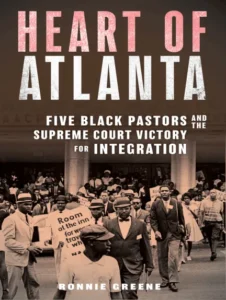
Heart of Atlanta: Five Black Pastors and the Supreme Court Victory for Integration by Ronnie Greene

Summary: A journalistic account of two Atlanta legal cases in response to the 1964 Civil Rights act, joined by the Supreme Court to uphold public accommodations (Title 2 of the 1964 Civil Rights Act).

I do not think I would have picked up Heart of Atlanta if my book club had not decided to go to a book talk with the author at the Atlanta History Center. But Heart of Atlanta is the type of narrow history that I think is exactly what we often miss in our too-quick presentation of the Civil Rights Era. The Civil Rights Era was so transformational because the movement was broad-based. Literally, hundreds of thousands of people participated, at least in minor roles. But even the often significant characters of the era have been forgotten. And the more minor characters were often never really known. One of the best examples of this is that frequently throughout the book, Ronnie Greene will cite a video or picture or newspaper story about these events, and the five main characters of the story were either unnamed or listed as “unknown.” In fact, the men often did not know that there was photographic or video documentation of their protests until Ronnie Greene showed it to them.

All five pastors in the subtitle were students at the Interdenominational Theological Center seminaries (ITC). Two of the five pastors are still living, Albert Sampson (involved in the earlier sit-in movement in North Carolina) and Woodrow Lewis (involved in the earlier Atlanta Student Protest movement). Unfortunately, the other three, Albert Dunn (also involved in the Freedom Rides), Charles Well, and George Willis (both having been in the military before returning to attend college and seminary), have passed away. All five continued their activism after their involvement in these cases, but like many pastors organizing in their communities, they did not obtain national recognition.

Read more

A Burning in My Bones: The Authorized Biography of Eugene H. Peterson by Winn Collier

Takeaway: I enjoyed it even more with the second reading.

On my second reading of A Burning of My Bones, I am not sure how to say something new or roughly the same things without making it seem like there was no value in rereading. But after sitting with the second reading for a little while, my thoughts are pretty similar and I finished reading the book deeply encouraged.

I still am not really fond of the start of the book, and I don’t really find myself drawn in until the chapters on seminary and early ministry. I am honestly not sure what it is about the early chapters that do not speak to me, but I suspect it is related that there is just less material for Winn Collier to draw on. I re-read this again as part of the Renovare book club. And one of the reasons I enjoy the book club is that they have resources to give background and understanding to the book. Most of the time, there are multiple interviews with the author, a couple of essays, and then a message board for readers to discuss. In one of those interviews, Winn Collier talked about reading Peterson’s journals and letters and sermons and books, and I have to imagine that the resources that Collier could draw on for Peterson’s early life were limited.

But again, in this reading, I settled into the pastoral years, and I was encouraged both by Peterson’s growth as a pastor, his love and orientation toward the people in the parish, and his limitations. Limitations are so important to recognize and embrace. And it is not that we embrace our limitations as an excuse or as a way to overcome them, but we embrace them because we are human, and part of what it means to be human is to have limitations. Those limitations are part of why I personally turn to God. I think the denial of human limitations is what is spiritually dangerous about wealth and much of our culture of autonomy.

Read more

Son of the Deep by KB Hoyle

Summary: A play on the traditional Little Mermaid story.

I am a big fan of remixes and reimaginings of stories. Orson Scott Card’s Enchantment is a reimagining of Sleeping Beauty, Ta-Nehisi Coates Between the World and Me is a reimagining of James Balwin’s letter to his nephew in The Fire Next Time, Kareem Abdul-Jabbar’s Holmes trilogy is a reimagining of the original Sherlock Holmes books, most of John Scalzi’s books are riffing off of older SciFi stories (Redshirts, Old Man’s War, Fuzzy Nation to name a few.) So many of our best books are based on older stories and ideas reimagined for a different context or to say something different to a current generation.

The Son of the Deep is a reimaging of the classic Little Mermaid story, which most of us know about through the Disney reimagining, not through the Hans Christian Anderson version, which is based on an older folk tale. In the Son of the Deep, it is “Hugo” who is the merman and who saves the Princess, and who has to convince the now Queen to marry him without his voice. The classic elements matter because they both are references that tell us more than just the simple words on the page; they highlight the subtle differences that do appear.

I will try to make this spoiler-free, but the back story to the Sea Witch matters even if we do not understand that connection until fairly late in the story. The magic of Hugo’s voice loss is more powerful than in the Disney version. He is prevented from responding to questions that may reveal too much about his background, writing, or any other form of communication. The tension between family responsibility and responsibility in our love for each other is stronger than in the Disney version. But this is not just a reimagining of Disney’s Little Mermaid; some of the classic elements, like merpeople becoming seafoam on death, are here.

Read more

Jayber Crow by Wendell Berry (Port William Series)

Jayber Crow cover imageSummary: A barber, near the end of his life, tells of life in the small town of Port William, along the Ohio River. 

I have been more interested in fiction lately, so I decided to pick up Jayber Crow, the book that most people I know suggest is the best book to start with for the Port William series. I have previously only read Hannah Coulter. A different member tells each book of the series of the community. There are eight novels and dozens of short stories.

I am reading this soon after reading Eugene Peterson’s biography, A Burning in My Bones, for the second time. Eugene Peterson was born in 1932, a few years before the fictional Jayber Crow started being the barber at Port William (at 23 years old). So there were about 17 years between them. Jayber dropped out of seminary, and although he took some classes at a college, he was not really enrolled to get a degree. So when he, on a whim, quits his job and starts walking in a rainstorm, he eventually returns to the home where he lived before he went to an orphanage (his parents both died, and then his uncle and aunt died before he was 10.)

Port Wiliam is a realistic book that details the cultural changes of the 20th century. When Jayber moved to Port Wiliam, he purchased a barbershop that had been abandoned to the bank by the previous barber. Jayber lived above the one-room shop in a one-room apartment. There was no running water or bathrooms. There was electricity, but there was no reason for it other than his razors. For 30 years, Jayber has been the town’s bachelor barber. There are not enough people in the town for Jayber to earn enough money to support a family. He has to become the church janitor and the town gravedigger even to support himself. The story is being told from the view of a retired Jayber in 1986.

Read more

March Forward, Girl: From Young Warrior to Little Rock Nine by Melba Pattillo Beals

March Forward, Girl: From Young Warrior to Little Rock Nine cover imageSummary: A young adult memoir of Melba Pattillo Beals about her early years before integrating Little Rock’s Central High. March Forward, Girl is a prequel to Warriors Don’t Cry

Last year I read Melba Pattillo Beals’ memoir of her life after Central High, I Will Not Fear. At some point, I read that Beals’ best-known book, the memoir of her Central High desegregation experience, Warriors Don’t Cry, was among the list of books that were being challenged as inappropriate to be taught in schools. So, as I was looking for that book, I also put her most recent book, March Forward, Girl, on my to-read list. I thought March Forward, Girl covered the Central High but was pitched to a younger audience than Warriors Don’t Cry, but it is more of a prequel. I am not great at evaluating what age would be best for reading, but my inclination is that March Forward, Girl is targeted to children that are roughly 10 to 13.

March Forward, Girl was written just a few years ago, and Melba Pattillo Beals is now 80 years old. The book opens with her coming to understand racism as a very young child. Born on December 7, 1941 (the day of the Pearl Harbor attack). Melba, as a child, understood more than what her parents and other adults thought that she did.

It seemed to me that the grownups must have thought they could say anything out loud in front of me and I wouldn’t really understand what they were talking about because I was so little. They were wrong. I took in every word, and I spent all my waking hours listening closely to the adult talk, trying to figure out their words, what they meant, and why they never spoke up, and pondering my world. How did I get here? How long did I have to stay? I imagined there must be places beyond Arkansas where my folks were treated better…Early on, I could tell that the white people in Little Rock believed we had to do whatever they wanted us to do. I told myself that it must be that God liked them better than us. They treated us like they owned us.

While March Forward, Girl was not published by a Christian publisher as I Will Not Fear was, it is still significantly concerned with her theological wrestling of what it means to be enduring pain and racism and to believe in God. Where was God in the midst of her pain? As I read March Forward, Girl, I thought about how Christians who are not paying attention to the world’s problems and working toward their solutions are keeping people from God. Melba Pattillo Beals eventually came to a deep faith in God. But those early years, she struggled to understand her Grandmother’s faith.

Read more

Be Free or Die: The Amazing Story of Robert Smalls’ Escape from Slavery to Union Hero by Cate Lineberry

Be Free or Die cover imageSummary: A biography (primarily of the Civil War years) of Robert Smalls, best known for captaining a steamship from Charleston harbor to escape from slavery during the Civil War, but who eventually served five terms in Congress.

I do not remember when I first heard about Robert Smalls. I am sure it was a history book sometime in the past ten years, but I have regularly seen him mentioned in passing in various books without really getting a full sense of his life story. There are two books that I am aware of that are about Robert Smalls, this one, Be Free or Die, is primarily about the Civil War years with a chapter on his early life for context and an epilogue for the remainder of his life. The second book is Gullah Statesman: Robert Smalls from Slavery to Congress, 1839-1915. My understanding is that Gullah Statesman is a more comprehensive biography and more focused on his later life, but it is not on audiobook, and the audiobook was on sale recently. So I listened to this audiobook, mainly on a long drive this weekend.

Robert Smalls was born into slavery in 1839. He was leased out for his labor and eventually started working as a deckhand on the steamer packet boat, The Planter. He quickly rose from deckhand to pilot. And in May 1862, when the White officers left the ship to spend the night with their families, Robert Smalls and the rest of the enslaved crew, along with at least some of the wives and children of the crew, left the dock and sailed out of the harbor and past the Confederate defenses and patrol boats out to the line of Union ships that were blockading the port. In addition to freeing themselves, the crew had just loaded three cannons that were being moved and Confederate codebooks and Smalls knowledge of the waters as a pilot. The crew shared a reward for turning over the ship leased to the Confederacy, and Smalls became the pilot of the Planter working for the Union and eventually its captain.

Read more

Gateway Chronicles by KB Hoyne

Summary: Young Adult fantasy series that is well-plotted, character-driven, and relatable. 

I first read the Gateway Chronicles series about four years ago. That is long enough ago that I have forgotten a lot of the specific plot details and twists, but I still remember the broad strokes. As I re-read the series, it felt like a sweet spot of enjoying some of the story’s nuances that I might have missed on a first read, but also still regularly be surprised at plot twists that I had forgotten.

Young adult fantasy is comfort reading for me. Earlier this year, I read the first three books of the Harry Potter series aloud to my kids. But that was as far as I felt comfortable reading based on their ages and response to scary parts. But that did not fully satiate my need for story. Part of what I love about young adult fantasy is its focus on the hero. Heroes have a clear purpose and goal. They are willing to sacrifice themselves for the good of a person or a group of people. There is beauty in the understanding of right and wrong. Adult fantasy often feels the need to nuance the idea of right and wrong so that everyone is so tainted that it can be hard to see any sense of goodness (similar to many modern spy stories.) I am not looking for wooden stories that have no development or struggle, just action, but I am looking for inspiration to press into the more challenging aspects of life because there is a sense of purpose.

Darcy Pennington feels detached from life. She is 13, and her family makes her go to a family camp. She wants to be popular and liked, but not by the two kids who will be there that she knows from her middle school, Samantha and Lewis. Sam and Lewis, along with three others, have been at the camp for years. They have a strong relationship, and Darcy feels both on the outside and a bit claustrophobic from the warm acceptance that Sam has for her. Those relational dynamics change when Darcy stumbles on a gateway into another world and has to bring the rest of the group back to the world to complete a prophecy. And that starts the series of six books. Each book details the group as they start the week of camp by magically entering the fantasy world. And once inside that world, they live for a year, grow and change and then return to the world of the camp at the same point in time. For six years, they essentially live two years, and by the end, their bodies are physically 18/19, but they have the life experience of 22/23

Read more