The Liturgy of Politics: Spiritual Formation for the Sake of Our Neighbor by Kaitlyn Schiess

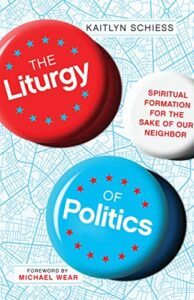
The Liturgy of Politics: Spiritual Formation for the Sake of Our Neighbor cover imageSummary: To have our faith impact our politics and not the other way around, we have to be intentional about our spiritual formation concerning our politics. 

My favorite definition of spiritual formation is from M. Robert Mulholland Jr., “Spiritual formation is a process of being formed in the image of Christ for the sake of others.” Kaitlyn Scheiss’ subtitle orients this book to think about spiritual formation in politics similarly. One of the most common complaints about “Evangelical” is that it has become a political descriptor instead of a theological one. Scheiss is also concerned about how Evangelical as a term has become oriented around politics, but her approach in this book is contrary to some who are also concerned about the overtaking of the church with politics. She believes that our problem is not overthinking about politics in the church but too little about politics.

Cornel West’s well-known quote, “Never forget that justice is what love looks like in public,” is related to how Scheiss is connecting politics to Christianity,

“In one way or another, almost any political or moral issue is about the honor and protection of human beings.  In reality, every piece of legislation is trying to legislate morality.  Every policy issue is based on moral principles and has moral implications.”

There is much in The Liturgy of Politics that references other books I have read on spiritual formation. James KA Smith’s work on cultural liturgies is hinted at in the title. Alexander Schmemann’s “For the Life of the World,” a phrase that has also been used widely by Miroslav Volf and others, is a chapter title. NT Wright’s thinking on eschatology is also crucial in Liturgy of Politics in orienting the reader away from inappropriate rejection of the importance of our work in this world. There is much here that I recognized from previous reading. Still, Kaitlyn Scheiss is rooting her work in political thought for the church in theological and spiritual formation thinking, not altering her theology based on her politics.

The two aspects of the book that I most appreciate are its orientation toward thinking about how spiritual practices, which we may do for other reasons, can, when we think of them regarding politics, also help form us to love others well politically. And I appreciate how she has worked through our theological and historical blindspots within evangelicalism that have made us susceptible to the abuse of power and politics.

Read more

Subversive Witness: Scripture’s Call to Leverage Privilege by Dominique DuBois Gilliard

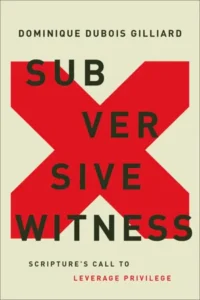
Summary: Privilege of all sorts is to be used to expand Jesus’ kingdom and for the good of others. 

Privilege has become a controversial word. Not so much for the rough meaning but because of the political implications and the tribalism that has arisen. In many ways, the main message of the book is what has commonly been understood as the Spiderman principle, ‘Remember, with great power comes great responsibility.’ (Which is a variation of Jesus’ statement in Luke 12:48, “From everyone who has been given much, much will be demanded; and from the one who has been entrusted with much, much more will be asked.” (NIV) Popular culture may attribute this concept to Spiderman instead of Jesus, but it is a deeply Christian concept.

Privilege also has, in many settings, come only to be thought of in racial terms. While Gilliard is not excluding racial privilege here, he is reducing all privilege to racial. The book’s focus is seeking out biblical stories of the right use of privilege and drawing principles for modern use. Along the way, there is social teaching, but primarily this is a book of bible study and implications to that study. I can’t help but be reminded of Andy Crouch’s book on power, Playing God. When it is common to deny that we have privilege (or power) or the limit the concept of privilege (or power) to particular narrow types, Gilliard reminds us that we all are privileged in some ways and that all of us should strive to use what God has given us for the sake of others.

Read more

Troubled Blood by Robert Galbraith (Cormoran Strike #5)

Troubled Blood (A Cormoran Strike Novel Book 5) cover imageSummary: Cormoran and Robin are hired to look into a 40-year old cold case.

Cormoran Strike is a standard grumpy private eye, ex-military, ex-cop. He has had a number of high-profile cases, and his absent father is a famous rock star trying to get Cormoran to show up to an album release party for the 50th anniversary of the band’s first release. Robin, his younger partner, is still trying to process through her husband’s infidelity and divorce proceedings and her concern that Cormoran will see her as a real partner.

Robert Galbraith (aka JK Rowling) has another book that has ballooned to an enormous size. Like the later Harry Potter books, Troubled blood has nearly doubled in size compared to earlier books and weighs in at over 900 pages. Considering the size, I read it quickly. I have listened to most of the previous books in the series, but I did not want to listen to 32 hours of audio. Also, this series pushes my boundaries with violence and sex. Troubled Blood is a thriller, and the series has always had violence and sex, but I read the series because I like the characters of Robin and Cormoran, not because I want to read about serial killers. In some ways, I am not sure I would start the series if I had known where the content would go. But I have started it, and I do like the leading characters.

Rowling writes engaging storylines, but there are a lot of traditional thriller/mystery tropes here. For example, the main characters are in love but won’t admit it to themselves or each other. They both have a history with previous relationships that makes them wary of entering new relationships. The tough guy Cormoran wants to protect Robin from danger, but that makes Robin more prone to risk-taking to prove herself, which is another reason besides their fear of intimacy with each other that keeps them from openly talking. So many things are hidden from each other that, if they would talk, would work out. I know that real people do this, but it is such an old trope in books that it can be annoying.

Read more

Where the Light Fell: A Memoir by Philip Yancey

Summary: A memoir of coming out of a fundamentalist, racist, and abusive upbringing. One reviewer described this as a prequel to his other books on grace and suffering. 

There are few names in Christian publishing that are more recognizable than Philip Yancey. He started his career writing for Campus Life and Christianity Today but became widely known for his books, most reflections on suffering and/or grace. Yancey has written about 30 books, depending on how you count books he contributed to or edited. And he has sold roughly 15 million copies of those books. He has been widely influential.

Philip Yancey is part of my parent’s generation, turning 72 next month, and I think it is natural for authors to think about memoirs and influences at that point. It is not that younger authors can’t also write memoirs; Danté Stewart’s Shoutin’ in the Fire is an excellent reflection of an author in his 30s. But memoirs that are written toward the end of life have a different type of reflective ability.

Where the Light Fell primarily deals with Yancey’s childhood and early adulthood before he became a writer. This is a book about what influenced him with a final chapter that grapples with that history, one that I read twice. The book is unflinching but charitable. There is a lot of pain here. And a clear view of the impact of generational trauma. Yancey is not a Christian author that tends to tie everything up in neat bows. At the end, there is still pain and disfunction.

Philip Yancey was the youngest of two children, born in 1949, three years after his older brother. His parents had what appears to be a storybook romance. His father was in the military at the end of WWII. He was invited to the home of a church member after attending church soon after becoming a Christians. His mother was living with that family while supporting herself through college to become a teacher. They met and soon married. He soon became wrapped up with her dream of becoming a missionary to Africa. They finished bible school, and he taught at a black bible college in Atlanta as they raised support. But soon after Philip was born, his father contracted polio and died before Philip had a conscious memory of him.

Read more

Shoutin’ in the Fire: An American Epistle by Danté Stewart

Summary: A beautiful, poetic memoir of being Black in America. 

Without question, this is one of the best memoirs I have ever read. I know part of my love of it is because Danté Stewart read the audiobook with his beautiful voice. Shoutin’ in the Fire is a book of lyrical, poetic writing, and I can’t imagine another narrator could have captured it as well. The prose reminds me in the very best way of James Baldwin. I know that will be a standard comparison, not just because of how prominent Baldwin is but also because of how frequently Stewart references him. Baldwin is an author for this age, as Eddie Glaude has written. I don’t want to overplay that comparison, their life experiences are so very different, but also they are both Black in America, with a view of both history and the future and with an eye to the church that this country loves to pay lip service to, but not carry through as it should.

I remember thinking to myself, and maybe saying out loud, at some point years ago, early in my awakening to the racial realities of this world, that as much as they are accurate, I wished there were more books by Black authors that were happier, less wrapped up in pain. The pain is hard to process as a middle-aged white man because it creates an obligation. Observing pain and not responding is a type of pathology that some are commending these days, as some call for resistance to empathy. It took me time to learn and process not just that pain and trauma need recounting, but that the history of race in America means no story can be told by Black authors that does not have pain somewhere in the lens, even if not in the direct words. It took me much longer to see that the very act of writing was an act of hope. I didn’t understand the complaints of Ta’Nehisi Coates’ Between the World and Me being hopeless. Coates is not hopeless, as I think this video with Thabiti Anyabwile shows. But the hope does not always have to be centered if the presenting problem denies reality.

The other comparison I feel when I read Shoutin’ in the Fire is with Esau McCaulley’s Reading While Black. Both books have a chapter on rage, and in both cases, I think the chapter is likely the most powerful in the book. That rage is not a denial of hope; both explicitly point to hope in other places and even in their rage. Both reference James Baldwin’s famous quote about rage that often is shortened to only the first sentence. But the more extended quote is essential:

Read more

One Nation Under God by Kevin Kruse

Summary: The subtitle “How Corporate America Invented Christian America” does not work, but the history is still fascinating. 

One Nation Under God is the third book of Kevin Kruse’s that I have read. I follow him on Twitter, and I appreciate his work. However, at this point, I wonder if Kruse’s niche is the history of the development of libertarianism in the US. The first book I read by Kevin Kruise, White Flight, was about Atlanta’s racial history and white flight and how white flight helped to encourage libertarian thought. The second book I read by Kruse was Fault Lines, a history of the US since 1974. Fault Lines was co-authored with Julian Zelizer, and while it is a comprehensive political history, its attention to the rise of political media was where it shined. It was not primarily about libertarianism, but you cannot tell the story of modern political history without the story of libertarian thought becoming mainstream within the GOP.

One Nation Under God is about how modern politics has become rhetorically religious in a different way from previous history. The primary history of the book is about how “One Nation Under God” was added to the Pledge of Allegiance and “In God We Trust” was added to our currency just a couple of years before the Supreme Court eliminated compulsory prayer and bible reading from schools. That story is commonly presented as a Cold War story. The US culturally understood itself as Christian in opposition to the USSR as an atheist country. So, it needed to demonstrate its religious nature publicly and self-identify as a country founded on religious principles. Kruse seeks to complicate that story by moving back to the 1920s and 1930s and showing how a conscious and planned work of corporate institutions and wealthy individuals used religious motivations and institutions to make a theological case for Christianity as an individualistic, pro-capitalist, and anti-government religion. Christian Libertarians were a category in the 1920s-30s, not just in the Tea Party movement. The epilogue of the book makes the case that these are connected movements.

Read more

The Last Shadow by Orson Scott Card (The Shadow Series #6)

Summary: A conclusion (?) to the spin-off Shadow series about Bean and his family bringing them back into the Ender Quintet. 

I have seen The Last Shadow both marked as the sixth book in the Ender series (starting with Ender’s Game) and the fifth book in the Shadow series (starting with Ender’s Shadow). It plays both roles. As I commented with The Last Tourist (odd that both have the same naming convention), it is just easier to read books that are written more closely together. The Shadow series was started in 2003 and Ender’s Game is a 1985 novel that was based on a 1977 short story. What I did not know until the author’s comments at the end of the book, was that initially Card had a contract to write the novel Speaker for the Dead, but realized that once he started writing that book with its roots going back to the short story version of Ender’s Game, he needed to elaborate and change some of the plotlines to prepare for the later books.

As I have commented before, I am not sure there is any book I have read more than Ender’s Game. Orson Scott Card has played around with the story since its novelization in 1985. He released a revised version in 1991 that took into account the fall of the Soviet Union. He revised it again slightly for a 20th-anniversary release in 2005. And he released an audio play version in 2013 that referenced some of the subsequent short stories and included new scenes and perspectives. And in 2011 there was a film adaptation. I am very familiar with the series and have even read the companion book that pays tribute to the ways that the novel has impacted scifi.

Despite my love for the “Enderverse”, I have been a bit mixed about Card’s writing over the years. Card has embraced his libertarian political ideas with the two books Empire and Hidden Empire about a second American Civil War. And Card’s Mormon theology regularly comes through in his writing, not just in his religious book series but frequently in his social commentary, especially around family.

A story has to be able to stand up on its own, not just as a plank in the world-building of a series. For the most part, I think The Last Shadow cleaned up some of the mess of the Children of the Mind. The original characters of Ender’s Game are essentially all gone except for Jane and some cameos by others. Miro from the 2nd-4th books of the series plays a significant role as does Peter from the fourth book and then the children and grandchildren of Bean that were introduced in Shadows in Flight.

Read more

The Last Tourist by Olen Steinhauer (Milo Weaver #4)

the last tourist book cover imageSummary: National interests may not be the primary driver of undercover and black-ops spying, but information will always have value. 

As a reader, I like to read a series together, or at least not too far apart. I started reading the Game of Thrones novels around 2002 or 2003. The first in the series came out in 1996. The next three books came out in 1998, 2000, and 2005.  Six years later when the fifth book of the still not completed series came out, I decided I would not read any further until the whole series was released. When there are five, ten or even more years between books in a closely related series, you really need to re-read the books in order to have a close enough memory of the details to understand subtle plot points. Especially in a spy novel like the ones that le Carré or Steinhauer write, those details matter.

I first read The Tourist, the first of this series in 2009 right after it came out. My memory is that it was a recommendation of John Wilson, editor of the then-active Books and Culture magazine. The next two books came out in 2010 and 2012. It is likely that I should have reread at least the third novel before reading the fourth. But I hoped that I would remember details as I read, and I think I mostly did.

Spy novels are in some ways an affirmation of the Christian theological concept of total depravity. It is not that there is no good in them, or no sense of virtue or loyalty or character. But that virtually all good spy novels know that even if a character is virtuous or loyal, there are temptations and a good spy has to assume that not everyone will maintain their virtue or character. It is a genre that lends itself to cynicism. It is why even though I really like le Carré’s writing, the cynicism means I limit my reading of his books.

This is a bit of a spoiler, but a fairly minor one. The early books grapple with how the US is no longer always the good guys. If anything, the US is largely the bad guys in this series. Being the primary superpower means that the access to power tempts the US to overreach and assume that their self-perceived ends will justify their means.

Read more

Dear White Christians: For Those Still Longing for Racial Reconciliation by Jennifer Harvey

Dear White Christians cover imageSummary: A critique of the primary orientation of approaching racial issues within the church through relational unity, and an assertion that an approach of repair and restoration is more adequate. 

Anyone reading my reviews regularly knows I have been reading widely about racial issues within the church for years. I first became aware of Jennifer Harvey with her book on parenting white children. At some point in time after that, I picked up the first edition of Dear White Christians but did not read it until the audiobook for the second edition came out.

Dear White Christians, like I Bring the Voice of My People: A Womanist Vision for Racial Reconciliation, has a clear critique of the friendship-oriented racial reconciliation that was popularized by Promise Keepers and the many books on cross-racial friendship that came out in the mid-1990s until now. Like Chanequa Walker-Barnes, Harvey’s complaint is not that friendship is not important, but that if the orientation is to friendship as the goal, then restoration will not be accomplished. Instead, there has to be an orientation toward restoration, and in the process, relational unity across racial and cultural, and class lines will be a byproduct.

I think Walker-Barnes and Jennifer Harvey’s books are a good pairing because they have a similar purpose, but are written to different audiences and from different backgrounds. Harvey is a white ethicist and clergy in the American Baptist denomination. Walker-Barnes is Black, a Womanist theologian and a professor of practical theology at Mercer, but her doctoral work is in clinical psychology. The orientation toward ethics and psychology comes out in their writing. But these books are also written to different audiences. Walker-Barnes is pitched to the evangelical and non-denominational Christians who looked favorably on Promise Keepers. Harvey’s book is written to the mainline Protestant world of American Baptists, United Methodists, Presbyterians, and Episcopal churches, which are more theologically, socially, and politically liberal, but still very racially white. Womanist critique is the heart of both books, although Harvey does not claim to be a womanist theologian, but only influenced by womanist theology and ethics.

Read more

Laurus by Eugene Vodolazkin

Summary: A second reading of this wonderful modern novel about a 15th century Russian healer.

Like the last reading, I am still unsure how to describe the book and talk about it. So if you do not want any spoilers, read my first post. But this time, I am going to give some spoilers because they matter to the discussion. 

This novel is about Arseny in four stages of life. His name changes in each stage, and the last name, Laurus, becomes the book’s title. If there is a central theme, it is the changes of life and how those changes cannot be skipped or circumvented. At the same time, more in this reading than the last, I wonder if there could have been alternate means of healing and wholeness. Arseny is the grandson of a healer and holy man. As a young child, he plays with his grandfather and absorbs the knowledge of medicine and healing methods available in the 14th century. Eventually, his parents die of the plague, and his grandfather more directly teaches him healing skills. When his grandfather dies, and he is left alone, the community essentially treats him as a stand-in for his grandfather and not his own person. 

Not too long after his grandfather dies, an orphaned teen girl, Ustina, finds her way to Arseny, and he nurses her back to health. In part because of their loneliness, they bond and become that family for one another. But Arseny hides her from the community. He does not want to share her. He is afraid that she will be taken from him, which includes preventing her from being baptized and partaking in communion because he is afraid of the implications of the child they conceived. He tells himself that once the child is born, no one can separate them. His pride prevents him from seeking out the midwife, even though he has never delivered a child. And while he does love her, his love is selfish. Depending on what version of the book summary you read, you may know that she and the baby die in childbirth. Because he prevented her from being baptized, she cannot be buried in the consecrated cemetery. 

The rest of the book is about his life, but that life is never alone. From that point until his death, his life is primarily concerned with living a life that can be for Ustina and his unnamed child. At the death of his wife and child, he feels like he must leave his home, and in the next phase of his life, he intentionally seeks out plague victims to do what he can. With care, many more survive than would have without his care. When he saves a local noble’s wife and daughter, he is pressed into service but allowed to serve all in that city. Here, he falls in love, and she with him, one of the residents that he heals. A widowed woman and her son could have become the “replacement” to the family that he lost, but he feels that that would violate the penance that he put upon himself. So he abandons another family situation and escapes out of the city in the middle of the night. 

Read more