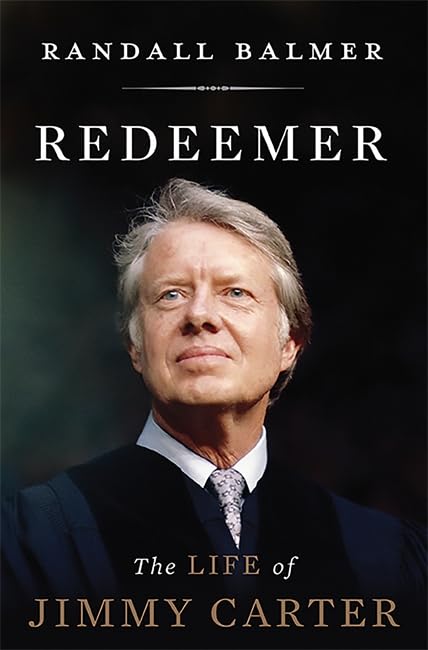
Summary: A religious biography of Jimmy Carter focused on his progressive Evangelicalism and the rise of the religious right.
I have begun to pay more attention to Jimmy Carter since I moved to Georgia 15 years ago. I was able to go to one of the quarterly report meetings of the Carter Center about seven years ago and was duly impressed, not just with the ongoing work of the Carter Center, but with Carter’s sharp takes on current events. The event was a breakfast meeting at 7 AM. It followed an evening conference that Carter had hosted, which did not conclude until 10 PM the previous night. Carter has a murphy bed in his office at the Carter Center, so he would have slept in his office. As part of the question and answer time, Carter cited four different articles from several newspapers that he had read that morning before the breakfast meeting. He had compelling thoughts on questions as diverse as North Korean proliferation, Black Lives Matter organization, protests of police brutality, environmental issues, and personal practices as a leader.
Part of what is fascinating to me isn’t just Carter’s post Presidental career, but how much of a transitional figure he has been to American politics. As I learned in the book, Carter was the first president born in a hospital. But his family home did not have running water until he was 11 and didn’t have electricity until he was 14. Carter was on the local school board during the integration era after Brown v Board. And he was pressured to join the local White Citizen’s Council, but resisted. He attempted to get his church to accept Black members in the 1960s, but there were only three votes in favor, including his and his wife’s. His church was still segregated when he became President, and the pastor was fired in 1977 for attempting to integrate it. That led to a church split, and for the remaining two years, he alternated between the two churches when attending church at home. He joined the new, integrated church the week after leaving the White House. It is incredible to think that a sitting president, known for his racial activism, was still attending an overtly segregated church.
Jimmy Carter was born in 1924. Which made him was younger than Reagan (1911), who was older than Gerald Ford and Richard Nixon (both born in 1913). George Bush and Jimmy Carter were born the same year, but then George W Bush, Bill Clinton, and Donald Trump were all born in 1946, a generation younger. The changes in the US since Carter’s birth are significant.
Randall Balmer’s primary thesis in Redeemer is well summarized in this quote from early in the book:
In the simplest terms, the brief recrudescence of progressive evangelicalism in the early to mid-1970s gave way to a conservative backlash, a movement known generically as the Religious Right, a loose coalition of politically conservative evangelicals and fundamentalists. The leaders of the Religious Right faulted Carter and his administration for enforcing the antidiscrimination provisions of the Civil Rights Act in evangelical institutions. They criticized his support for human rights abroad and equal rights for women and for gays and lesbians at home. Having joined the ranks of abortion opponents in 1979, the Religious Right castigated Carter for his refusal to outlaw abortion, despite Carter’s long-standing opposition to abortion and his efforts to limit its incidence. By the time of the 1980 presidential election, evangelical voters overwhelmingly abandoned Carter and threw their support to Reagan, the candidate who, with his faltering grasp of the essentials of evangelical theology and his episodic church attendance, had perhaps the most tenuous claim on the label evangelical.