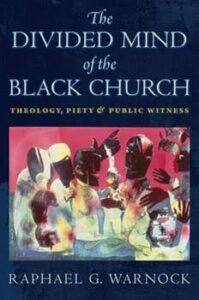
The Divided Mind of the Black Church: Theology, Piety, and Public Witness by Raphael Warnock

The Divided Mind of the Black Church: Theology, Piety, and Public Witness by Raphael Warnock cover imageSummary: A theological history of the Black church and its relationship to liberation theology. 

If Raphael Warnock had not been my Senator, I am not sure I would have picked up The Divided Mind of the Black Church. I am interested in the history and theology of the black church, but there is also a reputation for pastors who are writing, and it is a mixed bag. Many pastors are writing versions of their sermons or lightweight content that can be helpful but not essential. This is a serious book of theological history, and I was surprised at how good it was. I cannot think of another politician with a serious theology book.

That being said, there are going to be many who will not be fans of this book and its conclusions. The central thesis is that what Warnock calls Black Theology did not arise until the start of the civil rights era and, even then, did not fully develop until what he calls the fourth stage of development of Black theology, the rise of Womanist contributions. Warnock is part of a progressive wing of the Black Church, and he is pointing to Black Theology as a liberationist theology. He is not denying the Christianity of those whose gospel is now primarily a liberationist theology. Still, he is saying that the focus on liberation has made what is now called Black Theology distinctive. In his third stage are James Cone and others writing a theology that fully embraced liberation and God’s priority for the poor and marginalized.

Read more

Art and Faith: A Theology of Making by Makoto Fujimura

Art and Faith: A Theology of Making cover imageSummary: A theological vision for vocation and creativity and the connection between our work and our vision of the eschaton. 

I really love Mako Fujimura’s art and his artistic vision. Every time I read one of his books or listen to one of his talks, I dream about buying one of his pieces of art. I am not new to his writing. I have read his book Silence and Beauty twice and his book Culture Care once. I have listened to a huge number of his talks and interviews. If you want an introduction, I think his discussion with Mark Labberton at Fuller Seminary is a good place to start.

Many of the themes of this book are touched on in his other books or in his interviews or talks. I think this is a good place to start if you are new to his work, and then I would encourage you to go back to his book Silence and Beauty as building on some of the themes developed in Art and Faith. The forward by NT Wright is a natural choice. Wright’s theological vision, especially the ideas from Surprised by Hope are deeply worked out in Fujimura’s vision of what it means to create and live in the world. This quote I think summarizes that thought.

“In my experience, when we surrender all to the greatest Artist, that Artist fills us with the Spirit and makes us even more. creative and aware of the greater reality all about us. By “giving up” our “art,” we are, paradoxically, made into true artists of the Kingdom. This is the paradox Blake was addressing. Unless we become makers in the image of the Maker, we labor in vain. Whether we are plumbers, garbage collectors, taxi drivers, or CEOs, we are called by the Great Artist to co-create. The Artist calls us little-‘a’ artists to co-create, to share in the “heavenly breaking in” to the broken earth.”

Read more

The Extraordinary Education of Nicholas Benedict by Trenton Lee Stewart

The Extraordinary Education of Nicholas Benedict  cover imageSummary: A prequel with Nicholas Benedict being transferred to a new orphanage when he was nine. 

After the initial trilogy, I quickly picked up the prequel. Nicholas Benedict, the adult/parent figure for the original series was once a child himself. And like the children of the main series, he was brilliant and an orphan.

The book opens on a train with the staff person on a closing orphanage delivering Nicholas to a different orphanage. With the original series, I thought of the series of books by John Fitzgerald based around The Great Brain. Tom, the Great Brain, is a genius 10 year old who is always seeking to acquire more money. Many of his schemes do not work out well, and some harm his brother, who narrates the books. The difference between these books and those Great Brain books is that while both have genius children, the Benedict books are rooted in children looking out for the best for others. The Great Brain books were oriented toward selfish interest for the most part.

Nicholas is not perfect, although he is very nearly perfect. He realizes that he does need others and he has a responsibility to use his genius for others. And that is really the tipping point for him in this book. In someways I like I may have liked this book even more, although I think the range of characters in the main series is more enjoyable. I was glad to have read these books.

Read more

The Madness of Crowds by Louise Penny (Inspector Gamache #17)

The Madness of Crowds: A Novel (Chief Inspector Gamache Novel, 17) cover imageSummary: After Covid, a researcher proposes mandated euthanasia and eugenics as an economic response, and Gamache is asked to protect her and then solve a murder that may be related.

I do not know how authors will deal with the reality of Covid over the coming years. Of course, such a globally important event will find its way into many books of fiction and non-fiction, but what about as Covid is still very active? In the 17th book of this series, Louise Penny, a series that comes out annually in early fall, had to have written The Madness of Crowds as Covid was raging. But the Madness of Crowds is a consciously post-Covid book. The book opens with the town of Three Pines holding a memorial and the first real gathering after vaccines became widespread. And if only that were how Covid really had ended, cleanly without additional varients and outbreaks and widespread vaccine rejections. However, the Madness of Crowds is fiction, and in this fictional world that is not real in many different ways, Covid had a clean ending, albeit one that was still filled with trauma, grief, and loss.

Covid matters in another plot point. At the start of the book, Gamache is asked to provide security for a lecture at a small college near Three Pines. The Canadian government commissioned Abigail Robinson, a statistician, to prepare a report about shoring up the national health system in response to the widespread cost and devastation as a result of Covid. Dr. Robinson’s report is rejected before it was released, and a cult following develops around Dr. Robinson as she independently presents her findings. Violence has erupted at several earlier lectures as both supporters and protesters grapple with her call to mandate euthanasia for the elderly and disabled as a means to protect the economy and the national health system from economic ruin.

Read more

Love and Death Among the Cheetahs by Rhys Bowen (Royal Spyness #13)

Love and Death Among the Cheetahs Cover ImageSummary: The newly married Georgie and Darcy honeymoon in Kenya. 

I have been reading almost entirely non-fiction for most of the last 2 years. I am hitting a point where I know I need to rebalance my reading a bit. I just finished the whole Mysterious Benedict Society, and I will start the newest Inspector Gamache. And I picked up the latest Tourist novel this morning that I will probably start after that. So I am returning to old familiar authors, as I tend to do when I need to find some refreshment.

Cozy mysteries like Rhys Bowens seem particularly designed to comfort and not challenge. This long series (the 15th will be published in October) follows a cousin of King George in the 1930s. Her family is poor and has little more than their title, and as the younger daughter, she has less. But she is often in the right place at the right time and solves crimes or fixes problems for the Queen. Her now-husband, Darcy, is an Irish peer and has done much the same in a semi-official capacity for the British foreign office. They are newly married, and both tend to keep secrets from one another for various reasons that they are still working through. It comes out fairly early that while Darcy was trying to get them on an exotic honeymoon, they were also following the trail of a jewel thief. But even that isn’t quite the whole story, which again comes out a bit later.

Read more

A Third Reading of Color of Compromise

Summary: The church has been complicit in the creation of a racial hierarchy.

Last night I finished up a discussion group for the Color of Compromise. I was not particularly interested in re-reading the book because I have read/listened to it two previous times and watched the video series twice. But the Color of Compromise is exactly the type of book that brings about a shared story of the history of the United States so that there can be a place for Christians of different racial groups to come together for real discussion and future work.

This discussion group was the fourth round of small groups that I have helped lead or participated in that explicitly focused on racial issues at my church. And one of the significant confirmations of participating in these groups is how important it is to have a shared understanding of history. That does not mean that everyone has to believe the same things on all policy or theology or historical understandings, but it does mean that a shared basic shape of the history of the US and the role that race has played in that history is important for moving forward. Color of Compromise is a basic introduction to the history of race in the US. I have read a lot of history around race, and there is very little that is controversial here.

That being said, one of the consistent critiques that I have heard about Color of Compromise is that its history is not very good. Generally, when I have asked for examples, there are two main threads that people are talking about. One is that there is a frustration that Tisby does not spend more time talking about the role of white abolitionists or those that opposed segregation. And generally, my response is that this is not a history of abolition or ending segregation. This is a history of the church’s complicity in racism, and their complaint isn’t with Tisby’s history but the book’s focus that he actually wrote. The second area where people have complained about the historical work is from people who want more clear heroes and villains in their history and who are offended that Tisby is pointing out that some of our heroes were not very heroic regarding race. So again, this tends to be a problem with people’s understanding of the methodology of history and their theological anthropology.

The current historical methodology is not designed to create heroes. If you go back two hundred years, some early historians were trying to develop heroes and a shared ‘mythology’ (using it in the sense of a shared creation/origin story). For example, the ‘myth’ of George Washington chopping down the cherry tree arose about 10 years after Washington’s death in the fifth edition of a biography of Washington by Locke Weems. Weemes was not trying to tell a historically accurate story that he got wrong; he was trying to illustrate the importance of virtue. By 1835, PT Barnum purchased an elderly slave woman and advertised her as Washington’s nanny, and she told the cherry tree story as one of her acts. By 1854, the story was adapted to one of McGuffey’s Readers to teach reading. But it was a ‘myth,’ not in the sense of false story (although there is no historical evidence of it actually happening), but in the sense of a shared story of the virtue of our founding father, which allows us as US citizens to point to the story for a sense of identity and meaning.

Read more

Run: Book One by John Lewis and Andrew Aydin

Summary: A follow-up to the March Trilogy, taking up John Lewis’ story from 1964 until 1967. 

I am a huge fan of the March Trilogy, a graphic novel trilogy that tells the early years of John Lewis’ life, framed as him remembering his early life at Obama’s Inauguration. The graphic novel format I think is particularly suited to the Civil Rights era history because the era’s evocativeness is part of its importance. It is one thing to read a narrative history about Civil Rights era marches; it is something else to see images of those marches with a mix of dialogue and narrative. There is a reason that the March Trilogy was the first graphic novel to win a Pulitzer.

In some ways, the history of the early years of the Civil Rights movement, Brown v Board in 1954 until Selma in 1965, is a simpler narrative. There was a righteous cause, and while there was no universal agreement (civil disobedience was very controversial), once it was completed, the history has a clear narrative story of right and wrong. Post-1965, the narrative is much more nuanced and complicated. Pre-1965, the Civil Rights movement was largely focused on legal segregation and voting rights. Post-1965, the Civil Rights movement had less clear objectives. The Vietnam War and its disparate impact on minority communities, especially poor minority communities, and global solidarity with colonized communities around the world became the focus of some activists. Other activists tried to focus on poverty across racial lines. Other activists, especially women, began to focus on what we now call intersectionality and how different forms of discrimination overlap and act differently, and how the early Civil Rights era leadership had largely had a public male face with women doing significant parts of the organizing but were excluded from leadership.

This post-1965 era requires a much more nuanced story that we are still grappling with as a society. The current discussions over Critical Race Theory are not discussed in the book, but CRT arose because the legal changes due to pre-1965 work did not result in significant cultural changes. In a 1981 interview, political consultant Lee Atwater famously discussed the rise of less overt appeals to race as a motivating factor for engaging white voters. Derrick Bell and other lawyers who contributed to the rise of Critical Race Theory knew that a law simply saying that discrimination on the basis of race was illegal did not mean that discrimination did not occur. And once there was a shift as a result of the 1976 Washington vs Davis case, which required proof of intent to discriminate, a very high bar, more covert discrimination became not only normal but more insidious because it worked with the cultural concept of color blindness to prevent race from being openly discussed. The concept of a colorblind constitution or colorblind legal theory was used to oppose efforts to address historic racial discrimination.

Read more

The Mysterious Benedict Society Series by Trenton Lee Stewart

Summary: A talented quartet of children have to go to a boarding school to save the world from The Emergency. 

I have been looking for shows to watch with my kids that we all enjoy besides Bluey (the best cartoon out there right now). I saw a recommendation for the Mysterious Benedict Society on Disney+ and so we watched it together. I liked it more than my kids did. They watched, but I think it was a little bit old for them (they are 6 and 7). I enjoyed the show and by the 3rd or 4th episode (of 7), I picked up the first book in the series. The first book covers the main content of the show, although there are differences and a couple of details from later books come out in the show. (A few spoilers below.)

Mister Benedict is an eccentric genius who has recruited the four children to become students at a boarding school. The school is  run by Benedict’s equally brilliant twin brother. One of the details that is different between the book and the show is that in the book both are unaware of the existence of one another until midway through the book, but in the show they grow up in an orphanage until Benedict is adopted at about the same age as the kids in the book. Benedict has a loving family and is nurtured and he then becomes a nurturing caring adult. But his brother Mister Curtain, becomes power hungry and attempts to control everyone around him. In the show, Benedict feels guilty for not doing more for his brother.

These books feels a little like a British fiction, with the boarding schools and abstracted technology that is both modern and without cell phones or the internet. Maybe it is just that the books can feel a little like a non-fantasy version of Harry Potter. Brilliant, gifted children are nothing new to children’s literature. But one of the ongoing themes of the books is that these children need one another to be successful. They don’t always agree, or even like one another, but their skills fit together and as they learn to trust, not only themselves, but one another, they are more successful. There is a goodness to the children. They believe in truth and so ‘The Emergency’ which is concerning for everyone else hits them differently. There is a mind control device, which requires children for its use. Those that are not worried about truth are more susceptible to mind control. The children receive the mind control signals as discomfort, but it also makes them grumpy and snappish.

Read more

Bad Faith: Race and the Rise of the Religious Right by Randall Balmer

Bad Faith: Race and the Rise of the Religious Right cover imageSummary: An expansion of his 2014 Politico article.

This is a very short book that is an expansion of a well-known and controversial article. I listened to the book, and it was less than 2 hours. In paper, it is 128 pages, but those cannot be dense pages.

The rough thesis is that the rise of the religious right was not originally because of concern over abortion or gay rights as the story is sometimes told, but because of the IRS investigation or religious schools’ segregation stances. On the narrow thesis, I think that it is hard to argue against race playing a role. Segregation academies, as they are sometimes called, were a response to public school integration requirements, and these Christian schools, which just happened to usually be all white, just happened to appear in the years following Brown v Board. By 1970 (following an IRS rule change), the IRS started to research the rise of these schools and sent requests to the school to ask about their integration policies. Many schools obfuscated or allowed in a small group of minority students to avoid IRS investigation. But Bob Jones and a few others schools were vocal in their segregation. After several initial court cases, the IRS revoked Bob Jones’ tax exemption in 1976. Eventually, there was a Supreme Court case in 1983. (Ronald Reagan had a campaign stop at Bob Jones in 1980. George W Bush had a campaign stop in 2000. Also in 2000, Bob Jones University revoked its ban on interracial dating. In 2017, Bob Jones University regained its tax exemption.)

Up until the early 1970s, there was not a strong political movement within the religious right. Some Evangelicals were trying to raise concerns about abortion, but it was not a significant issue. The SBC had a weak resolution in support of allowing limited abortion in 1971. It was not until 1980 that the SBC had a resolution clearly opposing abortion.  The Chicago Declaration of Evangelical Social Concern in the fall of 1973 did not mention abortion at all.

Balmer is broadly right in the basic thesis that racial concerns were one of the contributing factors that gave rise to the religious right. I think there was a bit more nuance and detail in Bad Faith than in the Politico article, but I think there should still have been more nuance and detail. This is a concise book, but if he was clearer about how limited his claims are, I think this would be a better book. I know that many understood the Politico article to have a more expansive thesis, something like, “abortion was never really a concern of the religious right, it was always just covert racism all along.” That more expansive thesis would be too strong, but I think that the more expansive thesis is a misreading of the article facilitated in part by Balmer not limiting his claims more clearly.

Read more

How the Word Is Passed: A Reckoning with the History of Slavery Across America by Clint Smith

Summary: Reckoning with history through its landmarks and locations.

It is no surprise to anyone that I like to read history. History gives us insight into our current realities by exposing the forces that shaped our reality. But history is also narrative, the stories that we tell ourselves about how the world came to be. Many historians are incredible writers. Clint Smith’s background as a poet is evident. His language is personal, evocative, and at times searing. I am not brand new to Clint Smith; he hosts the YouTube CrashCourse series on Black American History. During a road trip to visit my parents, my wife and I listened to podcasts and a 90-minute discussion between Clint Smith and Brené Brown. When the podcast was over, I immediately purchased the audiobook of How the World is Passed, and we only listened to this audiobook for the rest of the trip.

About 15 years ago, I listened to the audiobook of Sarah Vowell’s Assassination Vacation. With her trademark voice and humor, Vowell traveled through the country to visit sites of political violence. If you have read that book, How The Word is Passed is a more serious similar idea. Clint Smith starts in his hometown of New Orleans and explores monuments’ role in understanding the history of slavery. Then he visits Monticello and the Whitney Plantations and explores how plantations handle the story of slavery and the mythology of the plantation. That history of plantations naturally leads to Angola Prison, one of the country’s largest and most infamous prisons built on a plantation.

Blandford Cemetery has been a cemetery since 1702 but was significantly expanded after the Civil War battle of Petersburg and is now mostly a Confederate Cemetery. I will expand on this description a bit more because this chapter is a perfect illustration of what Clint Smith is attempting to do with the book. He initially goes on a tour of the cemetery and the church that was on site. Then, referencing the earlier discussions of how plantations told their story, he details the discussion with the tour guide and the cemetery director. During the discussion, he discovers a Confederate Memorial Day commemoration at the cemetery that the Sons of Confederate Veterans put on. Along with the narrative of the visit, Smith recounts the history of the Lost Cause, the United Daughters of the Confederacy, and the Sons of Confederate Veterans and their roles in shaping education, the memory of the Civil War, and southern identity. Finally, during the discussion of the program and recounting of interviews with participants in the program and attendees, Smith discusses how various forms of white nationalism and confederacy remembrance are often interlinked. All of this gives context and depth but feels natural; a visit leads to another visit, and talking to one person leads to an exploration of the person’s ideas.

Read more