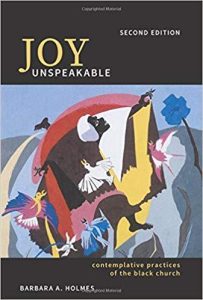
Joy Unspeakable: Contemplative Practices of the Black Church by Barbara Holmes

Summary: An exploration of contemplation in the Black church.

Part of the importance of reading widely is opening our perspectives to correction. Joy Unspeakable discusses the contemplative practices of the Black church but also redefines contemplation for those who are in and outside the Black church.

I did not read Joy Unspeakable quickly. I slowly read the book over a couple of months. I probably read it a bit too slowly, but I finished it as I was halfway through Armchair Mystic, a book assigned for my Spiritual Direction program. Armchair Mystic attempts to teach the basics of contemplative prayer. On the whole, it is a helpful book, but it is rooted in a white Western concept of contemplation.

“Black people for far too long have been forced to refine our message according to what is comfortable for the mainstream. We have made a distinctive choice not to do it…Our goal is to be free and authentic, not to pacify others.” Joy Unspeakable redefines or explores aspects of contemplation that have been underappreciated. There are more traditional ideas like music, traditional liturgy, prayer, and historical legacy. But more important to me is the non-traditional: activism, the leadership of Obama, BLM, and the subversion of older activist models, modern music, hip hop, blues, jazz, etc.

When the word contemplation comes to my mind, I think of Thomas Merton and his lengthy and illuminating discourses about the practices that include complete dependence on God. But I also want to talk about Martin Luther King Jr. and his combination of interiority and activism, Howard and Sue Bailey Thurman and their inward journeys. I want to present Sojourner Truth, Harriet Tubman, Fannie Lou Hamer, Barbara Jordan, and the unknown black congregations that sustained whole communities without fanfare or notice.

Read more

The Diary of a Country Priest by Georges Bernanos

Summary: A novel describing the thoughts and life of a young country priest in France. Set in the post WWI era, it feels connected to the modern world and distant from our modern world. 

I do not know when I first heard about the very famous novel Diary of a Country Priest. But it has been years. I do not think that I started looking for the book until it was listed in Eugene Peterson’s book about books he recommends to read. Until recently, the 1936 novel has not been available for a price I was willing to pay. But it looks like there has been a copyright change, and now there is a $0.99 Kindle version. There is also a free PDF that just scanned and not a very high-quality version.

Part of what I enjoyed was the look at the strain of being a country priest in an era before the widespread use of phones or cars. There is one scene where the priest is given a ride on a motorcycle. But as unusual as it is to read about this earlier era, and while cars and phones matter to pastoring today, the reality of how people act does not feel too distant. With the culture of the earlier era, a rural French setting is different, but not so different that it is unimaginable.

Read more

The Discerning Heart: Discovering a Personal God by Maureen Conroy

Summary: A book for those training to be spiritual directors focusing on developing discernment and using case studies to guide spiritual direction training.

The Discerning Heart is a book that was hard to track down. It is out of print, and when I finally found a copy for my classes, I was sent (and charged) for two. I am ambivalent about the book. I would rate it 3.5 stars if I were rating it. Some sections were very helpful. But the case studies got repetitive and didn’t feel like real conversations.

Where she was helpful was a good discussion on consolation and desolation (Ignatian technical terms) and their relationship to discernment. Conroy, on page 13, says, “The experience of consolation and desolation is the foundation of discernment,” but that base-level assumption is simply outside the realm of understanding for most Evangelicals that I know. One of the central areas that Evangelicals will need to be convinced to participate in Ignatian Spiritual Direction is that emotions are not contrary to spiritual reality. There are those working in this area, like Pete Scazzero’s work in Emotionally Healthy Spirituality, Jonathan Walton’s derivative work in Emotionally Healthy Activism, and Richard Foster and the late Dallas Willard’s work in discipleship through the organization Renovare. But those are not mainstream movements at this point.

I started reading this as I read Jesus and John Wayne, a history of the past 75 years of how Evangelicals conceived of the implications of leadership, gender roles, authority, and discipleship. The book’s final chapter pulls out many of the players that were discussed earlier in the book. Those leaders had consensual affairs, raped employees or church members, covered up rape or child abuse of others, abused their organizational power or authority, misused funds, destroyed their or other’s families, demeaned the name of other Christians (or non-Christians) falsely, or other sins. Cases where pastors called out a particular sin but then engaged in it or allowed it when convenient were common. Not every person mentioned in the book advocating “militant masculine Christianity” engaged in the above list, but a very high percentage did.

Read more

Jack by Marilynne Robinson (Gilead #4)

Summary: Jack, the prodigal child of Gilead, is in St Louis. This novel is set before the events in the earlier novel Home.

Marilynne Robinson is one of the more famous modern novelists of our age. And considering this is only her fifth novel, she has had a remarkable career. The Gilead books are intertwined. They can be read alone or out of order. But they all have some relationship to John Ames. The elderly pastor of a small church in Gilead Iowa, the main subject of the first book of the series.

The second book, Home, is mostly about Robert Boughton’s family, John Ames’ best friend and fellow pastor in the same town. It is told from the perspective of Glory, the daughter who has returned home to care for her ailing father. But nothing in the Boughton family is not about Jack, named for John Ames, but a prodigal who finally returns for a visit.

I need to go back and reread Home. Of the three previous, it was my least favorite. Not because any of Robinson’s books are not well written, but because I love the story of grace that is more central to Lila and Gilead. The character of Jack is part of a story of grace, but one I have always been less interested in. Rev Boughton grieves and prays for his son. The town can see how Jack’s hurts and harms, not just himself, but everyone around him. It is not always that Jack intends to harm. Quite often, the harm comes through bad luck. But it is easy to blame Jack for his bad luck.

Read more

No Name in the Street by James Baldwin

Summary: Memoir and social criticism, mostly focusing on 1963 to 1969, but with excursions to his childhood. Lots of reflection on the deaths of MLK, Malcolm X, Huey Newton, Eldridge Cleaver, and others. 

I picked up No Name in the Street because it was so heavily referenced in Eddie Glaude’s recent book Begin Again. No Name in the Street is mostly social commentary and memoir. Like The Fire Next Time, it is two long essays, with no real breaks. I plan to pick up a Baldwin biography next to get some distance and a clearer life picture.

I am continually mesmerized by Baldwin’s writing. I do not think that it too strong of a description. Baldwin draws in the reader and writes with such passion and clarity. Reading Baldwin can set my mind spinning. So much of his writing feels so very current. But at the same time, he was just a bit older than MLK and Malcolm X and about 10-15 years older than younger Civil Right Era leaders like Stokley Carmichael (Kwame Ture) and John Lewis. Baldwin writes in a way that seems very current, but about history that he lived through. Especially in No Name in the Street, when he was writing about his (still recent) reactions to the large number of Civil Rights Era leaders’ deaths, it gives a weight to this book that I found hard. I put it down several times because as important as the words are, Baldwin is a weighty writer.

Read more

The Deeply Formed Life: Five Transformative Values to Root Us in the Way of Jesus by Rich Villodas

Summary: Discipleship focused on five values: Contemplative rhythms, racial reconciliation, interior examination, sexual wholeness, and missional presence. 

About ten years ago, I remember being struck as I read John Stott’s last book (also on discipleship) how much culture impacts how we understand discipleship. Stott had chapters on environmentalism and international ecumenical cooperation (focusing on nuanced and negotiated written agreements and statements of faith). Some books on environmentalism talk about discipleship issues and some books on ecumenical cooperation also talk about the need to disciple people into church unity. Still, in general, those are unusual topics for a general book on discipleship. Stott was writing in a context where those were not unusual topics of discipleship. Stott’s UK background and the US background are different, so books on discipleship have different emphases.

Rich Villodas is a pastor in NYC. Three of the list of his discipleship values will be found in many books. Two of his discipleship values are less common. According to Barna, White Evangelicals have become more interested in racial issues and are more opposed to discussing racial issues. There is an increasing divide within the White Evangelical world regarding justice issues more broadly, but racial justice in particular. Pew shows a 15-20% drop in the percent of the population that self identifies as Evangelical over the past decade. (And I antidotally suspect that it may be an undercount, but it may also just be my cohort.)

The reality is that it is becoming increasingly clear that the demographic dominance of White Evangelicals of the cultural conversation is waning. If for nothing other than pragmatic reasons, there is increasing awareness among some about the need for ethnic diversity within the church. As part of an aside in an online lecture from Esau McCaulley on theology and race, he noted that seminaries and colleges that primarily have catered to White theological training will have to change, or some of them will die, solely because of demographic trends.

The Deeply Formed Life is not taking a pragmatic/utilitarian approach to the need for racial reconciliation among Christians. He is rooting it as a central value, particularly because of our racially and culturally divided age. John 13 quotes Jesus as saying, “By this everyone will know that you are my disciples, if you love one another.” But evidence of that love is often lacking.

Read more

Me and White Supremacy: Combat Racism, Change the World, and Become a Good Ancestor by Layla Saad

Summary: Journaling based exploration of racism. 

When discussing racism, a lot of pushback is focused on titles and approaches. And while I think there are some problems with this, it is important to get something that people will hear in the early stages. If a person cannot hear a voice or book or movie, it is unlikely to help them.

Many object to Robin DiAngelo’s book White Fragility because of the title and approach. Several people have recommended Me and White Supremacy as an alternative. So I read it with an eye toward the book to recommend to people that are early into the understanding of racial issues. For the most part, I agree that this is likely a better book for most people, but not everyone. First, the title still has ‘white supremacy’ in it. Generally, I tend to use ‘white superiority’ instead of ‘white supremacy,’ but the underlying meaning I agree with.

Me and White Supremacy is a 28 study, largely based around journaling questions. Layla Saad first tried the material out on her Instagram followers. And my recommendation is all about whether you are the type of person who will seriously take the questions. If you will not write out answers, or at the very least, think about them, then you will not find any value in the book. But if you engage with the questions and really think about your answers, then I think this is a beneficial book in laying out terms and ideas for anti-racism.

Read more

Doomsday Book by Connie Willis (Oxford Time Travel #1)

Summary: Time travel gone wrong.

I have not been reading nearly enough fiction lately. Doomsday Book was recommended by a friend a year or two ago. It came out nearly 30 years ago while I was in college and in an era where I was not reading a lot of science fiction.

Kivrin is a young ‘historian’ at Oxford. Historians go back in time to study a particular historical period. Most historians go back a couple of centuries because the further back, the more unpredictable the exact time you are being sent becomes. There is a problem with ‘drift,’ and you can be hours or days or weeks off your predicted location, impacting your retrieval. Part of the science of time travel is that the system prevents you from impacting future history and creating paradoxes.

Kivrin is interested in the Midevil era. Her mentor, Mr. Dunworthy, does not like the idea of sending her to the Midevil era, not because she is unprepared or just because she is a woman in an era that was not kind to women, but because the department that oversees Midevil historians is incompetent. Problems happen.

Read more

Vatican I: The Council and the Making of the Ultramontane Church by John O’Malley

Vatican I: The Council and the Making of the Ultramontane ChurchSummary: A brief history of the movement toward Vatican I and the council itself. 

I seriously considered not blogging about this book. Vatican I is an area that I have almost no background knowledge, so I cannot comment on the quality of the book. I had a friend recommend to me another book by John O’Malley, and as I was saving the book to my future reading list, I saw that Vatican I was free to listen to in Audible because of their new member benefit.

I know I have extensive holes in my knowledge of history. And in this case, that includes not knowing hardly anything about European history after roughly Elizabeth I and hardly anything about Catholic history between Trent and Vatican II.

Luckily, nearly half of the book was about the history and cultural influences that led to the start of Vatican I. So the book seemed to place the context of the subject well so that even someone like myself can benefit. Vatican I did not end, the Franco-Prussian war moved to Rome, and the council was evacuated. Officially Vatican I did not end until the start of Vatican II. Several of the decisions of the council may not have happened if the schedule had been different. There is quite a bit of criticism of Pope Pius IX, but that criticism also seems tempered from how strong it feels like it could have been.

Read more

Rediscipling the White Church: From Cheap Diversity to True Solidarity by David Swanson

Rediscipling the White Church: From Cheap Diversity to True SolidaritySummary: Stop emphasizing visual diversity and focus on solidarity. 

Among those interested in racial justice, there is significant interest in how to help people become interested in racial justice. I have frequently used the metaphor of evangelism because there is a sense of a message being that is necessary, and there is some sense of the Holy Spirit awakening the person to be open to that message.

David Swanson’s main focus in Rediscipling the White Church is discipleship, not evangelism. Similar to my interest in racial justice and spiritual direction (a method of discipleship) evolving in parallel, Swanson emphasizes that the way to correct a distorted church is an emphasis on correct discipleship.

Dallas Willard claims that a disciple is, most basically, an apprentice “who has decided to be with another person, under appropriate conditions, in order to become capable of doing what that person does or to become what that person is.” While there is more that could be said about what a disciple is, for our purposes a Christian disciple follows Jesus to become like him and to do what he does.

Swanson is building on the work of Dallas Williard, James KA Smith, and others that remind us that discipleship is not about intellectual knowledge acquisition but building habits.

Building on Augustine’s understanding of people as desiring creatures, philosopher James K. A. Smith writes that it’s our habits that “incline us to act in certain ways without having to kick into a mode of reflection.” Remember my implicit bias at the beginning of the chapter? Because we are not first and foremost thinking beings who rationally engage with every encounter, it is our habits which shape our imaginations or, in Augustine’s vocabulary, our loves. My unconscious assumption about who wrecked my cement was inculcated in me through a set of racially oriented habits. We aren’t usually aware of our habits.

The book’s central point is that Swanson wants to transform the goal of discipleship around racial justice is solidarity (regardless of how visually diverse a congregation is) and not some abstracted racial reconciliation or unity.

Read more