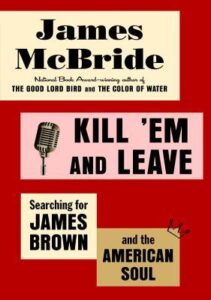
Kill ‘Em and Leave- Searching for James Brown and the American Soul by James McBride

Takeaway: Can we really know someone who does not want to be known?

It has been about two decades since I read James McBride’s breakout book about his mother, The Color of Water. Kill ‘Em and Leave is the first book of McBride’s I have read since then. Like Color of Water, McBride is a character in this sort of biography of James Brown. Half of the book is really about how hard it is for anyone, including McBride, to really understand James Brown.

Throughout Kill ‘Em and Leave, McBride recounts his interviews with the people who knew, worked for, loved, and were harmed by James Brown. There is little gloss here. James Brown was a musical genius and a nearly impossible person to be around. Those who stayed with him the longest were those who were willing to do what he said. If you ate with James Brown, you ate what he ate, and only what he ate. If you worked for him, you did what he said. If you played for James Brown, you showed up on time, played what he wanted, and supported Brown as the star.

But McBride also captures the importance of James Brown as a cultural figure for the African American community. There are a ton of stories about children just wanting to see a famous Black man who owned a plane and radio stations and said, “I’m Black, and I’m proud.”

This is important to McBride as well. McBride identifies with Brown in some ways. Kill ‘Em and Leave was partly written because McBride needed to write a book. He was broke after a divorce. He was living in a small NYC apartment. McBride has had big hits, but at 55, he was starting over again, similar to Brown. And McBride has no problem identifying the aspects of Brown’s life that were impacted by racism.

However, the biggest image of Kill ‘Em and Leave was of a man who was unable or unwilling to be known. His best marriage was his first as a young man before becoming a star. But she didn’t want to travel with him and didn’t like his philandering while he was traveling. Their divorce was about their different goals, more than a lack of love, and they stayed close throughout his life. His musicians were around him, and he owed much to their musical influences to his sound. But even those who were around him longest didn’t claim to really know him. Some of them didn’t want to talk about him. Many of them continue to live (or died) in poverty.

Read more

Left Hand of Darkness by Ursula Le Guin

Left Hand of Darkness by Ursula Le GuinSummary: An ambassador, Genly Ai, attempts to bring the planet Winter, into Ekumen (an intergalactic United Nations).

I like a number of Le Guin’s books. I started reading the Wizard of Earthsea books as a teen. But Le Guin is a wide ranging author. The Left Hand of Darkness is part of the Hainish Cycle. These are a series with the same rough universe, but not necessarily connected in story.

The Hainish ones are a lot about exploration of ideas. I read The Dispossessed about a year ago. It was largely about political system. The Left Hand of Darkness largely looks at the role of gender. The world has gender fluid inhabitants. Everyone is genderless except once a month they essentially go into heat and mate with whoever happens to also be in heat at the time.

Read more

Jesus and the Disinherited by Howard Thurman

Jesus and the Disinherited by Howard ThurmanSummary: A view of Christianity as the empowerment of the poor and disenfranchised.

Jesus and the Disinherited has been recommended to me a number of times. This month the kindle edition is on sale for $2.99 and I picked it up. This is a brief book. Just over 100 pages. It famously was carried by Martin Luther King Jr almost everywhere he went as inspiration.

Howard Thurman was a classmate with King Sr and the Dean of the Chapel at Boston University while Martin Luther King Jr was working on his PhD. Jesus and the Disinherited was based on a series of lectures and originally published in 1949. (Before Martin Luther King Jr was at Boston.)

The first chapter of Jesus and the Disinherited is about Jesus and how his role as a member of a minority group and in poverty impacted the message of Jesus. Much of this I have heard others say previously. (I really don’t remember anyone citing Thurman, but based on the date of the book, I know that much of my reading would have been influenced by Thurman without citation.)

What is interesting and a new thought to me in that first chapter is Thurman’s contrast between Jesus and Paul and their different positions in society and how that seems to have impacted their theology. Jesus was poor and outside of Roman society. Paul was a Roman citizen and one that used that status.

Thurman cites Romans 13 and other passages as an example of how Paul’s status as citizen is woven into Paul’s theology. Thurman is clear that Paul also subverts cultural assumption of status in Galatians (neither Jew nor Greek, Male or Female, slave or free). But that Paul does not subvert the system as much as Jesus does.

Read more

My Soul Looks Back by James H Cone

My Soul Looks Back by James H ConeSummary: Mid-career memoir of one of the founders of the Black Liberation Theology movement in the US.

It has been years since I have picked up one of James H Cone’s books. I think I have only read two, Black Theology of Liberation and Martin & Malcolm and America. I am pretty sure that I missed most of the content of both of those when I read them around my college or seminary years. But Martin and Malcolm and America in particular has stayed with me and I want to revisit again.

I have been intentionally reading memoirs of elder Christians in attempt to understand how they communicate their wisdom. L’Engle’s four volumes of memoirs, John Perkin’s recent book and Hauerwas’ Hannah’s Child have been the most recent examples. Cone wrote My Soul Looks Back in 1985, when he was 49. He was not nearly as old, or as near the end of his career as John Stott or Eugene Peterson or Thomas Oden‘s memoirs have been. But it matters that Cone’s assessment of the state of racism in the United States and the church read as if they had been written recently. (I would be fascinated to read a new memoir by Cone now that he is 81.)

I have appreciated the existence of Cone’s theology of liberation, even if I thought that I had moved past it. I think I would have dismissed it far less had I read My Soul Looks Back earlier. Liberation Theology today is often dismissed as too concerned with the political or reducing the spiritual life by focusing on the political. And by being too influenced by the discredited ideas of Marxism. Some of that critique has validity. But as I read Cone’s assessment of his own work, he dismissed Marxism as mostly irrelevant to the development of Black Liberation theology within the US.

Read more

Our Secular Age: Ten Years of Reading and Applying Charles Taylor

Our Secular Age: Ten years of Reading and Applying Charles TaylorSummary: A collection of essays about Charles Taylor’s A Secular Age.

At some point I will read A Secular Age. But frankly, the 900 page tome is far down my reading list. But this is at least the fourth book that I have read that is largely about A Secular Age. So now I have read about as many pages about a book as the book itself.

James KA Smith’s How (Not) to be Secular and Joustra and Wilkinson’s How To Survive the Apocalypse are both excellent introductions to Charles Taylor’s book. Richard Beck’s Reviving Old Scratch is a riff off of Taylor’s books, but not really directly about it. But more of an application of A Secular Age while looking at the concept of Satan. And now Our Secular Age is a series of essays put together by The Gospel Coalition that have been influenced by Taylor.

Any collection like this is uneven. But there are a number of helpful essays, even though I wanted to argue with a few of them. My problem is that I still have not read the original Taylor, so I am not sure if my impression of Taylor is accurate enough to adequately argue for or against the critiques here. Personally, I think John Starke’s chapter Preaching to the Secular Age and Brett McCracken’s Church Shopping With Charles Taylor were the two most helpful for me. Although I argued in my head with McCracken’s chapter virtually the entire time.

Alan Noble’s chapter, The Disruptive Witness of Art, is really an argument for the existence of the online magazine Christ and Pop Culture. (Which he helped to found and which I am a big fan of.) It is not a new argument to me, but I think it is an important argument. Art is evangelism and discipleship in light of the Secular Age.

Read more

The Ship of the Dead (Magnus Chase #3) by Rick Riordan

The Ship of the Dead (Magnus Chase #3) by Rick RiordanSummary: Final chapter in Riordan’s Norse trilogy.

Rick Riordan has become a young adult/children’s author powerhouse. Churning out nearly 30 books or graphic novel adaptations in just over the last 10 years. He is best known for his Percy Jackson series, which is set in the same world as this series. (Magnus Chase is the cousin of Annabeth Chase from the Percy Jackson series.)

This series I think is geared to a slightly older audience than the original Percy Jackson series. But returns to what made the Percy Jackson series good. It is clearly young adult, with the same types of tropes that most young adult novels contain. But it is also fun.

Read more

The Hangman by Louise Penny (Chief Inspector Gamache #6.5)

The Hangman by Louise Penny (Chief Inspector Gamache #6.5)Summary: A novella in the middle of the series.

Louise Penny was asked to write this novella by ABC Life Literacy Canada. It was intentionally written with an easy to read vocabulary and structure but with similar themes for adults and older teens that have difficulty reading.

This type of book is so important. There are many adults that for a variety of reasons do not have high level reading skills. But most of the books that are in the range of their reading level are thematically oriented toward children or teens. While I am glad that many adults are returning to read Young Adult or Children’s books, many adults do not want to only read children’s or YA books.

What I was most struck by while reading The Hangman was that it didn’t feel like a simplified book. Penny was able to construct a novella that while it isn’t as complex as her longer books in structure, it didn’t feel like she was reducing the book to something lesser than what she normally writes.

This is a novella, so I finished it quickly. But it was worth reading. It did not really add anything to the broader story, but at the same time you do not really need to know the rest of the series to pick it up.

Read more

Disunity in Christ: Uncovering the Hidden Forces That Keep Us Apart by Christena Cleveland

Disunity in Christ: Uncovering the Hidden Forces That Keep Us Apart by Christena ClevelandSummary: Unity is actually a pretty big deal.

I am not sure why it took me so long to get around to reading Disunity in Christ, but it has. The book came out four years ago and I purchased it two years ago. But I didn’t actually read it until last week.

I did not need convincing that Unity is a pretty important part of Christianity. The problem is not that unity is important, but what unity means and what we should be doing about the lack of unity.

Books on Christian unity are not completely unusual. But most books are either theological explorations of the concept of unity, or practical training on peacemaking. While there are theological reflections and practical ideas on how to build unity, what is unique is the social science that helps to explain both why unity is important and why unity is hard to achieve solely with human means.

Christena Cleveland is a Social Psychologist. She is currently a professor at Duke Divinity School and a frequent trainer. The background in social science research, along with a number of studies that she reports on, were her own, gives her credibility.

Read more

Philosophy and Religion in the West by Phillip Cary

Philosophy and Religion in the West by Phillip CarySummary: Overview of how Philosophy and religion in the west have impacted one another.

Phillip Cary was the professor in my favorite Great Courses course, The History of Christian Theology. He is a professor at Eastern University. Philosophy and Religion in the West was nearly as good.

This is a western history of philosophy. I would also like to see an eastern version, but I do not think that exists from Great Courses right now.

The course opens with Plato and Socrates before moving into Jewish and Christian philosophy. Because I have been intentionally trying to work on developing my philosophy background, there were things here that were both repetitive from other Great Courses or reading, but also a number of areas where something finally clicked for me.

Read more

The Pigeon Tunnel: Stories from My Life by John Le Carré

The Pigeon Tunnel: Stories from My Life by John Le CarréSummary: Memories from a great novelist.

John le Carré (the pen name for novelist David John Moore Cornwell) has had a long career. He turned 86 last week, but started writing in the late 1950s. He most recent novel, a sequel to The Spy Who Came In From the Cold was released in September.

Part of what interested me from the reviews of The Pigeon Tunnel was how le Carré knowingly plays with the idea of memory. Several places he suggests that his recounting is what he remembers, but then comments that others remember the situation differently.

In one of the later chapters, mostly about his father, he says that he paid two investigators to give background on his father. He wanted to write his memory of events and then have the “˜actual’ events as recounted by the investigators on a corresponding page to show the difference. The investigators were not able to find the level of detail that he needed to carry that idea out. But that hint of how le Carré views memory and reality give a sense of what he was trying to do in this memoir.

Le Carré can tell a story. As I was reading or listening (I alternated back and forth between Kindle and Audiobook with le Carré narrating the audiobook), I was almost always engaged. But I would put it down and not be super excited to pick it up again. So I spent several weeks working through The Pigeon Tunnel.

As with almost every memoir there are people and stories that are mentioned that hold great importance to the author that do not quite get communicated to the reader. Some of the name dropping went completely over my head.

But I thought the end of The Pigeon Tunnel was especially good. His discussion of his father (a con man who spent time in jail and was wanted in many countries) was particularly insightful and interesting. That led to a discussion about his own education being covered at one point by a rich friend because his mother disappeared when he was a child and his father was unreliable (and a crook). Because of the friend loaning him the money, le Carré was able to finish his education and get the job in the intelligence world which led to him become a novelist. In a similar way, le Carré connects a story of him helping someone else to become a doctor by loaning him the money for his education. Those types of stories about how we are related matter. Le Carré’s stories are often cynical, but not everything about him is cynical.

Read more