America’s Constitution: A Biography by Akhil Reed Amar

Summary: History, Law and Political Science together help us understand the origin and meaning of the Constitution.

I have been very slowly working my way through America’s Constitution: A Biography for months. Part of what has been interesting is reading it along side books like The Half that Has Not Been Told and Reconstruction: America’s Unfished Revolution, Very Short Introduction to the President and theology books like the one I am currently reading on hermeneutics.

When I picked up America’s Constitution I was expecting something like either a Very Short Introduction series book, that describes the content with a bit of analysis or one of the Biography of Religious book series, like the one on Mere Christianity or The Book of Common Prayer or Letters and Papers from Prison that were as much about how the books were received as they are about the content of the book. Instead Akhil Reed Amar is using a mix of history, legal interpretation and analysis of the politics that created and amended the constitution. This well rounded perspective give both an overview of the content as well as helping to understand why we understand the constitution as we do.

I appreciate the well rounded analysis, but the organization occasionally left me a bit frustrated. The full constitution is in an appendix at the back. And I probably read it completely at least three times and sections of it many more times than that trying to get context for the discussion. I do wish there was more extended quotations of it in context of the book (or better linking to the sections as footnotes in the kindle edition.) In many ways it is exactly like theology books that reference passages of scripture without actually quoting them, so that you need to stop and go look them up in context to understand the discussion.

The most helpful parts of the book was the extended discussions throughout the book on role and politics of slavery in the development of the constitution and how the constitution was amended and understood. What the discussion of slavery shows is how much politics matters. The constitution is not just a document of ideals, but of practical realities. It is what was passed and approved. Amar also includes speculation of what could have been approved based on notes of discussions, the constitutions of states and the understanding of legal theories of the times with English Common Law system. What we have could have been different and that matters to how we understand the constitution.

Read more

Is the Bible Good for Women by Wendy Alsup

Is the Bible Good for Women by Wendy AlsupTakeaway: The fact that this question (and the related questions about whether the church or Jesus is good for women) needs to be asked is depressing.

Maybe it is just me. But I find when working through books that are a bit to the left of me, it is fairly easy for me to take what is good and leave what is not. However, books and teachers to the right of me, I have to more consciously and intentionally listen to what is being said and not insert “˜so what you means is“¦’ statements that do not adequately reflect what the author is intending.

I have followed Wendy Alsup’s blog for years. There is much that I agree with and appreciate about her writing. I intentionally attempt to read her with an open mind because even though we disagree about some issues of theology and approach to scripture, I have greatly benefited from listening to her over time.

Alsup is in an uncomfortable middle ground. She is writing this book for women that either are from a fundamentalist background and have absorbed teaching that really is anti-women or for those that are outside the church and assume they know what the bible is about.

She is also in an uncomfortable position of pushing back against overly restrictive positions on women (for instance she believes and talks about in the book why women should be ordained as deacons) while not accepting women as elders and pastors. She frequently critiques complementarian views as commonly understood and taught, although many from the more egalitarian side easily lump her in with the term.

Alsup uses the phrase, “˜the bible is the best commentary on itself’ frequently in Is the Bible Good for Women. I like this idea, but it is a nuanced and theological idea and in the working out of it I frequently disagree with Alsup’s takes. My disagreement starts with Genesis 1 and 2. While gender is present in Genesis 1 and 2, my bias suggests that the point of those passages are not about gender or roles, but about God being supreme god above all other gods in the land.

Read more

The Color Purple by Alice Walker

The Color Purple by Alice WalkerSummary: Life is horrible, then it gets a bit better.

I have spent a lot of the past year or so reading history and other non-fiction about racism, slavery, Jim Crow and the broader African American experience in the US. I have not read a lot of fiction in part because non-fiction I can distance myself a bit.

A large part of the point of fictional portrayals of the African American experience is to engage in an emotional way. I am still reluctant, although I know that is where I need to start going more often.

The Color Purple has been in my library for years. I picked it up on sale on kindle. Then picked up the audiobook on sale. But it wasn’t until the musical Color Purple was included in my Broadway in Atlanta subscription (so I could get Hamilton tickets) that I finally sat down and read The Color Purple.

Alternating between kindle and audiobook, it took me about a week to read the first 20%, but only two or three days the read the last 80%. The opening of The Color Purple is rough. Celie opens the books with short, childish letters to God. She is describing being repeatedly raped by her father as her mother gets sick and dies. And this continues for years after her mother’s death. She gives birth twice, with her father taking away the children into the woods to an unknown fate.

Later, when her younger sister starts to mature and become attractive, she starts to try to protect her. That leads to Celie essentially being sold off to a widower to be his new wife (and sex slave) and mother to his children (who are not much younger than she is.)

The time scale for The Color Purple is decades. As I tried to describe the story to my wife in preparation for the musical (we go Sunday night), the weight and breadth of the story really came to me. There are a number of characters that are well developed with enough back stories and emotional life to make telling the story difficult.

Read more

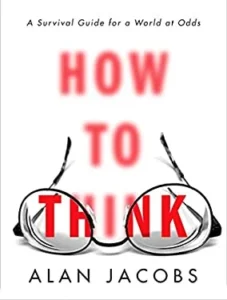
How to Think: A Survival Guide for a World at Odds by Alan Jacobs

Summary: How to think is as much art as science, but it needs to become a habit to make a difference

Alan Jacobs is one of my favorite essayists. He was a professor at Wheaton when I was there (although I never had him). He is now a professor at Baylor. I have read a number of his books, from a biography on CS Lewis to several collections of essays, to a history of the Book of Common Prayer, my favorite book on reading, a cultural history of the concept of Original Sin, and now How to Think.

I wasn’t completely sure what I was getting into when I picked this up yesterday morning (it was released yesterday). Jacobs is one of the authors I pre-order. But especially if he was writing something about how to think, I wanted to read it.

This is sort of like A Little Exercise for Young Theologians (or Letters to a Young Calvinist or one of the many other similar short books). How to Think is a book of advice written with the clear intention of helping the reader. Jacobs has taught Literature and Composition for more than 30 years. Helping people to think, write, and communicate has been the job of English Professors more than professors in most other subject areas.

Jacobs starts by taking us down a peg or two. We are not as original as we think. We are not as good at evaluating ideas as we think we are. We, like everyone else, have confirmation bias, mental shortcuts, and sloppy habits. We also probably don’t really listen all that well.

Read more

The Underground Railroad by Colson Whitehead

The Underground Railroad by Colson WhiteheadSummary: Historical fiction imagining the Underground Railroad, as an actual Railroad.

The underlying idea of the Underground Railroad is fascinating. It feels at times like fantasy more than historical fiction. However, The Underground Railroad is as much history as fantasy. Virtual every plot point in the book is based on a real historical event. Having read this after The Half Has Never Been Told and Reconstruction: America’s Unfinished Revolution and listening to the Yale Historian David Blight’s lectures on the Civil War and Reconstruction, several of the historical events that I would not have recognized, were part of my recent memory.

I assume that the rest of the plot points that didn’t always make sense were also historical. Fiction can sometimes be more helpful in presenting history than straight history is. What is helpful about Underground Railroad is making that history real through seeing what the impacts of slavery were like on real people.

Read more

New Kindle Oasis Announced

Amazon has announced the 2nd Generation Kindle Oasis. There has a couple of very nice new features.

Larger Screen: Since the original Kindle in 2007, Kindle screens have been six inches (except for one large format device). The new Kindle Oasis has a 7 inch screen, which is supposed to have 30% more text than a 6 inch screen.

Waterproof: I have been waiting for a waterproof kindle for a while. In 2009 I picked up a waterproof case and loved it. It was floating and I took my kindle in the ocean to read. It was my dream vacation activity. Eventually the case broke and I upgraded to a new kindle. In 2015, I picked up a WaterFi Kindle, which was an after market Paperwhite that added $100 to the price of the Paperwhite and nearly 50% additional weight. This Oasis is now waterproof, a boon to bathtub and beach readers everywhere. (IPX2, which is 2 meters of water for 60 minutes.)

More Storage for Audiobooks: The Oasis has either 8GB or 32GB of storage for books. A 32GB Paperwhite has been available in Japan for a while because of their focus on Magna comics. So this isn’t a surprise. What I was surprised about was that the storage is also for Audiobooks from Audible. There is not a speaker on the Oasis, but there is a bluetooth connection for either a Bluetooth speaker or headphones. This I would use.

Read more

The Fire Next Time by James Baldwin

The Fire Next Time by James Baldwin

Summary: Two essays from 1963.

Since I saw the documentary I am Not Your Negro, about James Baldwin, I have been wanting to read more of him. This is my second book this year and I am planning on reading at least one of his novels before the end of the year.

I knew that many people compare Ta-Nehasi Coates to James Baldwin. But it was not until I read We Were Eight Years in Power that I realized that Coates’ Between the World and Me was a conscious effort to write a modern version of The Fire Next Time. Coates wanted something that was short, powerful and personal. And that is what The Fire Next Time is.

There are two essays here. Between the World and Me is more consciously emulated after the first, a short letter to Baldwin’s nephew on the 100th anniversary of the Emancipation Declaration. (Coates writes Between the World and Me as a letter to his son.)

The much longer (roughly 80% of The Fire Next Time) section is Down at the Cross. This is an essay about Baldwin’s understanding of the implications of historic racism for him personally. Much of it is about his grappling with faith. Christianity, which is where Baldwin started as a boy preacher, gets a lot of credit for saving Baldwin so that he could become a writer. But Baldwin eventually moves on because the Christianity of his world is not Christian enough to actually address the problems of race either by focusing on the radical repentance or the radical forgiveness that would be necessary to deal with the sin and result of racism.

Read more

Hannah’s Child: A Theologian’s Memoir by Stanley Hauerwas

Hannah's Child: A Theologian's Memoir cover imageSummary: Hauerwas theological and personal memoir.

I have been on a memoir kick this year. I tend to read through a genre or subject areas quite a bit and then set it aside for a while. This year my memoir reading has been consciously seeking out wisdom from elder Christians.

I picked up Hannah’s Child looking for something like Eugene Peterson’s memoir The Pastor or Thomas Oden’s memoir A Change of Heart. I have not previously read much by Hauerwas. The only full book that I think I have read is Resident Aliens, which I read in my first year of college, over 25 years ago. I have some relationship to him because a friend of mine studied with him and I absorbed some of Hauerwas’ positions through him.

Hauerwas is unique. He grew up as a working class boy from Texas. He was clearly brilliant. But also seems to have fallen into his life in a number of ways that he was not consciously choosing. The title, Hannah’s Child, is a reference to his own mother’s desire for a child after infertility and her prayer modeled on the biblical Hannah and her dedication of Samuel to the Lord’s work. Hauerwas clearly sees his mother’s prayer and God guiding him into his life as a theologian.

Hauerwas started his teaching at Augusta College (in Rock Island, IL where I lived from 6th grade to high school graduation.) From there he spent 10 years at Notre Dame and then the rest of his career at Duke. That progression and the different characters of the schools and the people around him really did shape him and that comes out clearly in the book. (After the book came out he retired from Duke in 2013 and was appointed to a Chair of Theological Ethics at the University of Aberdeen.)

Read more

We Were Eight Years In Power: An American Tragedy by Ta-Nehisi Coates

We Were Eight Years In Power: An American Tragedy by Ta-Nehisi CoatesSummary: A reflection on eight years of Atlantic Essays during the time of Obama.

When I first heard about We Were Eight Years in Power, I was excited for a book from Ta-Nehisi Coates about the Obama years. Coates both is a serious critic of Obama and someone that has strongly defended him. I am going to continue to look for a book like that in the future.

We Were Eight Years in Power is not really that. Instead it is a repackaging of a number of essays by Coates from the Atlantic. Coates first essay for the Atlantic was about Bill Cosby and his conservative lectures to the black community to pull themselves up by their bootstraps. That initial essay eventually led to Coates becoming a staff writer for the Atlantic and a number of cover stories that many will have already read.

The three most famous are his Reparations article, his article on Mass Incarceration and his essay earlier this year on Trump as the first consciously White (post Obama) president.

Previously to reading We Were Eight Years in Power, I had read most of the essays. It was still worth re-reading the essays. But what I found most interesting was Coates introductions to each essay. These were sometimes biographical or historical, telling the reader about his life or the country when he originally published the essay. Almost all of them included an evaluation of the content, usually pointing out weaknesses in his approach or places where he wishes he had expanded the analysis or where he got part of the essay wrong.

That analysis was helpful both to give context to why he wrote the individual essay, but also to give context to his larger project and how, for good and ill, racial issues were important during the Obama years.

Coates talks quite candidly about his discomfort with being the main or only writer on race issues that many Whites have read. He has a clear perspective. One that is famously not particularly hopeful. But it is realistic to the current age and to the data as he sees it.

Read more

Flee, Be Silent, Pray: An Anxious Evangelical Finds Peace with God through Contemplative Prayer by Ed Cyzewski

Flee, Be Silent, Pray: An Anxious Evangelical Finds Peace with God through Contemplative Prayer by Ed CyzewskiSummary: An Evangelical discovers contemplative prayer.

Ed Cyewski is a freelance author. He is roughly my age, a stay at home Dad, a seminary grad and from what I have read, I think we would get along. I have read four of his books (links below) and picked this one up right after it came out. Although it took me months to get around to reading it.

Cyzewski grew up nominally Catholic, but came to a real faith as a teen through Evangelical outreach. He left the Catholic church and rejected it, partially out of Evangelical bias against Catholicism, but also because of some of his own history.

This book is focused on making contemplative prayer accessible to Evangelicals. For Cyzewski, that has meant coming to terms with some of the Catholic practices that he rejected earlier. My own movement toward contemplative prayer is less about coming to terms with than discovering as new.

Read more