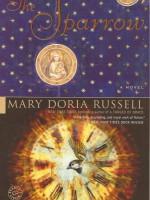
The Sparrow by Mary Doria Russell

Summary: A returning missionary has to work through the problem of evil in light of the death of his whole team and what he previously understood as God’s clear direction and guidance.

I have mentioned before that I subscribe to the online magazine Christ and Pop Culture. Their private Facebook group is the best thing about Facebook right now. Marion Hill (an author and book blogger) is one of the active participants in the group and frequently talks about books he is reading. So, several books that are on my radar are directly a result of his advocacy.

The Sparrow is not a new book—it will be 20 years old next month—but I had not heard of it prior to Marion’s suggestion. The Sparrow is the story of a group of people, mostly Jesuit priests, who travel to the first new alien world discovered to understand the population and eventually evangelize it.

The story starts at the end. We know that Emilio Sandoz (one of the Jesuits who specialized in linguistics) was the only survivor of the trip. He was found by a team from a follow-up United Nations mission and sent back to Earth. Once the initial introduction to the story occurs, then we start at the beginning of Sandoz’s journey out of poverty through the priesthood. We see how God appears to have gathered together a team of people put at the right place and time to providentially be prepared to take on a first-contact mission.

Theodicy, or how a good God can permit evil, is the book’s main focus. It takes until the very end of the book to really get the story of what happened to the mission, how everyone else died, and why Sandoz was found in the status that he was found in. Sandoz, at the start of the book, is a completely broken man, physically, mentally, and spiritually. The telling of the story is in part about the care of the man who has been brutalized (in ways that are not completely unique to other missionaries in history.)

Read more

Surprised by Oxford: A Memoir by Carolyn Weber (Read Again Review)

Surprised by Oxford: A MemoirTakeaway: The love story, whether between man and woman or God and human is one that brings joy to those that have experienced it.

I have said it before.  But one of the things I most love about blogging is that I have grown to ‘know’ so many authors. It is a distant knowing.  I have yet to meet any of them in person. But Matt Anderson, John Dyer, Rhett Smith, Tyler Braun, Karen Swallow Prior and Carolyn Weber (and others) I have interacted with beyond their books. It is not merely using one another for page views and book sales. With social media and some longer conversations, I feel like I can actually enter into their lives, at least in a small part.

Carolyn had a baby boy this past year and we exchange the occasional pleasantries. Carolyn has on several occasions thanked me for a blog post or review, and there are very few things that make my day more than an author I love (especially Carolyn) making appreciative comments on my writing.  The internet is such an odd world.

So on this second reading of Surprised by Oxford, I am not coming to the book fresh.  The first time I picked it up because of good reviews and a free review copy. The second time I had more invested  I had purchased a couple of copies for friends. Some had liked it and some had not. I now knew what was going to happen. These were people that I had some understanding about, both the characters from the memoir and the real people that inhabit the current world because these are people that I potentially could meet.

In my last reading, I was most struck by the beauty of the words. Carolyn Weber writes beautiful, evocative prose. That is no less true this time. But most of what struck me was the story. It was not new, but for some reason, I wanted to savor the poems that the characters were sharing. (And I am not a poetry guy, the fact that I found myself re-reading poems should speak very highly of this book.) I was more invested in Caro and TDH (Tall, Dark, and Handsome)’s occasional romance.

Read more

The Magician by Michael Scott

I am reposting this very early Bookwi.se review from 2009 because the Kindle Edition is on sale for $1.99

The Magician: The Secrets of the Immortal Nich...
Image via Wikipedia

It is hard not to compare this series of young adult fantasy books with Harry Potter.  Both Harry Potter and the Nicholas Flamel books concern magic, immortality, the epic struggle of good and evil and children that are powerful magicians, but grew up unaware of their power.

The first book, The Alchemyst (my review), barely started the series. Even at 400 pages, we only follow the two teens for two more in the first book.  The Magician is just under 500 pages and only gets us another 3 days.  But these books are not slow.  They follow two 15 year old twins that we discover in this book are, in fact, the twins of an old prophesy.

This is not a new theme for young adult books.  I think it is one of the older themes of young adult books, the discovery that you are someone that really is important.  There is a Steve Taylor song, “Hero”, that talks about a boys dream of becoming a hero.  As the boy ages in the song, the dream cracks, but does not die.  The hero is what most boys want to be (an probably most girls too.)

Read more

The God I Don’t Understand by Christopher Wright

The God I Don't Understand: Reflections on Tough Questions of Faith

Takeaway: It is fine (and biblical) to admit we do not understand God.

I have recently discovered the blog Black, White and Gray. Bradley Wright (links to reviews of his books below) and a couple of other Christian Sociologists talk about statistics and sociology of Christianity. When I started The God I Don’t Understand I had just read the third of a four part series about research into Deconversion. Each of the posts were interesting and I would really recommend reading them to get past a lot of myths about why people leave Christianity.

The third post was about Christians responding badly to doubt. Of the 50 deconverts that wrote testimonies of their deconversion that were analyzed, 42 mentioned frustrations with Christians they knew. The problem was not primarily misbehavior or hypocritical attitudes as I would have assumed, but frustration with how Christians respond to doubt.

Having finished The God I Don’t Understand, I would highly recommend it as a book that properly responds to doubt. Christopher Wright is an Anglican Priest and professor and the head of the foundation that John Stott started to encourage pastoral education in the developing world. This is the second book I have read by him recently and I will be reading more. Christopher Wright (no relation to NT Wright) is wonderfully pastoral in his approach, but even more important he is incredibly biblical. Christopher Wright specializes in teaching Old Testament theology and more naturally than any other scholar I have read, talks about the bible as a single grand narrative of which the Old Testament cannot be removed.

Read more

The Lion’s World: A Journey into the Heart of Narnia by Rowan Williams

The Lion's World: A Journey into the Heart of Narnia cover imageSummary: A theologian and scholar walks us through CS Lewis’ Narnia.

The Narnia books, and maybe Screwtape Letters or Mere Christianity, are all that many know of CS Lewis. I am far from a Lewis scholar, but I have read over 20 books by or about Lewis over the last three or so years. I continue to gain insight into Lewis as I read different perspectives.

Rowan Williams, in his 2011 Holy Week lectures, talked about Lewis and Narnia and how both can speak to our Christian lives. This book is the result of those lectures (similar to his later book, Being Christian, that I read earlier this year and his book on Paul.)

I did not realize until I was done that this was based on a series of lectures. This did not feel like a series of lectures but like a planned book.

What I most appreciated about this book was its generous nature. Williams illustrated well what it means to read to give the author the benefit of the doubt. Especially in the chapter about Narnia’s critics, but also throughout the book, Williams wants to make sure we are not unfair to Lewis and his time or what Lewis was attempting.

Read more

Sacred Texts of the World (The Great Courses) by Grant Hardy

Sacred Texts of the World (The Great Courses) by Grant Hardy book reviewSummary: An overview of many of the sacred texts of world religions.

After my last positive experience with a Great Courses audiobook, I picked up several more when they were on sale last month.  The first of those that I have listened to is Sacred Texts of the World by Grant Hardy.

As Professor Hardy notes in the opening, this is an introduction. As someone that know a good bit about Christian scriptures, I had some quibbles with his presentation of Christian scriptures. But if I can assume that the rest of the presentations were of roughly similar quality, then I think this was probably fairly accurate.

Part of being educated about the world is being educated about the world’s religions. This is not primarily about evangelism, although I think it is a good idea to know about for evangelism reasons. Primarily this is about understanding additional context to international news.

My overwhelming feeling is how much the ‘Protestant Bias’ has effected the way we think about other world religious scriptures. As Hardy presents it, Protestant Bias comes into play because so many of the early scholars of world religions were Protestants that assumed that other world religious scriptures acted like the Christian bible (and they often do not.)

Read more

Introduction to Christian Liturgy by Frank Senn

Summary: Helpful, but dry, look at history and variety of practice within the Christian Church’s liturgy. Frank Senn’s Introduction to Christian Liturgy was recommended to me as a good method to understand the historical elements of Christian practice across a variety of traditions. And although a bit dry, it is very helpful. Senn takes different aspects … Read more

Pines (Wayward Pines #1) by Blake Crouch

Pines (Wayward Pines #1) by Blake Crouch book ReviewSummary: A secret service agent wakes up in the woods outside of small town where nothing seems quite right.

The Wayward Pines trilogy hit the world a few years ago and many people I know recommended it. Last year Fox turned it into a TV show. And because I signed up for Kindle Unlimited a couple weeks ago, I decided to pick it up since the audiobook is part of the subscription. I thought I had picked up enough hints from reviews and discussion that I knew what was coming. But I was just enough wrong about the story to be surprised while thinking the big reveal was just ahead.

As I said in my review of Countdown City, reading these two books back to back has left a bit of strange taste in my mouth. For Wayward Pines, it is more about the violence than anything else. The creepiness and fear of madness that runs throughout the book totally makes sense. The flashbacks to torture in the Iraq war and in the current timeline just felt over the top. It is not that they do not fit in the story as written. It is more that I did not want to read (or listen in this case) to them. (There is enough horror in the world right now for me to want to intentionally ingest more.)

Read more

Countdown City by Ben Winters (Last Policeman #2)

Countdown City by Ben Winters (Last Policeman #2) book reviewSummary: The end of the world is coming soon, but there are still cases to solve and people to help.

Maybe it is just too easy to envision the end of the world, but I am having a hard time reading the apocalyptic and dystopian fiction lately. It has been a steady part of my book diet for years. But reading Countdown City and Wayward Pines back to back, during political convention season, was probably a bad idea.

Countdown City is true apocalyptic fiction. Hank Palace is a former police detective. At the end of the The Last Policeman he gave up his job and now he is ‘working’ as a private detective. The problem is that the world is going to be ending in a few months and society is falling apart. (A giant asteroid is coming.)

What is interesting about the trilogy is Detective Palace’s desire to solve the crime in the face of impending doom. What is maddening about this book (and clearly it is intentional) is Palace’s focus on the crime as a tactic to avoid reality. Palace is not getting paid. He is doing the impossible to find a missing man when the whole world has gone missing and at a time when society and infrastructure is crumbling. The minor issues of pay and preparation for the end of the world all end up in the back seat. The constant question from others, ‘why are you doing this?’ annoys both Detective Palace and the reader.

Read more

The Grace Outpouring: Blessing Others Through Prayer by Roy Godwin with Dave Roberts

Summary: A wandering, but very encouraging story of how obedience can be used by God.

I know that some dismiss books that are written “˜with”¦’.  These are books where a person has a story to tell but does not have the time (and usually skill) to tell it well in book form.  Whenever I have hear automatic dismissal I think of the work that John and Elizabeth Sherrill did in bring the stories of Brother Andrew, Corrie Ten Boom, David Wilkerson and many others where their names did not clearly appear in the “˜with”¦’ section.

I do want to say clearly, that while I am supportive of people like the Sherrills and Dave Roberts in this book, I think these cowriters need to always be acknowledged and Christian publishers in particular need to stop the practice of hidden ghost writers.

In the Grace Outpouring, Roy Godwin tells the story of how God has used him and the Ffald-y-Brenin retreat center in Wales to bless others and bring God’s power to the people that visit the retreat center, the community around the retreat center, and even people that have never been there.

Testimony stories like this are an important part of Christian literature.  Sometimes I can forget how important a part they are.  These types of books are usually not great literary works, but instead are simple narratives of Gods work in normal people’s lives.

Read more