 Takeaway: We need to think theologically about the importance of elders and sharing wisdom.
A few days ago on Facebook, someone that I know was lamenting the lack of wise elders in their life. I was reminded (in part because I was reading Rohr) that because one has acquired age, does not mean that one has acquired wisdom. The two sometimes go together, but not always. And in some ways I think age and wisdom are probably less associated now than previously (unwise people I think had a decent chance of dying because of their lack of wisdom in previous ages.) We are in an odd cultural place. We need wisdom, we are living longer than ever and culturally we embrace youth culture more than ever.
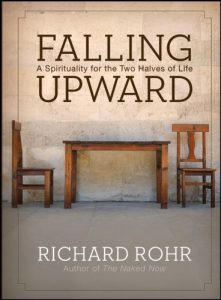
Richard Rohr is a Franciscan priest and popular speaker and writer. I have read several things by him and generally found him helpful and wise. I originally read Falling Upward when it first came out just over five years ago. I think that was my first exposure to Rohr. When I first read it, I found the book a bit difficult and was not as clear about some of his language. I did not re-read my review until I finished the book for the second time. My original review was one of the earliest reviews on Bookwi.se and it feels very dated to me. It is a sign of the progress of time that many of the things I found difficult on the first reading I did not find difficult on the second. I have read a lot more Catholic writers in the past five years and am much more comfortable with the subtle differences in meaning in some of the language of Catholics and Protestants. And where there are more commonalities than I understood five years ago.
Rohr understands how to sound profound. That is not to say that many of the things that he writes about are not profound. His writing drips with significant insights. But Rohr is also obscure and opaque at time and I think that is sometimes seen as wisdom as well. Rohr is a mystic. And part of being a mystic is believing that the world is not completely understandable or describable. I agree with that, but I am also less satisfied with the esoteric descriptions of the world that Rohr gives in this reading. I think some of the book could have been tightened up and made less esoteric and more clear. And it would have been a better and more helpful book. But maybe viewed as a bit less wise.
The main organizing metaphor is the first and second halves of life. This is modeled in the difference between the Odyssey and the Iliad. The two voyages are examples which Rohr refers back to frequently of how in the first half of life we are interested in identity and personhood. Finding not only who we are, but also establishing ourselves, building families, creating careers, finding relationships (romantic and other). All of these are good and important. But in the second half of life we tend to be less dualistic, more about building up others and passing on wisdom. The first half of life is about understanding the rules and institutions of life and their importance. The second half of life is about understanding the role of grace in breaking rules and circumventing institutions for people.