All is Grace by Brennan Manning

I am reposting this 2011 review because the Kindle Edition is free through Oct 20, 2015. All Is Grace

Takeaway: In the end, all really is Grace.

Spiritual biography and autobiography has a tendency to push the lesson before the story.  That is not all bad.  Since Augustine’s Confessions, Christians have learned much from those that have gone before us.  There are problems when the biography/autobiography verge into hagiography, showing only the good and never the bad.  There is equally problems with the tell-all conversion stories that seem to revel too much in the pre-conversion life and too little in the post conversion reality.  All is Grace does a good job of balancing the real, the history and the lesson.

Manning has had a hard life. This will be his last book.  His ill health has meant that he has not been capable of speaking and writing over the past couple years and this book was only completed with the help of John Blase.  This is the third such last book I have read this year.  John Stott’s Radical Disciple, Eugene Peterson’s The Pastor: A Memoir (probably not his last book, but still in a similar vein of concluding his public ministry) and now Brennan Manning’s All is Grace.  All three are very different, but are quite reflective of the lives that each have lived and the types of ministry they were called to serve.  Stott’s book was more theological and pastoral, prodding us to continue on.  Peterson’s book was reflective, asking us to look and see if we are adopting too much of the attitudes of the world instead of acting like the servant.  Manning’s is another call to understand grace by looking at his own life that was marked by both great grace, and great need of grace.

I have read several books by Manning, but this memoir provides some historical structure that does much to give context to his other books.  Brennan was born to a difficult family, marked by a lack of love and caring and a prevalence of alcohol.  Manning was drinking heavily by age 16.  But he also was a talented writer and started college young.  He dropped out of college, joined the Marines right before the end of the Korean War.  He became a war correspondent, went back to school to become a journalist, dropped out of college again, became a Franciscan, left the Franciscans to become a Little Brother, came back to the Franciscans and served as a college chaplain, participated in a experimental community like the Little Brothers in the US, again became a college chaplain.  Each time it was about 2 years before he moved on to the next thing.  By the last he was a clear alcoholic and was forced to seek treatment.  After some treatment and some success with the treatment he started a new career as a Evangelist speaking about grace and forgiveness as a recovering alcoholic priest.  But the alcohol never really was far away.  Some alcoholics are able to live full lives, clean for the rest of their lives.  Manning was not.

Read more

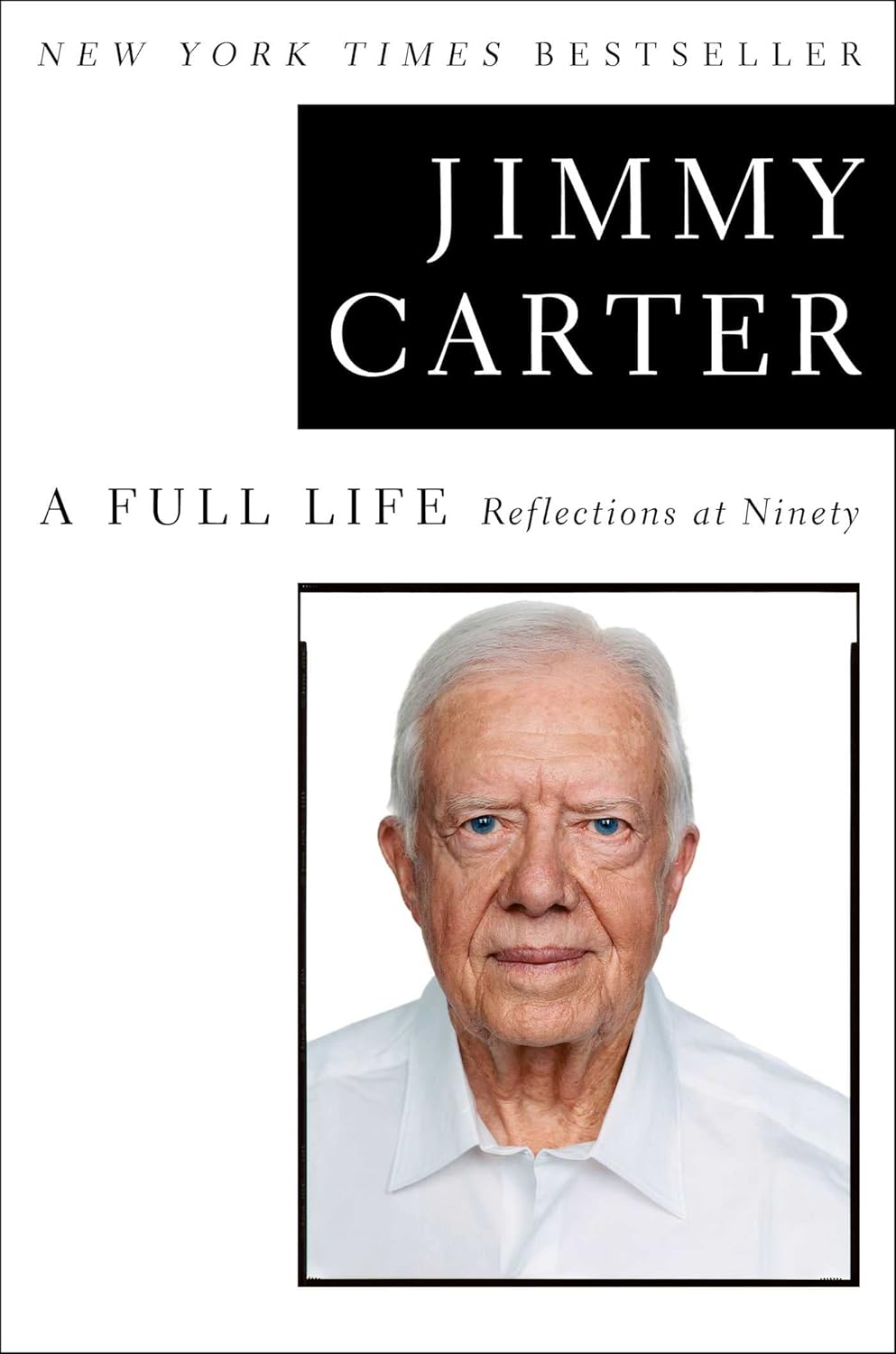
A Full Life: Reflections at Ninety by Jimmy Carter

Takeaway: Regardless of your politics, Carter is a fascinating man.

Carter is a fascinating man. I have read a couple of his books, but this the first of his that is more more memoir than policy.

I listened to this as an audiobook and he narrates it himself. This feels like a bit of a wrap up, especially since his recent cancer diagnosis. There is not a sense of finality about it, but rather a wrapping up.

Carter gives a brief review of his life. If you did not know anything about him, this is a good place to start. He spends time talking about his presidency, but not too much. A Full Life is about his life in general including politics, but not exclusively politics.

If anything it is the political portions that are less interesting. Carter, like many experts, thinks he is right. So the last chapter where he is talking about his post presidency and how he has interacted in the world has more than several places where he directly says that he thinks the world would be better off if the presidents after him had followed his policy or had listened to his advice or had let him help more. In some cases he might be right, in some cases I think he was likely wrong. But those sections are few.

Part of what is always interesting to me about listening to first person narrative from people toward the end of their lives is what they talk about. Carter certainly talks about his legacy and the things he tried to do. But he also is proud of his kids, he adores his wife. He is proud of some of his positions on race and integration. He also spends times talking about how much he loves woodworking and furniture making (I had no idea). And how much his mother was involved in his politics and the legacy his father left.

Read more

The Pastor’s Kid: Finding Your Own Faith and Identity by Barnabas Piper

I am reposting this 2014 review because the kindle edition $1.99

Summary: A pastor’s kid talks to pastors and other pastor’s kids about being a pastor’s kid.

I am a pastor’s kid. In fact, pastoring is a bit of a family business. My brother, father, and 3 uncles and an aunt are pastors, another uncle is not officially ordained but was the main interim pastor for a small church for several years. Also a grandfather, a great-grandfather, a great-great grandfather were pastors and a great-great-great grandmother was a traveling evangelist in the civil war era (if I have my history right.)

And I know a lot of pastor’s kids. When you go to Wheaton College, there are a lot of pastor’s kids (and Missionary Kids which has its own special set of issues.) I know pastor’s kids that have done well, and those that have not. So I picked up The Pastor’s Kids (a review copy) with interest.

This is a pretty short book (about 140 pages of content or 3 hours of audio). John Piper introduces it and acknowledges that at time the book was hard for him to read because it is being written by his son about the problems of being a pastor’s kid. But John Piper wants to assure the reader that anything critical is about wanting what’s best for the church as a whole and pastor’s families in particular.

The end really hits that tone by concluding with all of the good that can come of being a pastor’s kid.  Personally, that is where I and most other pastor’s kids I know end up.  All in all, we are glad we were pastor’s kids.

Read more

The Liturgical Year by Joan Chittister (The Ancient Practices Series)

I am reposting this 2009 review because the Kindle Editionn is on sale for $1.99
I grew up as a low church baptist.  We didn’t pay attention to the liturgical year, we didn’t use the Lectionary.  I have absorbed some things about the church year through my time at Wheaton College and seminary.  Some friends have paid more attention to the liturgical year and my wife and I have paid attention to Lent on and off since we went to Israel for Easter in 2001.  But this book was a good formal introduction to not only what the liturgical year is, but why it is.  The author describes it this way:

“The church year is not the marking of one lucelent, passing moment in the midst of eleven long months of dark nothingness all the rest of the year. It is month after month, every year of our lives, being taken back to the empty cross and the empty tomb, one way or another, in order to shape our own life in the light of them.” (From the 1st chapter.)

The author is a catholic nun, and writes using the Roman Catholic system as her primary focus.  She also talks about some of the differences between Eastern and Western calendars and where the differences arose.  It is not technical, fairly conversational and quite understandable to an outsider.  It was a quick read, I read it is in two evenings.

Read more

The Last Policeman by Ben H Winters

Summary: There is only 6 months before the world ends, but Detective Palace still has crimes to solve.

Mostly I picked up this book because I liked the concept. A large asteroid is coming toward earth and because of its odd orbit it was not detected until just about a year before it is scheduled to hit the earth. At the time of the book, it is six months until it hits. It has been confirmed that it is a certainty that the asteroid will hit and it will likely wipe out most of the population of the earth.

The world economy is in shambles (reminiscent of Station Eleven), but there is a longer preparation time. What would you do if you had six months to life, and so did everyone else?

Hank Palace is a young detective. Only 25, but he is sure that his recent suicide case (his ninth in 3 months) is not actually a suicide. But he not only has to fight for the freedom to solve it, he has to try to solve it in the context of a system that is breaking down.

Read more

The Children Act by Ian McEwan

Summary: A family law judge wrestles with the ethical issues of her job and the personal issues of her life.

I once primarily read science fiction because it was in science fiction that I thought that ideas were best explored. I have since grown and experimented more in my reading choices. And recently I have come to think that “˜literary fiction’ should be defined more by its ability to interact with bigger ideas than any other measure.

The Children Act (and the Susan Howatch books I have been reading much of this year) are prime examples of what I mean by this description of literary fiction.

Fiona Maye is a UK High Court judge. She has very difficult cases in areas that in the US we would call family law. Divorce, child abuse, medical treatment of children, etc. While she is at the top of her career, a career that she has sacrificed her own chances of motherhood for, her husband has decided that his life needs a change. And so he is asking her permission to have an affair, although it is clear he has decided to have one regardless of her permission.

Read more

The High Flyer by Susan Howatch

Summary: A high flying lawyer, with no time for the spiritual life, is forced to confront the spiritual world.

Carter Graham is a no nonsense lawyer that has a life plan and is sticking to it. That life plan includes getting married at around 35 and having children sometime before 40. When Carter meets Kim Betz, she thinks she has found a perfect partner to continue her life plan.

As with most of Susan Howatch’s books the story is important, but the story is also a means to work through spiritual and philosophical issues. In this case, the atheist Carter Graham, confronts the reality of the spiritual world through unexpected spiritual manifestations (ghosts, spiritual healers, curses, etc.) and then has to work through her issues around theodicy, the problem of evil, the role of God in evil, why God didn’t create a perfect world, her role in sin and how her sin affects others and other’s sin affects her, etc..

More than most of Susan Howatch’s books I have read this is a book of explication. Carter spends a lot of time talking through issues with counselors, doctors, psychologists, spiritual directors, friends, etc. This allows for a lot of different perspectives, but also a book that is as much theology as story.

Read more

Holy is the Day: Living in the Gift of the Present

Holy Is the Day: Living in the Gift of the Present
Summary: Another beautifully written book about finding God in the present.

I love blogging. But every once in a while, I get tired of the pressure to keep churning out content. It is work to try to figure out something to say about every book that you read.

However, much more often, books are a joy to read. It is one of my great pleasures to be able to recommend particular books to friends and family and then have them come back later and say they loved the book.

One of the books that I recommended to many over the past two years is Carolyn Weber’s Surprised by Oxford. It is Weber’s account of her first year of studying at Oxford and her unexpected conversion to Christianity during the same year. It is a beautifully written book.

So I have been expectantly waiting for her new book Holy is the Day. I was lucky enough to get an advanced copy the day before I left for vacation last week.

This was an airplane book (the only place I regularly read paper books.) Much shorter and more episodic than her previous book, Holy is the Day recounts stories of where Weber finds God in daily life.

I, as an expectant father, was particularly drawn in because the book opens and closes with birth stories. Birth and death are natural places where we see God because they are such transcendent experiences. But in between birth and death, God sometimes gets a little lost (or at least we lose sight of God in the midst of our busyness).

Most of the stories are in some way about family, community, and the church. We have a tendency to live as if we are alone. But it is in community, our families, the church, neighbors, and friends, that we often most clearly see and hear God. (This is very similar to the focus in Eugene Peterson’s Practice Resurrection).

Read more

Waterfi Waterproof Kindle Paperwhite Review

If you asked me what my favorite thing to do, on the list would be floating in the ocean, reading. Several years ago I found a floating waterproof case for my Kindle 2. And up until recently I had still been using it. It finally broke and on impulse I picked up a refurbished Waterfi Waterproof Kindle Paperwhite two weeks ago right before I went to the beach for a week’s vacation.

The first thing you notice about Waterfi’s waterproofed Paperwhite is that it is basically indistinguishable from a regular Paperwhite. The waterproofing is not visible and doesn’t add any weight (at least not enough to be noticeable).

Waterfi is an aftermarket system. So you purchasing one from Waterfi voids the Amazon warranty. A refurbished Waterfi has a six month warranty. The refurbished Paperwhites are a mix of 1st and 2nd generation Paperwhites, but you can ask them for one or the other.

There are two main negatives about the Waterfi system that was not true of my old floating Kindle case. First, it does not float. So if I dropped it in the ocean, I would have go grab it. I have thought about how to create some type of float for it, but I haven’t worked that out yet. (I think some type of foam case should work.) I was just careful when I was swimming with it.

The second negative is that because the Paperwhite is a touch screen device that moves by electrical conduction, hard spray from salt water can turn the page or turn on the screen commands. It was not a huge problem, but I did need to try to keep it out of the spray to actually pay attention to the book. (And it really makes me wish that either Amazon had real page turn buttons or that Waterfi had waterproofed a Kindle Voyage).

But those two negatives aside I am really happy with the purchase. It is waterproof, the screen was not at all fuzzy as the one waterproof case for the Paperwhite that I have tried was and while I would not normally spend the extra $20 to get rid of ads, it is nice to not have ads.

Read more

Vanishing Grace: Whatever Happended to the Good News by Philip Yancey

Summary: The central message of the gospel is grace. If the world around us understands the central message of the church to be judgement, then we have messed up the message that Christ came to give.

There are four parts to this book and even in the introduction Yancey says that this is essentially four different books. I just wish he had tried to do less.

The first part is all about the vanishing of grace from the message of the church. This part is five stars and I would like virtually all Christians to read it. He calls on Christians to not only recover grace as the central message of Christ and the church, but also to remember that the method of the message has to be in love. I really don’t think that basic message can be emphasized too much in Christianity because the natural temptation of Christians is to change the message of the gospel to one that is about earning our salvation through moralism or tradition. After all, a gospel of moralism or tradition is easy for Christians who tend to be already familiar with tradition and fairly good at presenting a moral facade to the world around them. But that changing of the gospel away from grace fundamentally changes the message of the gospel.

Read more