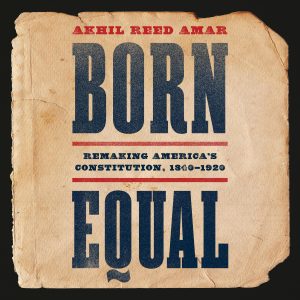
 Summary: An exploration of how the United States slowly became a country where additional people were increasingly more likely to be “born equal.”
Born Free is the third of Akhil Reed Amar’s books which I have read. (The Bill of Rights Primer: A Citizen’s Guidebook by Akhil Reed Amar and Les Adams and America’s Constitution: A Biography). Both of those books are long and as he said on Advisory Opinions when he was asked about the length of Born Equal, he said, well it was shorter than some of my previous books.
Born Equal is worth reading even if it is quite long. It is the second of a trilogy about the Constitution. I have not read the first, The Words That Made Us: America’s Constitutional Conversation, 1760-1840, but I will get to it before the third comes out. I think it should be compared to Mark Noll’s trilogy about the use of the bible in American public life. Noll’s has published two of the three, In the Beginning Was the Word: The Bible in American Public Life, 1492-1783 and America’s Book: The Rise and Decline of a Bible Civilization, 1794-1911. Noll’s book about the roughly same period was about 150 pages longer than Amar’s already long 753 page tome.
Part of why I compare them is that both are trying to contextualize their subject to a modern reader. Noll is trying to show how central the bible was rhetorically to public life. But Noll is also pointing out how much the view and use of the bible was shaped by people molding the bible to fit their point, not allowing scripture to shape them. I do not know if Amar is religious, but he is known for being a progressive originalist. While most legal originalists are ideologically conservative, Amar regularly points out that originalism is not about political conservatism but about paying attention to the words.
The theme that runs through Born Equal was that Abraham Lincoln was the foremost originalist legal theorist of his age and that after the founding generation passed away, and their children passed away, there needed to be a recovery of a legal theory of how to view the American governmental system. Amar contends that Lincoln had an originalist theory that took seriously the words of the constitution as the basis of the meaning and limitations and role of the government.
The second main theme of the book is that the Declaration of Independence should be understood as providing context of the ideals of the constitution, even if the actual early leaders of the United States did not live up to the ideals that were put into the Declaration of Independence. The Dred Scott decision said that the US government was under no obligation to view Black residents of the US, whether slave or free, as citizens. And that view, that many of the people in the US, all women, Black people (many who had been brought to what became the United States against their will but by the mid 1800 many were 4th or 5th generation residents of the United States, and Native Americans all were not allowed many privileges of citizenship. Born Free traces constitutional history from the rumblings of succession and the Dred Scott decision until the passage of the 17th (direct election of senators), the 19th (women’s suffrage) and the 20th (alterations to President’s term of office and other changes) amendments. All three of these amendments (and the 18th) were expressions of an expanding democracy. (Native American’s were officially recognized as citizens between the 19th and 20th amendments.)
I was skeptical of the claim of Lincoln’s being one of the early originalists in the early pages of the book. But I was pretty convinced by the end. In many ways, while I am not convinced by many of the conservative originalist arguments which often would fail to overturn Plessy or that give us current “history and tradition originalism”, Amar’s focusing of originalism on the ideals of America as found in the Declaration of Independence and then fleshed out in the constitution made sense of a type of originalism. It has become almost cliche to talk about the reconstruction amendments as the second founding of America, but Amar is tracing the thread of the reconstruction amendments through the 20th as being ever expanding democracy that was living out the ideals of the Declaration.
I know I didn’t have a great education in history. We studied the revolution and the civil war and then skipped to the gilded age and the depression and didn’t really get much past that. I was taught that reconstruction was a failed experiment as was common. But Amar and Foner and many others of the past forty years have been refocusing on reconstruction as the tipping point toward real democracy. Amar’s originalism doesn’t do what my history education did, abstracting the founding from its real context and ignoring the reality of a fundamental reshaping of the conception of the US with the reconstruction amendments (even if they were not fully realized and there was a significant backlash that gave rise to a 100 years of Jim Crow).
I also think that I am interested in this type of legal history because of my background in biblical hermeneutics. Bringing Noll back into this, part of what Noll gets into more than Amar does (but is an undercurrent of what was going on during this era) was the rise of a split between fundamentalism and a type of ecumenical pluralism. The fundamentalists wanted a cultural uniformity and a flattening of the understanding of scripture. I have heard from many fundamentalist leaning teachers that the bible can only have one meaning of every passage. While the pluralists can have a problem with ever expanding meanings so that anything can be made from anything. I think that Amar is trying to make the argument that originalism can give us some boundaries that doesn’t flatten or remove context from judicial interpretation. And that the same time it doesn’t promote an ever expanding meaning that allows the interpretation to support near limitless expansion of the role of government or rights. There will be conflict. And part of the way forward is not to use the courts to keep changing the meaning of the laws or constitution, but to actually make changes to the law and constitution when it doesn’t accomplish the ideals that were set out in the Declaration of Independence.
Born Equal: Remaking America’s Constitution, 1840–1920 by Akhil Reed Amar Purchase Links: Hardcover, Kindle Edition, Audible.com Audiobook
1 thought on “Born Equal: Remaking America’s Constitution, 1840–1920 by Akhil Reed Amar”