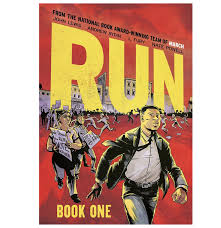
Save It for Later: Promises, Parenthood, and the Urgency of Protest by Nate Powell

Summary: A memoir of parenting and activism over the past five years.

Nate Powell is best known as the March Trilogy artist, a collaboration with John Lewis to tell the story of his early years as a Civil Rights Activist through the end of his days at SNCC. A new series telling John Lewis’ story after his days at SNCC will start coming out in August.

This interview at Paste in 2015 says that after his kids were born, he has a hard time doing more than 250 pages of art a year. Graphically, he tends toward black and white with occasional splashes of color for effect. In many ways, he has become one of the best-known artists in the country””the first to win a National Book Award and the winner of many other awards. There are a ton of good articles on Powell. He has also talked many times about the near impossibility of making a living as an artist. Even one that is as well known as he.

Save it for Later is a memoir. I preordered as soon as I heard about it, and like many books that I buy because of the author, I intentionally did not read much about it before I read it. I was unprepared for how much of the book was about navigating parenting as an activist. And it was that part that really spoke to me as a reader.

You cannot read my book reviews regularly and not know that I am somewhat of an activist myself. As I discussed yesterday, part of what motivates me is that I cannot parent as I want to if I do not deal with my own issues first. I am an activist in part because I want my kids to be activists. I want my kids to work for change in the world and see their responsibility to work for change for the sake of others. I took my kids, 3 and 4 at the time, to the 50th Anniversary march remembering MLK’s funeral. They came with us to several marches and prayer services in response to Floyd, Aubry, and Taylor’s deaths last year. I discussed with my daughter the death of Daunte Wright and the protests going on this morning.

Powell is five years younger than I am, but his kids are slightly older. He is a stay-at-home father as well. In this memoir, he draws his kids with animal heads in a brilliant move of protective reality. He communicates the difficulty of informing his kids of the world’s problems because he thinks it is important, and struggling with how much to tell them at what age. There is a point where he recounts a conversation between himself and his daughter about the police. He wants her to know that policing is corrupted and racially discriminatory, but he does not want her to fear the police.

Read more

The Great Sex Rescue: The Lies You’ve Been Taught and How to Recover What God Intended

The Great Sex Rescue: The Lies You've Been Taught and How to Recover What God Intended Book CoverSummary: There are many bad books written about marriage and sex in the Christian book market. 

If you had asked me to recommend a good book about sex and marriage from a Christian perspective, I am unsure what I would have said before this. Gary Thomas’ Sacred Marriage is decent, but there are weaknesses because it is a book about discipleship more than anything else. Beyond that, I know there there are lots of bad books about marriage and sex. Some that have good parts but are concerning on the whole. And a whole raft of books that may be okay in some situations but often are stereotypical, oriented toward gender essentialism, do not take into account abuse or other more complex situations, or are just frankly dated. It is not that there are not nuggets of truth in many of those books; for many who are reading books about marriage and sex, they are too naive about sex and marriage to know how to sort through what is good and what is not.

There are three general times when I have read many books about sex and marriage, right before and after getting married, when marriage is tough for one reason or another, or when my wife and I have led small groups for newly married couples. I don’t want books that have some good and some problems for the first two situations because, frankly, I probably would get the two reversed. And as I read books when we were leading small groups for newly married couples, I had difficulty finding things I could really recommend. (And the newly hired small group pastor that came in toward the end of our second year leading those small groups didn’t think that we should be talking about sex at all, so we stopped leading those groups.)

Coming into The Great Sex Rescue, I knew there were problems with several Christian books on sex and marriage. There were some that I immediately threw away once finishing them, like Everyman’s Battle (it is trash and should never be recommended). And some that I read through and knew were problematic and wouldn’t recommend. But as a man, I definitely was reading them from a male perspective. One of the most important reasons we need to be reading books from various author perspectives is that I can’t see what I can’t see without a guide. One of the book(s) discussed frequently is For Men Only and For Women Only. When for Women Only came out, I read it and notated where I thought it was right and wrong about me as an individual. I particularly knew that books based on surveys and that include stereotypes can be helpful for discussion. Still, without an understanding of the particular person that you are married to, they are limited.

The Great Sex Rescue is designed to take the messages of many previous Christian sex books and put them in the context of current polling and research, facilitated with the range of individual stories from follow-up interviews and turn around what is often one-sided advice and make it more helpful. The reframing of ideas at the end of each chapter is probably the most helpful aspect of the Great Sex Rescue. It is not a book that is just pointing out what is wrong; it is also committed to figuring out how to present a positive message.

For instance, there are few things that Christian books on marriage and sex are more sure of than men being more interested in sex than women are. Almost all books assume men wanting sex more often than their wives as the default reality of Christian marriage. But current polling suggests that roughly a quarter of women have higher libidos than their male spouses. And nearly another quarter of women say that they and their spouses have approximately equal libidos. This means that the default assumption (which may be true slightly more often than not) is false nearly half of the time. An assumption that is wrong nearly half of the time, presented as nearly always true, is then not mostly right, but an assumption that should not be presented in the first place.

Read more

Holy Disunity: How What Separates Us Can Save Us by Layton Williams

Summary: Unity is important for Christians, but there are times when unity can mask issues of justice and legitimate disagreement.

I probably would not have picked this up if it has not been included in Audible Plus Catalog (which means it is free to listen to for audible members.) Generally, I am strongly in favor of ecumenical work and of the church as a whole recognizing itself. I am part of a group called The Initiative, designed to facilitate understanding and cooperation between Protestants, Catholics, and Orthodox Christians.

I am a part of several groups trying to build a similar understanding and cooperation among Christians of different racial groups. But you cannot seriously participate in groups like this without thinking about lines you will not cross. One of the significant and accurate charges in White Evangelical Racism by Anthea Butler is that White Evangelicals often claim to be against racism but rarely are willing to make racism a line which they will break fellowship over. One example in that book is MLK Jr directly asking Billy Graham not to appear on the platform with a noted segregationist in 1957, a request that Graham refused.

Not all unity is a positive unity. Unity can be achieved through various means, and sometimes the means to unity actually subverts the cause of Christianity. If visible unity requires suppression of people or their personhood, then that unity is a false unity. But even that is not nearly nuanced enough. There are times when it seems appropriate for a person to choose to voluntarily not exert their own rights for the sake of unity. It becomes more difficult when a larger group, especially a group of historically marginalized people, is required to not exert their rights as a Christian for the sake of unity.

Read more

After Whiteness: An Education in Belonging by Willie James Jennings

after whiteness cover imageSummary: An exploration of theological education as spiritual formation emphasizing its need to create belonging and explore how it has historically promoted white male normativity and individualism.

I have read several articles and a couple of Dr. Willie James Jennings’ books, but I was not sure this book was for me. On its face, it is a book about theological education. I am not in theological education and do not anticipate ever being a professor or teacher. I finally picked it up after someone on Twitter talked about it as a discussion of spiritual formation, whether in or outside the academy. I am interested in spiritual formation. I commend listening to Dr. Jennings’ interview with Tyler Burns on Pass the Mic podcast or Wabash Center’s Dialogue on Teaching Podcast, which has very different interviews but is helpful to get at what the book is doing.

Jennings posits that Western education, in general, but theological education in particular, has a model that emphasizes three virtues: possession, control, and mastery. These three virtues are generally assumed to be ‘masculine’ virtues, and as Jennings discussed in his previous book, Christian Imagination, these virtues are also identified with the colonization project. Because we are an individualized culture, these values are about asserting the individual as the one who is master and self-sufficient. To counter this image of the self-sufficient master of educational knowledge, Jennings takes the image of Jesus, who gathers together many who would not choose to be together if it were not for the desire of all of them to be near Jesus. Jennings’ corrected imagination rooted in Jesus’ ability to gather people together suggests that the point of theological education in particular, but Western education in general, should be rooted in belonging, not exclusion, hence his subtitle, An Education in Belonging.

Part of what Jennings addresses here is that the soul is not formed primarily through information. We are not, as James KA Smith suggests, ‘Brains on a stick.’ Theological education, while it does include information, must have spiritual formation as a primary focus. And that spiritual formation, because it is a significant aspect of theological educators’ work, must be concerned not only with the theological education of its students but also with the faculty and staff and the institutional aspects of its community.

Read more

What’s Your Decision?: How to Make Choices with Confidence and Clarity: An Ignatian Approach to Decision Making

Summary: An exploration of decision-making using Ignatius’ Rules of Discernment as a guide.

Part of what I have wanted to explore this year is Ignatius’ Rules of Discernment. I have asked around to get book recommendations, and What’s your Decision is one that was recommended.

The Rules of Discernment are not only about decision making, but that is how they tend to be used from what I have seen. So What is Your Decision is a good practical guide on the use of the rules of discernment. It is filled with stories and examples, which makes the somewhat vague and abstract rules tangible.

I like that it keeps the decision-making focused on spiritual reality while not over-spiritualizing everything. In an era where we tend to think of decision-making as an individual activity, Ignatius and the authors of this book remind us that we live in community, and not only are decisions made better by outside input, those decisions impact those around us, and we should both hear from those around us and take into account the impact of our decisions on others.

These are three brief quotes that I highlighted that I think give a sense of the discussion. (I have 14 highlights on my Goodreads page if you want to see more.)

“The evil spirit wants us to forget that we are fallible, limited beings; sharing our decisions with another person will keep us grounded in reality.” (p 96)

Read more

I Will Not Fear: My Story of a Lifetime of Building Faith Under Fire by Melba Pattillo Beals

Summary: The faith-filled memoir of a woman who rose to fame as one of the Little Rock 9, but who continued throughout her life to work through the ways race has continued to play a role through systems and culture whether or not it was legally mandated. 

I have been a bit in a reading slump. There are many ‘important books’ that I want to read, but I don’t have a lot of motivation to actually read them. I don’t want to blame the global pandemic overly, but over the past three months, my kids have been at home more than they have been at school, both because of school vacations, school closures, and quarantining because of covid exposure. My traditional method of resolving reading slumps is to change genres. Fiction or story-based history or biography often is the cure I need to re-invigorate my desire to read again.

I Will Not Fear is a book I picked up years ago when it was on sale but never read. Last fall, I noticed that it was part of Audible Plus (their program of including back catalog books for free as part of membership). But it wasn’t until January that I actually picked the book as a follow-up to the John Lewis biography. Melba Beals is not a household name. But many of us have a rough understanding of the Little Rock Nine, the nine high schoolers that integrated Little Rock Central High School. Initially, the state national guard was deployed by the Governor to block the Black students from the school entrance on the first day. A mob gathered to protest the integration harassed the students. The description of the threatened rape and lynching of the students and Melba and her mother being literally chased through the streets is harrowing.

Read more

His Truth Is Marching On: John Lewis and the Power of Hope by Jon Meacham

Summary: A exploration of John Lewis’ life, focusing primarily on his time in SNCC and before. 

I know Jon Meacham is a well-known biographer, but as someone that really likes biography, I have not read any of Meacham’s other books. This made me a bit reluctant to pick up this book on John Lewis. Because I was interested in John Lewis, and because the only books I have read are the excellent March graphic novel biographies and because my library had this on audiobook, I picked it up anyway. Because His Truth is Marching On is primarily about John Lewis’ early years, I still want to find a more full-length biography and read some of Lewis’ own books.

The biography feature that I most appreciate is the focus on Lewis’ Christian faith as a factor in his civil rights work. Obviously, it is not the only factor, but I think it is an under-appreciated factor in many civil rights leaders. It is also striking to realize how young John Lewis and Stokley Carmichael, and many other civil rights leaders were. John Lewis was 26 when he was voted out as the chair of SNCC. He obviously had a long career after that point, but he was so young to have accomplished as much as he did by that time.

Read more

The Carpenter’s Son by Arnie Gentile

Summary: A fictionalized story of Jesus and his family and then escape to Egypt and Jesus’ early life.

I am not sure I really appreciate the difficulty of Christian fiction. Or maybe I do and that is part of why I tend to read so little of it. Fiction regardless of genre or background needs to tell a compelling story. It has to provide the reader with something, escape, adventure, excitement, insight, longing, a glimpse of wonder. But Christian fiction has to do that and also portray faith and God not just according to the author’s perspective but also in a way that others will accept.

Books about Jesus are even more difficult. Jesus is both God and fully human. He was someone that was physically real, experienced actual bodily reality, and was still sinless. How can that be portrayed? As an infant, he had to eat and cry and poop and get sick and have foods that he liked and ones he probably liked less. He had to learn to walk, which means he would have had to fall down and make mistakes. The line between mistakes and sin complicated one. Some mistakes are clearly sin. Some are legitimate accidents, but some of those accidents are also sins of communion because of a lack of case or attention or awareness. I do not want to police the difference but as I read The Carpenter’s Son I did think about the difference. A child that throws a block out of- frustration, but not understanding the consequences of that action has made a mistake in judgment and emotional control, but can there be growth and maturity without experience? Regardless of intention or theology, a story of Jesus will offend. If nothing else some will object because they believe it is a violation of the second commandment to portray God.

The Carpenter’s Son is mostly, but not entirely, focused on Joseph. He has visions and tries to follow and trust God but he does not always understand or trust his own perceptions. There are meetings with older men asking for advice. (Joseph is portrayed as a young man, not much older than Mary. As opposed to a much older, likely widower, that some assumed.) Joseph loves Mary and seeks to protect and care for and listen to her as well, but it is Joseph that has the deeper internal dialogue.

Read more

Piranesi by Susanna Clarke

Summary: Piranesi’s house is ancient and infinite. Filled with statues that never duplicate, but only one other person who is alive. Susanna Clarke’s Jonathan Strange and Mr. Norrell was excellent. It is unusual that I read a book of fiction multiple times, especially one that is nearly 900 pages. For some reason, I never have … Read more

White Lies: Nine Ways to Expose and Resist the Racial Systems That Divide Us by Daniel Hill

Summary: An exploration of why Christians need to expose the evil of white superiority, not just attempt to increase diversity. 

As with Rediscipling the White Church I have a somewhat ambivalent approach to reading Daniel Hill. He is an excellent writer, and I really do appreciate what he writes. But I am also reminded that part of why he is needed to voice racial justice is part of his subject matter. In his first book, White Awake, his voice is needed because so many White Christians are resistant to hearing about issues around racism and White racial identity from non-White voices. And the book White Lies is needed because simple exposure to diversity does not actually root out white superiority problems (a euphemism for white supremacy as a cultural system) within the church without it directly being addressed. I am ambivalent, not because his voice is not useful (and certainly not because he isn’t a skilled writer or thinker), but because White voices like his are necessary because of the very nature of White belief in the superiority of White culture, which requires White voices to condemn White superiority for White people to be able to hear the problem.

I think it is important to use clear language and say that no one within the United States culture is not impacted by racism. I, as an individual, have feelings of White superiority. While I want to work against those feelings and to work to make sure those are never translated into actions, it is why I regularly point back to George Yancy’s language, “the best that I can be is an anti-racist racist”, and as a male, “an anti-sexist sexist.” And as a Christian, an anti-sin sinner. Because we are not solely individuals, but within a culture and community, regardless of my own attitudes, biases, thoughts, and actions, I cannot control how others respond to me. When I, as a stay-at-home Dad, take my kids to the grocery store (in pre-covid times), the response to me as a parent is different than the average response to a stay-at-home mother who is doing the same thing. I am routinely praised for being a good Dad for doing simple tasks that every mother also does without praise. When I walk around a store, the lack of undue attention because I am a middle-aged White male is not a result of anything I have done, but because of cultural assumptions and realities. But my lack of desire to be racist or sexist has nothing to do with the reality that I still receive benefits whether I want them or not.

Read more