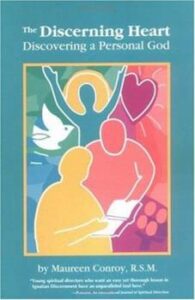
 Summary: A book for those training to be spiritual directors focusing on developing discernment and using case studies to guide spiritual direction training.
The Discerning Heart is a book that was hard to track down. It is out of print, and when I finally found a copy for my classes, I was sent (and charged) for two. I am ambivalent about the book. I would rate it 3.5 stars if I were rating it. Some sections were very helpful. But the case studies got repetitive and didn’t feel like real conversations.
Where she was helpful was a good discussion on consolation and desolation (Ignatian technical terms) and their relationship to discernment. Conroy, on page 13, says, “The experience of consolation and desolation is the foundation of discernment,” but that base-level assumption is simply outside the realm of understanding for most Evangelicals that I know. One of the central areas that Evangelicals will need to be convinced to participate in Ignatian Spiritual Direction is that emotions are not contrary to spiritual reality. There are those working in this area, like Pete Scazzero’s work in Emotionally Healthy Spirituality, Jonathan Walton’s derivative work in Emotionally Healthy Activism, and Richard Foster and the late Dallas Willard’s work in discipleship through the organization Renovare. But those are not mainstream movements at this point.
I started reading this as I read Jesus and John Wayne, a history of the past 75 years of how Evangelicals conceived of the implications of leadership, gender roles, authority, and discipleship. The book’s final chapter pulls out many of the players that were discussed earlier in the book. Those leaders had consensual affairs, raped employees or church members, covered up rape or child abuse of others, abused their organizational power or authority, misused funds, destroyed their or other’s families, demeaned the name of other Christians (or non-Christians) falsely, or other sins. Cases where pastors called out a particular sin but then engaged in it or allowed it when convenient were common. Not every person mentioned in the book advocating “militant masculine Christianity” engaged in the above list, but a very high percentage did.



 Summary: Exploration of how reading in the diverse Black Church Tradition works in several practical examples.