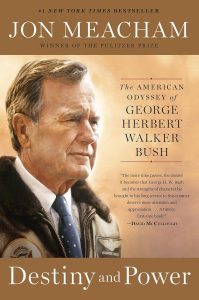
 Summary: Well written biography of a man that was interested in character and service to country.
Earlier this year, I read a biography of Jimmy Carter and I was struck by how much that I learned, even though I had read multiple books by or about Carter. A good biography, even if it appreciates the person (as Alter did appreciate Carter) still should complicate the presentation of the person. I have read Meacham’s book on John Lewis and knew he was a good writer. I also, because of that book and some interviews, knew that Meacham was not going to write a fluffy biography.
Personally, George Herbert Walker Bush is on the edge of my memory. I remember the 1980 election, but I was 7 and only just remember it. I was in high school in 1988 and remember Bush very soundly defeating Michael Dukakis. And after having some memory of the 1984 blowout of Reagan over Mondale, I think I had the assumption that presidential elections would always have a very clear winner. I graduated from high school in 1991. I very much remember the first Gulf war because while it ended just before I turned 18, I remember discussion about the draft and registering for selective service with that in the background. I was a skeptic about the first Gulf War, not because I thought that Iraq should not be prevented from invading other countries, but because I didn’t think that the US had the willingness to not counter invade Iraq in response. George HW Bush (in 1992) was the only presidential election that I have ever voted for a Republican. I thought that his willingness to change his mind and raise taxes, when he said he would not, was an act of character. He thought that taxes were bad, but that deficits were worse and that increased taxes were for the greater good, even if it was bad for him politically with his base. And I thought that not deposing Saddam Hussein, was at the time the right decision and showed restraint, that again, countered his base.
There was far more that I didn’t know about Bush than I did know going into this biography. I, obviously, knew he was Vice President and President and the father of a President. I knew that he had been the head of the CIA. But I didn’t realize he had been a Congressman or the Ambassador to the UN and China. He had far more political experience than I realized. I knew he came from an old family, but didn’t realize his father was a Senator. I knew he made money in oil, but I didn’t realize that he really started with very low skilled jobs to learn the business and he and Barbara were living very modestly in the early years.
One of the themes of the book is that Bush had connections that gave him a significant leg up, but his orientation toward service meant that while he did make money and live comfortably, he still worked hard both for his family but also for the common good. He made his money in oil in large part because he was the person responsible for getting investment and financing for his company, a job made significantly easier because of his family connections. His turn toward politics in his early 40s was also made much easier by the fact that his father was a sitting senator at the time and that he was by this time personally wealthy enough to invest the time and resources into politics. His later work in government service from the mid 1960s to the early 1990s rested on personal wealth.
The second main theme was that Bush was raised to believe in public service and the responsibility of those with resources to work for the good of all. He was not a social darwinist that blamed the poor for their poverty. He and I had different conceptions of the role of government with regard to poverty and social safety-net programs, but he believed in a social safety net. And while many poked fun at his 1000 Points of Light, his belief in the charity and community institutions is one that I wish more conservatives embraced now.
There is a tension with community service that was true not just of Bush and Carter, but of many. They believe that they can do good and that they amass power (often consciously) for the sake of doing good, but that can lead to justification of unethical strategies of winning. In the case of Carter, he used racial resentment strategies during the civil rights era to win the Governor’s job and then led Georgia with very racially moderate to liberal policies. Bush allowed Lee Atwater to smear Dukakis in ways that I think were unethical, but Bush also pushed some of the most important environmental legislation and the Americans With Disabilities Act as well as structural reforms that led to much of Clinton’s economic success. Bush did have some lines and he opposed targeting Clinton’s affairs as a line of attack. (Meacham suggests that it was because Bush had a number of affairs alleged against him during elections, although there is no evidence presented that he ever had an affair.)
Part of what I think Meacham was doing is showing how the role of the president has changed. Bush had a caretaker’s orientation. He believed in compromise to get things done. Carter did not like compromise and post-Gingrich, much of the tools of legislative compromise have been weakened and the systems continue to resist legislative compromise in ways that was not true prior to that time. Bush did not have the personality to grandly inspire the country. He was pretty good as a president, but not necessarily great at campaigning. And the job seems to now be more about long term campaigning than management.
This was a book that had access to all of George and Barbara Bush’s diaries and letters and notes and Meacham had over a decade of interviews and access to family and staff which meant that this was not just reporting events, but included a lot of contemporaneous thoughts and motivations. So it was personal. Bush was not known as an expressive president, but this talks a lot about his tears, mostly shed privately. And his pride in his family that did not make him objective about them, but defensive.
I do think that Bush will continue to increase in stature over time. He was a man of character, even if he was not perfect. I disagreed with a lot of his politics, but appreciated his willingness to compromise and push back against his base. In most cases, it was his own GOP opposition that defined his presidency more than the weak Democratic opposition of the era. Again, that is something that has changed in the last 30-40 years. This was a personal biography that looked at the man more than the particular events. It did not focus on the day to day events of the presidency as much as the large currents of his life. I thought it was well worth reading.
These two quotes from very early in the book I think set the stage for the main themes of the book:
Americans tend to prefer their presidents on horseback: heroes who dream big and sound the trumpets. There is, however, another kind of leader—quieter and less glamorous but no less significant—whose virtues repay our attention. There is greatness in political lives dedicated more to steadiness than to boldness, more to reform than to revolution, more to the management of complexity than to the making of mass movements. Bush’s life code, as he once put it in a letter to his mother, was “Tell the truth. Don’t blame people. Be strong. Do your Best. Try hard. Forgive. Stay the course.” Simple propositions—deceptively simple, for such sentiments are more easily expressed than embodied in the arena of public life.
and
This, then, is held to be the duty of the man of wealth: To set an example of modest, unostentatious living, shunning display or extravagance; to provide moderately for the legitimate wants of those dependent upon him; and, after doing so, to consider all surplus revenues which come to him simply as trust funds, which he is called upon to administer, and strictly bound as a matter of duty to administer in the manner which, in his judgment, is best calculated to produce the most beneficial results for the community—the man of wealth thus becoming the mere trustee and agent for his poorer brethren, bringing to their service his superior wisdom, experience, and ability to administer, doing for them better than they would or could do for themselves. The pursuit of wealth was thus imbued with a sense of purpose. America, wrote the banker Henry Clews, was “the land of the self-made man.”
Destiny and Power: The American Odyssey of George Herbert Walker Bush by Jon Meacham Purchase Links: Paperback, Kindle Edition, Audible.com Audiobook