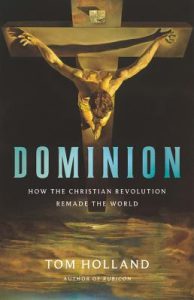
 Summary: A secular historian’s perspective on what impact Christianity made on the world.
Dominion is not a new book. It has been out for about seven years at this point. I have been hearing people praise it since it came out. And it is not the kind of book that has a corner of Christianity praising it. I have seen progressive process theologian Tripp Fuller and SBC seminary president Al Mohler praise it. And it largely seems to be well received in the secular and academic world as well. This very long and detailed review on the History for Atheists blog closely read the book and traces the nuances of the argument well.
But I mostly was avoiding Dominion because I kept seeing it used badly as either a type of apologetics or as a defense of Christian dominionism support. Those who are now largely labeled as Christian Nationalists tend to believe that the western world and its culture was shaped by Christianity. Which is a simple form of Holland’s thesis. Holland is suggesting that the world that Christianity arose in (Greek influenced Roman world) was shaped by power, wealth and a rejection of care for the poor and vulnerable. It is anachronistic, but the section on Friedrich Nietzsche details why Nietzsche was rejecting Christianity as being weak precisely because of the cultural influence that Holland is describing.
Holland is not presenting a simplistic narrative. Christianity and the west did not actually follow the principles of Christianity quite often. But there were many times where it did. One of the good examples of this is Alcuin was an advisor to Charlemagne. Alcuin not only became an advisor to Charlemagne, but convinced him that killing non-Christians was a violation of Christian ethics. Alcuin instead encouraged education and missionaries who could persuade people to become Christians voluntarily because Alcuin argued that you can force people to be baptized, but not to believe. Charlemagne revoked the death penalty for not being Christian and stopped using war as a means of conversion.
Holland presents the tension throughout Christian history of political power and theological reform. Early Christianity was established with a cultural reform movement that was oriented toward care for the poor and vulnerable, but as it became established and associated with wealth and power, it used that power to dominate. But over and over again, theological and ethical reform movements arose to reorient Christian to guiding principles.
One of the main points of Holland thesis is that the very nature of discussions about human rights and the value of individual liberty is rooted in Christian thought so that even when secular discussions about rights are using secular ideas and motivations, they are rooted in a historically Christian framing of the ideas. And the irony of Holland’s thesis is that those who would positively use Christian Nationalists as a self descriptive term, tend to want to use the political power of the state to enforce a cultural identity and political structure are rejecting Alcuin’s point more than 1400 years later.
I do think I have undervalued the extent that a secular post-Christian right is worse than a Christian right because it embraces a type of social darwinism that justifies the rejection of care for the poor as being good for society. But my main objection of a Christian dominionism is that it is bad for Christianity, not that it is better for society than a post-Christian right.
I do think there is value to a good reading of Holland here. But I also think that my concerns about the misuse of the book are still valid. But misuse is still misuse. Tom Holland is a very good writer. Dominion is long, but very engaging. He knows how to tell a story and how to frame that story to make his point without glossing over problems. Holland is quite nuanced and those who I have seen that either are misusing the book or are objecting to the book, mostly are ignoring the nuances of the argument. The reform movement within the church is part of the continual need of the church because power tends to lead to selfish use of power.
I listened to the audiobook (by far the cheapest option when I picked it up) and Holland very capably narrates the nearly 24 hour book himself. At this point, the paperback is the cheapest, but there are used hardcover and paperback versions that are even cheaper.
Dominion: How the Christian Revolution Remade the World by Tom Holland Purchase Links: Paperback, Kindle Edition, Audible.com Audiobook