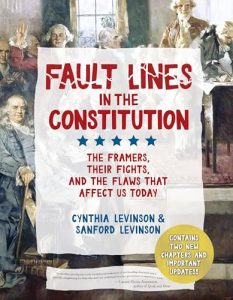
 Summary: An advanced (but young adult) book about the constitution.
I am fairly familiar with the constitution. I have previously read America’s Constitution: A Biography and two books on the reconstitution amendments, as well as a variety of more general history books that included discussion of the constitution. I am an avid listener to Advisory Opinions, a legal podcast that regularly dives into constitutional issues. I did not realize when I bought Fault Lines in the Constitution was a young adult book. I listened to a podcast interview with the authors and I thought the idea of looking at the constitution as being a document that could have been constructed in other ways (every chapter has a discussion of either other country or state constitution that handled that topic in different ways) and a look at the ways that current debates are in large part a result of the way that the founders wrote the constitution was an interesting perspective.
In general, this didn’t really feel like a “young adult” book in the sense of it being dumbed down or simplistic. The book feels like it is pitched to a high school advanced government or early college class with a few exceptions. The exceptions were times when it felt like the authors were trying to engage what they thought were young adult issues, primarily related to age for voting, minimum ages for office and military service. While I think there was good content in those sections, it felt pandering to me. I am in my mid 50s, so maybe those areas would not feel pandering to actual people in their late teens or early 20s, but I would have pitched those differently.
This is a legal history, part of discussing history is to contextualize why choices were made, to consider what other options could have happened, to make the ideas more complex (not to over simplify but to really understand the nuance.) I am simplifying the Five Cs of historical thinking, which this book does really well. The authors, as all authors do, have a perspective. But they do try to explore different perspectives and point out especially the perspectives that are more foreign to modern people. Culture, assumptions and language has changed since the constitution was written. The constitution was not a perfect document. It was changed, and changed almost from the very beginning. Part of the focus of the book is pointing out not just that the change occurred, but where it needed to be changed because of unintended consequences (the rise of political parties and the way that impacted the relationship between the president and vice president) or because of compromise (3/5 clause and other slavery related issues) or because they just didn’t want to deal with the issue explicitly.
Fault Lines in the Constitution is topical, so it does not need to be read straight through. It can be a source to understand a particular topic, for instance why the various post-civil war amendments were needed. I do think this is framed as an introduction. It also feels current because it has been updated several times to reference recent events. The current version of the book was released in Oct 2025 and references events after President Trump’s 2025 inauguration.
The work of Akhil Reed Amar in his trilogy of the history of the constitution is trying to develop depth that would be a good follow-up if someone is interested in that length. But most people do not want to read 2000 pages on the history of the constitution, so I think that Amar’s America’s Constitution would be a good follow up to this because the two books are framed so differently that the overlap in focus is minimal. While Fault Lines in the Constitution is a young adult book, I think most adults would do well to learn the content that is here to understand both what the constitution is and to understand how it might be different as a method of understanding what the constitution is trying to do and how it is limited in its approach.
Fault Lines in the Constitution: The Framers, Their Fights, and the Flaws that Affect Us Today by Cynthia and Sanford Levinson Purchase Links: Paperback, Kindle Edition, Audible.com Audiobook