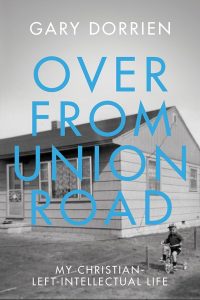
 Summary: A memoir of Union Seminary professor, ethicist, community organizer and theologian Gary Dorrien.
I picked up Breaking White Supremacy: Martin Luther King Jr. and the Black Social Gospel at some point when it was on sale, but I never started it (in part because it is over 900 pages.) I knew that it was the second in a trilogy of the theology of the Black church and social gospel and so I wondered if I should start with the first book so I just never started it. I needed something different and I tend to like to read near end of life memoirs of theologians because I am interested in how they appraise their life and work. Because I do not really know Gary Dorrien’s work, this was a bit of a a blind pick. But it is currently on sale for kindle and hardcover and it was a low barrier to entry.
Gary Dorrien grew up in a poor rural Michigan family. He was the grandchild of a mixed Native American and White couple, but did not have much contact with his Native American heritage, but did feel some of the impact of the discrimination of his family. Dorrien’s mother started college but only completed a year before deciding to get married. So Gary Dorrien was the first of his family to complete college. And going on to graduate school and a PhD was very new to the family.
I am sympathetic to Dorrien’s work as an organizer and a Democratic Socialist and his long work as a college chaplain before going to Union. But it is honestly quite amazing to me the number of mammoth tomes that he completed in a relatively short period after starting at Union. He had written several books before that point, but when he started at Union, his wife had passed away, his daughter had started college and he wasn’t working without a break year-round running multiple programs at his college.
I also was interested to know his close relationships with James Cone and Cornel West and a number of others who I was more familiar with as authors or academics or public intellectuals. In part I think I respect his work more after reading this because he was primarily focused on doing behind the scenes organizing and intellectual history which allowed others to take a more prominent role.
Some memoirs are about life development and experiences. This memoir does includes those things. We know about his daughter and his wife being a pastor and eventually dying of cancer relatively young. But this is a book that is more about his intellectual development and his interaction with the ideas and movements of his academic career.
Some people will not be interested in that type of a memoir. But for me, this is exactly the type of book that helps me to make connections. I am currently also reading Reinhold Niebuhr and Christian Realism by Robin Lovin. Lovin was one of his grad school friends that is mentioned multiple times in the book. These intellectual connections between people do matter in the way that their ideas develop. And things like James Cone encouraging Dorrien to write his three volume history of the Black social gospel while Dorrien also had a three volume history of liberal theology tells me that this is not just a white academic studying the Black church, but someone with context and history in and outside of the Black church.
I am not as connected to Dorrien’s political orientation, but I am very sympathetic to his organization, desire to ground organizing in both Christian faith and good social and philosophical theory, and his desire for local church connection. I did not know he also has books on Anglican/Episcopal denominational history and theology. I don’t love reading 800 page tomes, but I am now excited to pick up a number of Dorrien’s books. I will start with Breaking White Supremacy because that is what I already have. But I try to pick up at least one other this year.
Many who lean left do not feel that connected to their Christian background. This quote from close to the end I think is a good illustration of how that connection still is important.
On the road, at Columbia, and even at Union, I meet people for whom Christianity is a ruined word. They ask me nicely, or with puzzlement, or hostility, why I am a Christian. I try to explain that I was drawn long ago into the spirit and way of Jesus, which draws me like a magnet into its gravitational force. I was caught by the gospel picture of the divine Word entering the world. I am held by the subversive peace and grace of Christ, the meaning of suffering, the challenge to oppose every form of exploitation and violence, the willingness to give my life to others, and the promise of new life that it brings. These experiences shape my understanding of how I should live. To say with Paul that faith, hope, and love remain, these three, doesn’t mean the evidence is in their favor. It means they remain, they abide, regardless of the evidence. Faith is trust and commitment. Hope gives you courage, helps you face another day. Love makes you care, makes you angry, throws you into the struggle. I need all the faith, hope, and love I can get, and I cannot get any of it on my own. Only through the ties of faith and love with others that grace my life do I have any capacity for hope. We are not in control, so it isn’t up to us to make history come out right. In drawing closer to the divine, we are thrown into work that allows others to share in the harvest, which is enough. Love divine calls out from created things the love for which all things are created to be, pouring through all the processes of life across all boundaries, exceeding what we understand. We enter the mystery of the divine by its grace, beginning in faith with that which transcends faith and draws it forth.
Over from Union Road: My Christian-Left-Intellectual Life by Gary Dorrien Purchase Links: Hardcover, Kindle Edition
1 thought on “Over from Union Road: My Christian-Left-Intellectual Life by Gary Dorrien”