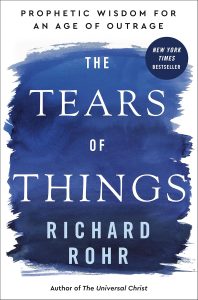
 Summary: A thematic look at the prophets, particularly looking at how those prophets can speak to today.
I have mentioned before that I participate in a couple of book groups. The Tears of Things was read with a book group that I participate in through Ignatius House, a Jesuit retreat center near me. That group meets on Tuesday mornings at 10:15 and in part because of the time, it is made up of mostly retired age people. I have participated in it for about 3 years now. I am the youngest, and this book was the only male in the group. There are about 20-25 people in the group with about 15-18 that are there on any given week. Most of the group are Catholic or Episcopal, but there are a few others. The group is a mix of people. Several are spiritual directors, there is a retired pastor, a former Catholic high school religion teacher and a number who are lifelong Christians but have no formal theological education. It is particularly that mix of background that I value, even though on the face of it, women in their mid 60s to early 80s do not seem very diverse.
Richard Rohr is a particular favorite of the group. This is likely the fourth or fifth book of Rohr’s that has been read by the group since it started and the second since I started three years ago. I have a mixed relationship with Rohr. I think he stirs things up in mostly helpful ways. His Center for Contemplation and Action is like my intent on being a spiritual director. He talks about why he founded it in this book and I resonate with trying to tie activism to spiritual depth and contemplation. But on the negative side, I think he can be vague and obtuse and my history is that Rohr’s non-dualistic thinking, in the wrong hands, often ends up being a cover for pietism or inactive moderation. It is unfair of me to get irritated with Rohr for the bad reading of Rohr, but that bad reading I think does have a relationship to his vague writing style.
That ambivalent background on Rohr aside, this is one of the better books by Rohr and is unlike any other book I have read by Rohr. It is essentially a thematic look at the Old Testament prophets. It was commented on several times that people in the group have not really read or studied the prophets. Almost everyone in the group is part of a liturgical tradition that reads a lot of scripture, and the prophets are regularly in the lectionary readings. But those lectionary readings of the prophets tend to take passages out of context and not lend themselves to understanding the prophets in their whole context. This is not a book on any particular prophetic book, but instead is a book on how to read the prophets and why reading the prophets is important.
If I have a quibble, I think it may have been a good idea for Rohr to do the overview that he did but also take a shorter book and do a deeper dive into that particular one to give a better idea on how to practically read and study a prophetic book. But instead, he did keep this a fairly high view of the prophets as a whole.
Where I am less comfortable with the book is that Rohr is evaluating the prophets on their anger. He creates a color scale of anger to love and suggests that the reader read the prophets and use colored highlighters to evaluate the message of the prophets. As an exercise, that does get people to read the prophets. But this is particularly the type of thing that I think Rohr falls into where he creates a dichotomy while trying to opposes dualistic thinking. Where I think this approach is helpful is that it emphasizes that the bible was written by humans and the human authors had a voice, it was not simply God direct verbal inspiration without any influence of the human author. Rohr’s point here is that as we are prophetic today, our spiritual and relational maturity does influence the way we are heard by others. Rohr is calling on the reader to primarily love and that our prophetic words are best with spoken out of love and lamentation as opposed to anger. I think that point is right, but I am not sure that his method of evaluating the prophets gets at that point quite in the right way.
I wish he had spent a bit more time on lamentation and grief as a driving force of the prophets, but what he did do was good. And generally, I think that is mostly my feelings about the book as a whole. I got a lot out of the book because of the discussion of the book. And I tend to appreciate more attention to the prophets, the bible as a whole and the intention of tying our activism to our spiritual lives. And especially the importance of spiritual, emotional, and relational maturity within activism. But at the same time, I still am not sure that Rohr is the right voice for me. I tend to be more attracted to the Black church tradition and voices like Howard Thurman and womanist theologians who I think do a better job at calling us to more robust ethical thinking that avoids unhelpful dualism without demonizing those that have different positions than Rohr.
The Tears of Things: Prophetic Wisdom for an Age of Outrage by Richard Rohr Purchase Links: Hardcover, Kindle Edition, Audible.com Audiobook