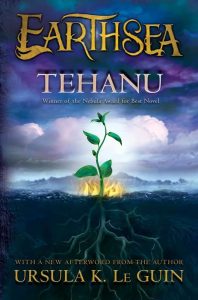
 Summary: Tenar (from Tombs) had a life after she left the Tombs.
I was a teen in the late 80s and early 1990s and I thought of Earthsea as a trilogy. I didn’t know that there was a fourth book until I reread the series as an adult. There was more than 20 years between the publication dates of The Farthest Shore and Tehanu. So unlike the first three books of the series, this is just my second reading of the book.
In the second book we are introduced to Tenar as a priestess of unknown Gods. Ged comes to retrieve an amulet that will reunite the kingdom and allow for a king to regain the throne again. But as he does that, he finds Tenar, a young teen girl who alone was allowed to serve these unknown God in the tombs. Together they help one another escape. Their ages are never discussed, but I think Tenar would have been about 14-16 years old when she meets Ged. And we know this is sometimes after the end of the first book, so Ged is in his mid 20s. There is never any question that she will not follow him after the escape, because the life of a mage is one of a wandering hermit and marriage was out of the question for wizards, even if there had not been an age gap.
Eventually Tenar settles on Gant, Ged’s home island with Ged’s first teacher. Tenar has skills for magic, but she wants a normal life. And because she is a woman, she cannot go to study magic at Roke, which is only for men. (The short story collection Tales of Earthsea, explore why mages have become only male and what has been lost from magic because the mages have rejected women’s magic.) So Tenar marries a farmer nearby and raises a family and lives a “normal” life. Eventually her children grow up and move away. And then her husband dies and she is alone at the farm with some tenants and she has to find her way again.
About 30 years pass from the end of 2nd book to the main story of the fourth book. On Ged’s side, he became the Archmage on Roke, and then the story of the Farthest Shore happens and the timeline of book three ends at about the same time as Tenar’s husband dies. Eventually the two of them reunite on Gant, where Ged retreats after he has lost his magic and he is recovering. And where their shared teacher is at the end of his life and Tenar has gone to see him before he dies. Another story thread is that Tenar has fostered an abused child who was abandoned for death after abuse and a burning.
The story is much smaller in scope. There is a villain, but it is almost incidental to the story other than its role in helping Tenar rediscover magic. Again, this is a book about seeing how doing the next right thing leads toward “destiny.” The magic of Earthsea is about balance. Restoring all things to balance is the focus, so there is a distortion, something must be done. This is also a book about trauma. The trauma of Tenar, Ged, and the child, Therru, are all very central to the plot and conflict. It is handled well.
Le Guin is sometimes thought of as a feminist writer, but this is one of her most famous series and the setting has a male-only magic guild who reject that women can have magic. They swear the mages who are a part of the guild to celibacy and prevent them from having families or strong ties to a community. So when Le Guin starts to show the weakness of that system in a much later book, I don’t think it is a feminist as much as it is writing something that wasn’t ready to be written earlier. There is an introduction in the edition I read from Le Guin talking about whether this was a feminist book or not. She rejects the label, but I do understand why it was applied. Tenar is a strong character, but not in the way that fantasy tends to portray strength. She is not a great magician. She does what is necessary for others, she cares for and loves children. She protects the weak. She herself is weak compared to many around her. But it is that weakness that allows for the deeper strength that the male-only mages seem to have forgotten. “Weak as women’s magic” is a phrase that keeps being used throughout the series and Le Guin knows what she is doing by exposing the bias in the fantasy world of the 1960-70 of the first three books so that by 1991, when Tehanu was written, I think there was an openness to seeing a book about a woman, not just woman who took on “men’s” roles, but who was fully female and herself, but who still had a role to play in the fantasy world.
Purchase Links: Paperback, Kindle Edition, Audible.com Audiobook