 Summary: Reflections on what Baldwin can teach us.
I have been leading a zoom book group for about five years now. It started out of a Be the Bridge group at my church. Most of the people have changed, but we still meet about 35-40 Thursday a year doing about 4 books a year with good breaks between books. The group is mostly reading book by Christians about racial issues. The Gospel According to James Baldwin was our most recent book and honestly one of the best discussion books we have had in the last couple of years. People who didn’t often talk much found things to talk about here.
Most of the time, we read books that I have already read. I don’t choose every books, but generally I give about 5 suggestions of books I think are worth reading as a group and the group chooses what they are most interested in. I was a bit surprised when the group chose The Gospel According to James Baldwin because that was outside of our normal history, bible study, sociology types of books. (White Flight, The Anti-Greed Gospel by Malcolm Foley, If God Still Breathes, Why Can’t I?: Black Lives Matter and Biblical Authority, Brown Faces, White Spaces: Confronting Systemic Racism to Bring Healing and Restoration are some recent books we have read.)
I had not read The Gospel According to James Baldwin yet and if I had, I am not sure I would have recommended it. That isn’t because it is a bad book, but I would have thought it was too literary, too dependent on knowing Baldwin and too much of a stretch for the group to see someone who didn’t identify as a Christian have something to teach us as Christians. At the first session I found out that none of the group had previously read James Baldwin and only two or three had seen I am Not Your Negro documentary. (I own the documentary, watched it at least four times and read at least eight of Baldwin’s books as well as David Leeming‘s biography and several others books that draw heavily on Baldwin like Coates, Clint Smith, Eddie Glaude and Dante Stewart.) Again, had I known the lack of familiarity I would have overruled the group and not let the book be chosen.
But this was a book that the group loved discussing. The chapters on Faith, Justice and Identity were by far the most engaged. The first two chapters (which we read together) were a background on why Garrett wanted to write about Baldwin personally, and who Baldwin was. From there each chapter was thematic: culture, faith, race, justice, identity, before a conclusion. So we spent 6 weeks on roughly 180 pages.
I don’t know if others in the group will pick up Baldwin, although most of the group did watch clips of Baldwin that were referenced in the book, the interview with Dick Cabot, parts of the debate with William Buckley, the interview Kenneth Clark. And I encouraged people to pick up either The Fire Next Time or If Beale Street Could Talk as two different starting places. I am planning on picking up Nicholas Boggs new biography soon.
This is not a long book. And I was overtly challenged over the title the first week because Baldwin did not claim Christian faith, even if he was strongly influenced by Christianity through the black church and the broader culture and Biblical imagery. But I think we can learn from those outside the church about how the church is reflected in society. Baldwin thought that those christians closest to him often did not seem to believe what they said they did. It was not a charge of hypocrisy as much as it was a charge of faithlessness. I didn’t like the book much, but Craig Groeschel’s book The Christian Atheist gets at the idea that we claim Christ, but life as if we were independent of God.
Much of what we can learn from Baldwin about Christian faith is his devotion to love of enemies and his ability to cross boundaries. I don’t think he ever really understood the mystical reality of God, but I think he did understand the call to love as being a rejection of the acquisition of power. And Baldwin did understand the church as Welcoming Table (similar to King’s idea of Beloved Community). The problem with understanding faith as only practice is that it lacks the power of the spirit or grace that actually gives the power to engage the practice. But I do think that he is like much of the Christian self help books that devolve Christianity to a version of the prosperity gospel (if you do this, you will get that.) There are limitations from learning from a view of Christianity like that. But we can learn with caution about where to not go wrong while being reminded that the love part does really matter.
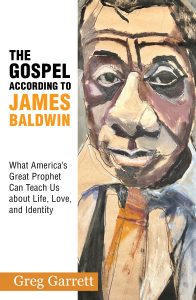
The Gospel According to James Baldwin: What America’s Great Prophet Can Teach Us about Life, Love, and Identity by Greg Garrett Purchase Links: Paperback, Kindle Edition
1 thought on “The Gospel According to James Baldwin by Greg Garrett”