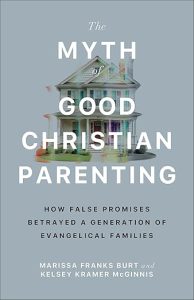
 Summary: An evaluation of Christian parenting advice books from the past fifty years.
As with many books that I end up recommending, I was initially going to skip this book until I heard an interview with the authors. I grew up on the edge of Evangelicalism. I knew people who were big into Gothard, but my family always thought it was a cult-like group. I am too old for the main purity culture movement. I did grow up listening to Dobson and MacArthur on the radio, but my parents were not big parenting advice readers. Generally, while I know many people who did suffer as children from bad parenting advice that their parents received, I did not think I really needed to read this book personally. But then I listened to the authors talk about parenting advice in a way that felt to me like anti-discernment and how it was primarily an authoritarian approach and I realized that I did need to read the book. It was on sale for less than $2 on Audible and I finished the book in just over two days.
I also overlapped Good Christian Parenting with Why I am a Protestant which had a very good discussion about the importance of affirming diversity within Christianity as part of the book. And that emphasis really made me want to lean into thinking about The Myth of Good Christian Parenting as an exploration of the range of Christian beliefs within orthodox Christianity as part of my frame of reading evaluation.
I just need to name up front that almost all of the really bad parenting advice described in this book was rooted in a theological commitment to hierarchy. While there is a range of understanding of that hierarchy, virtually all of the teaching framed parenting as a means of control of children by parents for the sake of teaching children about submission to God. That framing placed parents as a God-figure in the parent/child relationship. An additional wrinkle is that most of the parenting advice also emphasized the sinful nature of the child from either birth or conception, so that there were a number of examples of authors condemning the sin of newborn to toddler children. Voddie Bauchman’s “vipers in diapers” is just one example of framing children as intentionally attempting to manipulate adults. Or even in some cases children intentionally attempting to sexually arouse the adults around them.
That isn’t to say that bad parenting advice only comes from one corner of the Christian world, but that the loudest voices about parenting were from those who tended to lean toward a high authoritarian perspective that also tended to lean into strongly reformed theological perspective and a strongly patriarchal cultural perspective. That combination worked in partnership with the Young, Restless and Reformed movement of the 1990s-2000s to catapult a narrow slice of Christians to be nearly the only parenting advice being given to Christians.
I like how the authors framed the book. The first two chapters were mostly about context and history of how the changes in culture and publishing created the category of Self-Help books, how the category of teenagers arose, which created more concern about parentings, and the changes in social science and research changed some of the assumptions about parenting. These and other factors worked together to give rise to parents wanting advice about parenting and people who wanted to give that advice were listened to. James Dobson was the first well-known Christian parenting author. And unlike most of the rest of Christian parenting authors, he did have relevant training, although he mostly ignored the consensus of psychology as he wrote and leaned into his mentor’s (a noted eugenicist) approach. (Dan Koch had two good podcasts talking about James Dobson a couple weeks ago, an initial thoughts podcast and a longer discussion podcast).
But generally apart from Dobson, the initial wave of parenting authors were either biblical counselors who rejected academic social science research or were pastors or lay people with no child development training. As noted later in the book, with the rise of the mommy blogs in the early 2000s, there has been a shift away from male parenting experts to mom parenting experts, but those are still mostly approaching parenting from personal experience and not research, therapy, child development or other relevant backgrounds.
After the initial chapters of background, the next five chapters are mostly thematic: the umbrella of authority, the design of a Christian family, rights or autonomy of children, children as sinners, and corporal punishment. I am most aware of, and most concerned with, rooting Christianity in hierarchy which is most discussed in the umbrella of authority chapter. I am familiar with many of the other topics, but the idea that children really are less human (as women are sometimes thought to be less human), or that children really shouldn’t have autonomy to resist parents or any others, or that there is advice to actually remind parents of newborns that there child is really a sinful being which requires you to break their will seems to me such over the top wrongheadedness that I have a somewhat hard time understanding how people listened to that type of advice.
But part of what the authors are pointing out is that this type of advice wasn’t just abstract parenting advice, but part of a theological system. And they rightly note that much of this advice overtly is telling the parent to not trust their instincts, but to spank a child longer than you think reasonable or to resist empathizing with your child because the child is intentionally (even as an infant) trying to manipulate your empathy to control the parents. The more overt “sin of empathy” that has arose over the past few years can be traced in part to this condemnation of empathy by parents in the earlier parenting books. There is also the context of the very authoritarian shepherding movement of the 1970s and 80s which arose in the post-Jesus movement. Authoritarian movements often target traumatized people who seek out people to tell them what to do as a trauma safety mechanism. The parents that were part of the hippie movement and then became Christians as part of the Jesus movement were primed to accept authoritarian leadership of the shepherding movement, which was connected to a number of these early parenting figures.
One of the features of The Myth of Good Christian Parents is that the authors thread the very important needle of offering grace to parents who were accepting the advice they were given, while not minimizing the harm that was committed. Adult who naively accepted bad advice, were one type of victim of the movement while the children who were abused and traumatized were another type of victim. Offering grace to parents does not mean (as is very clearly repeated throughout the book) that harm did not happen or that relationships with those parents needs to be restored. Parents who abused children, even if they didn’t intend abuse, still have to accept responsibility for the abuse.
I think another aspect of the harm that is handled well is that parents were saddled with responsibility for the result of the child’s behavior, again removing any autonomy from the child. Parents are parents and have influence over children, but to make them responsible for a result which they do not actually have control is to put pressure on parents in an unhealthy way. That is similar pressure on fathers to be sole breadwinners, regardless of their skill or capacity, and responsibility to be a perfect homemaker for women, irrespective of their own gifts. That is also similar to the way that much of this parenting advice denied the reality of childhood development.
The Myth of Good Christian Parenting did not talk about Paul Miller’s book on submitting suffering within relationships (he advocates submitting to abuse in a variety of relational situations so that the abuser will see grace and repent). But it is a good example of both the authoritarian view of family and church, but also a denial of child development. This is a quote from the book:
“Our modern age creates categories…and then traps people in them. For instance if we label 2 year olds with ‘Terrible twos’ then they are no longer responsible. So when they lose their tempers they are just exhibiting the ‘terrible twos’ instead of sin in need of discipline. Labeling returns us to the rigid world of paganism which freezes everyone into a category, ethnic group, occupation or social status.” (from A Loving Life)
The end of The Myth of Good Christian Parenting is three chapters in response. There is a chapter on healing from the trauma of bad parenting, a chapter on the false promises of the parenting advice and a chapter that is mostly about resisting universal advice and well as an appendix that helps readers to evaluate parenting and other advice. I both thought the final section was a bit too long and that it didn’t talk enough about the different ways that trauma occurs (I would have liked a section on betrayal trauma and religious trauma that was more explicit about how trauma can occur emotionally, not just physically.) I didn’t want to minimize the grace offered to parents, but contextually, I think parents are often given a lot of grace and as is emphasized throughout the book, children by the very nature of being children are dependent and vulnerable. One of the aspects of childhood abuse is that those children have their normal development altered and childhood abuse often impact them throughout their lives.
Particularly when abuse is spiritualized, and when abuse is committed by those who vulnerable people like children are required to depend on, many of the tools or resources that may be available to assist in healing are no longer available. When you are told that God is waiting for you to mess up and that abuse is part of what it means to love, the view of God and the natural connections of human love are broken. The book quotes freely from adult children who were surveyed about how these parenting systems impacted them and many of the quotes show evidence of the impact. Connecting abuse ritualized activities like prayer as part of spanking, or sexuality in ways that some spanking was ritualized with bared bottoms can have an impact in areas that have nothing to do with parenting.
I think a lot of people will connect The Myth of Good Christian Parenting to Jesus and John Wayne in a variety of positive and negative ways. One of the ways that it is very different is that DuMez was trying to only recount history and very much was resistant in the book and in interviews to giving advice. But Burt and McGinnis spend a lot of time at the end offering what I think is good pastoral wisdom. They overtly advocate ending spanking as an option for Christians. They talk about evaluating advice in ways that are very much in line with good discernment teaching. This is not an advocacy book, but I think it does a good job at revealing a problem and then trying to give some steps to addressing the problem, which some academic studies very much avoid doing.
As I finish the book, I was left with the problem of how to think about recommending the book. Many who were most severely traumatized by abusive Christian parenting advice may find some value in the larger context of their abuse. But there should be a big trigger warning for people who were abused within Christian homes. I think pastors and church leaders should be reading this to understand not just the type of general parenting advice that is out there, but as an example of why pastors and other church leaders should be resistant to giving too much advice on areas where they have not done the work to understand the situation. I also think that one of the important realities is that much of our christian media is oriented toward a particular type of culture and that lack of diversity is part of what allows harm like this to fester. We need diverse perspectives on all types of issues. And not having that diversity is part of what allows bad advice to continue to be spread.
The Myth of Good Christian Parenting: How False Promises Betrayed a Generation of Evangelical Families by Kelsey Kramer McGinnis and Marissa Franks Burt Purchase Links: Paperback, Kindle Edition, Audible.com Audiobook
1 thought on “The Myth of Good Christian Parenting: How False Promises Betrayed a Generation of Evangelical Families by Kelsey Kramer McGinnis and Marissa Franks Burt”