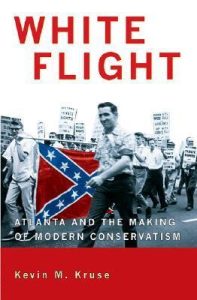
 Summary: Local history matters.
I am not going to repeat my previous review. I reread this after about six years with my book group. It is always interesting rereading something with a group because different people are impacted by different aspects of the book. Different areas strike them because they have a different connection to the history. My book group is made up of people who have all lived in the Atlanta areas for 10 or more years, but none of us were born here. We all came here as adults, mostly 20 to 30 years ago.
That connection that we have to spaces and institutions matters. All of us had connections to this book because organizations that we were in, or spaces that we commonly use, or jobs that we have had were discussed in the book. Knowing that a school that our kids went to or a club that we belong to or an employer that we have has a relationship to has a history of upholding segregation in a way that we were unfamiliar with, means that we did not know the fuller picture that we probably should have.
I continue to be a bit frustrated with how Kruse ended the book. He has nine solid chapters on history drawing an argument that he then summarizes in a nine page epilogue. I would like to see him do a second edition of the book where he adds a new chapter at the end that very clearly shows the mid 90s to 2020s. I live in Cobb County, one of the areas that grew because of White Flight. In the early 1970s, the population was 95% white. In the 2020 census, the population was 50.1% white and the main county school district has been predominately minority for nearly 15 years. Part of the reality of white flight is that as Cobb has become more racially diverse, some people have continued to move further away from Atlanta continuing the process in slightly different ways from the original white flight.
The book also does not really grapple with the modern reality of ethnic enclaves, especially of immigrants that may have some anti-black racism as part of the choice of location. Forsyth County, which was the subject of Blood At the Root, and which had essentially no black residents until the early 2000s after nearly a century of being a sundown community, is now nearly 1/3 Asian. That is still a radicalized reality, but it is a different radicalized reality than a simply all white community.
Narrative history is hard to discuss with a group. In part it isn’t really about ideas, but discussion of history. And either it is an accurate presentation of history or it isn’t. If it isn’t, then you can discuss how the history is cherry picked or framed badly, but to have that discussion, you have to actually know the history well enough to give evidence. I think that White Flight is a good history, but for those that do not have a good background in civil rights era, local Atlanta history, or the broad social changes in media, government and other institutions since the 1950s, you may not know if it is a good history or not. I always wanted more context and discussion, but I also have a very good background in the history of the era. And much of my group did not and found the book challenging to keep all the threads together. Especially the earlier chapters which broadly progress chronologically, but still are thematically developed, there is an overlap in the history from one chapter to another but with a different facet, which can make holding a timeline in your head a challenge.
Everyone in the group commented on it being one of the best books we have read. Everyone commented about how they had recommended it to others. It is well worth reading, especially if you actually live in the Atlanta areas. But it is challenging if you are not familiar with the underlying history to keep everything straight and to follow the characters and movements of the history.
White Flight: Atlanta and the Making of Modern Conservatism by Kevin Cruse Purchase Links: Paperback, Kindle Edition, Audible.com Audiobook
3 thoughts on “White Flight: Atlanta and the Making of Modern Conservatism by Kevin M. Kruse”