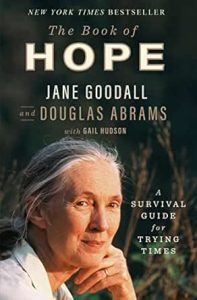
 Summary: An interview book with Jane Goodall about the importance of hope.
I read the Book of Hope as part of a book group that I am have been a part of for the past several years. This group is based at the Ignatius House, a Jesuit retreat house near me. I did my spiritual direction training here and I have been on three retreats here in addition to this book group since 2022. I rarely love the books that we discuss. But I love the people. The group is made up of mostly women in their late 60s to early 80s. There are a few outside of that, but it is most of the group. A bit over half the group is Catholic, most of the rest are Episcopal. The group is pretty solidly on the political left with a mix of theological perspectives. Generally these are people who appreciate contemplative spirituality and justice.
The Book of Hope is formatted mostly as an interview. Douglas Adams’ previous book was framed as a conversation between the Dali Lama and Bishop Tutu and it was called The Book of Joy. I am mixed on the format. Adams is a character in the book. He discusses his place in the conversation but mostly is setting up Jane Goodall to talk about her own thoughts on hope. Contextually, the hope is mostly about hope in the face of environmental catastrophe, but that isn’t the only issue in the book.
As the group discussed the book at our last meeting, most people thought the book got better the longer it went. The start was too much introduction and “chit chat”. The stronger sections on what hope was and how to work to build hope was good. When I started reading this I had just finished reading Racial Justice for the Long Haul, which was mostly also about the hope required to continue working on social issues in the face of discouragement. I am in process right now of reading A Systematic Theology of Love by Thomas Jay Oord, which is not about hope directly, but it is largely about the role of the problem of evil in our understanding of who God is and how God works in the world. Which is in part about these overlapping discussions.
The group I read this with is an overtly Christian group. It almost always opens and closes in prayer. We always discuss matters of faith. But this book was not particularly religious. It was vaguely spiritual, but whatever Goodall’s spiritual faith is rooted in, she was not talking about it. It is not that I think you need to have faith to have hope, but I do think that it is hard to talk about why you as an individual or as a group have faith and not discuss what that hope is rooted in. Goodall has hope because of youth, because she thinks that we are designed to have hope and that it is a survival skill. She thinks that hope can be encouraged and developed. And she is opposed to a faith surface level hope that denies hard things. But again, that felt too amorphous.
I was skeptical of the book going in because I suspected it may be too vaguely progressive for my preferences. And I think that is exactly what happened. But there was there in it that I thought were helpful. I learned more about Goodall’s life and family, but not much more. I learned more about her work of advocacy in the past few decades and I admire her for that. But I also wonder about what wasn’t said.
The Book of Hope: A Survival Guide for Trying Times by Jane Goodall and Douglas Abrams Purchase Links: Paperback, Kindle Edition, Audible.com Audiobook
Adam – I’d love to hear your thoughts about A Systematic Theology of Love!
Thomas Jay Oord
I am about 80% done. I will write about it later this week.