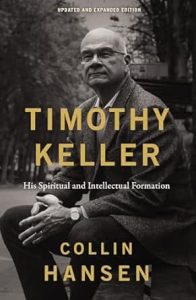
 Summary: Part biography, part intellectual history.
I have a lot of theological disagreements with Tim Keller even as I respect him and think the evangelical world would be much better off if there were more people like him. That is not to start with outlining of my disagreements, but to frame my thoughts here as largely those of an admirer who strongly disagrees.
I think my main issue, both with the book and with Keller is summed up in this quote.
“By his 1975 graduation from Gordon-Conwell, most of Keller’s enduring theological commitments had been settled. He subscribed to the Westminster Standards and Presbyterian-Reformed theology. He advocated for penal substitution, classic covenant theology, amillennialism, and what would later come to be known as a “complementarian” view of gender roles in the home and church. He believed in a historic, specially created Adam and Eve, in an old earth, and in the reality of biological evolution. He aligned with the neo-Calvinist approach to culture that combined evangelism and social justice. He resisted tying the church to one political agenda. He wanted the church to approach homosexuality with pastoral care without compromising the biblical sexual ethic. He prayed for the kind of revival Edwards saw in his day. The popularity of these beliefs might wax and wane, both inside and outside the church. But Keller didn’t do anything more than tweak some of these views after 1975.” (p103)
For every aspect that I really appriciate about Keller, his focus on ecumenical activity and evangelism and his advocacy of justice and a robust understanding of culture, there are others that are not just sometime I find problematic, but heralded here. For example, just after a long exploration of Keller’s understanding of the relationship to preaching about grace and not turning the Old Testament into moralism, Hansen talks about Keller promoting Jay Adams and biblical counseling, which expressly is about moralism. Or in the sections about how Kathy Keller became convinced that women should not be in church leadership, it was largely because of the teaching of Elizabeth Elliot that Kathy changed her position from being in favor of the ordination of women to being opposed to the ordination of women. But it was because of the seminary teaching and missionary experience of Elliot that Kathy and then Timothy Keller changed their minds. (Experience they would not have had if they were at a school that was more complementarian.)
Again, I can’t help but be influenced by my experience of Keller and those Keller was influenced by. Hansen emphasizes how Keller emphasized grace and revival and opposed the moralizing of the gospel, but then cites people who I have experience with as being those who emphasize external morality. My experience of Elliot seems to be the exact opposite of what Keller took from her.
Especially in the quotes from Keller about contextualization and justice, I find almost nothing that I disagree with about the relationship of the gospel to culture and the importance of justice to the reality of the gospel. I know that people like Brandon O’Brien who worked for Keller and whom I very much respect. But then I also wonder at how TGC seems to be so strongly wrong at most every cultural take on movies or music or art if it was so strongly influenced by Keller’s understanding of culture and contextualization. Keller strongly spoke to the sin of racism, but TGC seems to be more attracted to Doug Wilson’s orientation toward ethnic nationalism than Keller’s pluralism.
I appriciate that Hansen is not trying to write a traditional biography. He says the point of the book is to explore the people and thinkers who influenced Keller. And largely I think that focus makes sense. But this does verge on haigiography. And often it is comments that are show an insular perspective where this shows most strongly. In a discussion of the movie Babbette’s Feast, he says, that if you have seen the movie or read the book it is probably because of a recommendation from Tim Keller. And then says that Keller first mentioned the movie in 1997 in a sermon. But there was wide support of the movie by Christian from its earliest days. I saw it in the theater because my church went.
I also really wish there was more evaluation and exploration of Keller. I have the expanded version that was expanded after Keller’s death. But the concluding thoughts are thin. There is very little about how Keller has become someone to push back against by Aaron Renn and James Wood and others who seem to have this reverse nostalgia that thinks that starting a church in NYC in the late 80s and early 90s when NYC was less than 1% evangelical was some how “easy”.
I don’t think Hansen is probably the right person to do that deeper evaluation and it probably is too early to do that. But I think that is what this book needs. I am all for this type of exploration of his intellectual formation, but when the framing is that Keller really didn’t change any significant positions after 1975, then it is hard to really explore what those intellectual formation was all about.
I thought this was worth reading. I have respected him, even as I have disagreed with many things because he was someone that seems to have the ability to disagree and still relate. I learned things and I found people that I want to learn more about. But I also thought that this was too fluffy and could have been just as respectful and affirming of the man and dig a bit deeper.
Timothy Keller: His Spiritual and Intellectual Formation by Collin Hansen Purchase Links: Paperback, Kindle Edition, Audible.com Audiobook