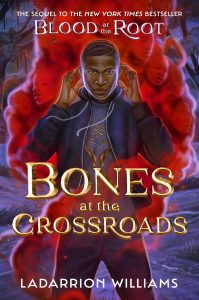
 Summary: After the death of his grandmother and the revelation that his mother (who he thought was dead) is behind a number of murders, Malik tries to settle into college and figure out how to try to have a normal life.
Blood at the Root was a bit of a surprise hit. I read it about 9 months after it released and a number of friends or acquaintances had been recommending it. Blood at the Root was a very good opening fantasy book. There was good world building and character development. I alternated between ebook and audiobook for that first book and then I just listened to the audiobook for this second book.
This series is clearly producing audiobooks with the intent of drawing in the YA audience that is used to TV and movies. I don’t traditionally love sound effects and music in audiobooks because I think it often sounds cheesy. And there are definitely some aspects of the audiobook production that I think lean in (intentionally I think) to the cheese, especially during fight scenes where magic duels sounds like star wars blasters being shot back and forth.
As I skimmed through reviews on goodreads, there is a clear split between people who are five stars (“it was great”) and those who thought it dragged. I both really enjoyed it as a whole and thought that the middle dragged and that the book as a whole was trying to do too much. This is a second book and they need to develop differently from first books. I get the point of why it was slow in the middle. It was oriented toward character development and complicating the story by exploring the motivations for a variety of characters to keep them from becoming too cardboard. But I think this is where Ladarrion Williams shows that he is a fairly new writer. He is skilled in plotting and I think he has great intentions with writing a complex story, which I appreciate; but that complexity needs to be shown without as much explicit explication. I agree that the middle of the book drags. (The second book is about 1/3 longer than the first book and I think with some better editing it would have been better if it had kept to the length of the first book.)
At the same time as I think that the middle of the book drags, I am all for the attention to mental health and breaking generational cycles. And I am all for the various storylines about the way that different forms of discrimination often are not addressed together. (I am also reading a book about Jim Crow era Black social gospel, and there are so many examples of opposing racism but being sexist or opposing racism but being elitist, or knowing that white supremacy is a problem but buying into various forms of respectability politics that are rooted in hierarchy.)
In a post-womanist world, Williams is paying attention both to the use and misuse of calls to move together against oppression in all forms. And paying attention to the need to do internal personal work to prepare for the work against systems of oppression. My problem isn’t the politics, or the fact that this is a fantasy novel that is paying attention to political and social issues (all fantasy novels do this or don’t do this in a way that reveals the politics of their authors.) My problem is that the political and social and psychological work that is is being done her can’t bring the story to a grind. And there is only so much angst that a character can express before the reader gets a bit annoyed.
The novel opens with an author’s note about the need to allow for novels about Black boys that allow them to be messy and grow. I think Williams is right both in the content of the note and right to have it at the start of the novel to remind the reader to do that here, not just have it as a theoretical possibility. I think one issue here is that I keep needing to be reminded that Malik is supposed to be 17 here. At the end of this novel, we are only about six months from the start of the first novel. I think it would feel more realistic to have spread the development of the book out over a couple years instead of a couple months. Malik barely got to know his grandmother before she died. Malik has not even finished a whole semester when the main action of the novel happens. The first novel was entirely during part of a summer school quarter. As much as a reader I am rooting for health and wholeness in Malik and those around him, as a guy in his 50s, I know that change takes real time and what has happened here hasn’t been enough time.
One of the themes in the book is that as a 17 year old, Malik deserves to have a childhood. He is tired of having to fix things he didn’t break. And all of that is true. But as a reader, it is conflict and resolution that generate interest, so while I agree that Malik deserved to have a childhood and do the fun developmentally appropriate stuff that a 17 year old should be done, we are reading the book because he isn’t just any other teen.
I know that when I wrote about the last novel, I said I was going to pre-order this book and read it immediately. But I didn’t get to it until almost a year after it released. But the third book is still four months away. I have enjoyed the audiobooks. But I think I will end up reading the third as a kindle book because the audiobook feels like it slows the book down a bit. This second book was nearly 20 hours (or 529 pages in print) and I think I could have read it faster and not have felt the drag in the middle as much.
Bones at the Crossroads by LaDarrion Williams (Blood at the Root #2) Purchase Links: Paperback, Kindle Edition, Audible.com Audiobook