 Summary: A systematic theology that is attempting to make love as the center.
I have heard Thomas Jay Oord interviewed on several podcasts, including Gravity Commons and Homebrewed Christianity, which is why I picked up A Systematic Theology of Love in the first place. I had not realized it came out in February until I saw that a friend was reading it. It took me the whole month of April to read it.
I have a mixed relationship to systematic theology. I both appreciate that it is trying to be comprehensive because it is clear that theology is interrelated and choices in one area do impact choices in another areas. But I also am wary of systematic theology because of its attempt to categorize everything and I am just not sure that we can know it all. Many of my complaints here are about the fact that this is only volume one, and I have questions that are not answered yet (because they are going to be in the next two volumes, which Oord is going to try to get out in the next couple of years).
I am pretty persuaded by A Systematic Theology of Love. I think the orientation toward God as love and a God who is loving in a way that we traditionally think of love, is easy to get on board with. John Armstrong’s The Transforming Fire of Divine Love: My Long, Slow Journey into the Love of God I think is a good introduction to God’s love and has a number of overlaps with the early chapters of Oord’s book.
In particular I think it is easy to see that the influence of greek philosophy on the early church makes it hard for the early church to conceive of a God that loves in a way that we think of as loving.
“Although biblical writers mostly use “love” to describe actions that promote abundant life, blessedness, or well-being, Augustine defines love as desire. Countless theologians adopt his mistaken approach. In Teaching Christianity, Augustine poses a question: “How does [God] love us?” Because Augustine defines love as desire, he thinks God desires by either enjoying or using us. If God “enjoys us,” says Augustine, “it means he is in need of some good of ours, which nobody in his right mind could possibly say.” We have nothing of value, according to Augustine, because God already has all values eternally. So, God can’t love/desire us in the sense of needing us. Because he defines love as desire, Augustine says God loves by desiring what’s valuable. Being wise, God desires only the most valuable. This means, says Augustine, God only desires/loves Godself…In short, God only loves Godself. By defining love as desire, therefore, Augustine is forced to conclude God doesn’t love the world.” (p12)
The mix of thinking about love as desire and thinking of immutability as necessary for perfection, means that it is hard for the early church to think of God as loving in the ways that we see scripture talking about love. (This is an example of the problems of systematic theology when commitments to internal consistency trump the larger scriptural evidence.) I find Oord persuasive as he walks through why love matters and points to both scripture and other traditions within the church that require love as the fundamental preconception of God. I already have this as my primary orientation theologically so I am easily persuaded here.
Oord does spend time on how he understands love.
“To love is to act intentionally, in relational response to God and others, to promote overall well-being.” (p27)
and then later
“In sum, I propose a definition of love as acting intentionally, in relational response to God and others, to promote overall well-being. This definition applies to divine and creaturely love, although I’ll argue that God’s love differs in scope, duration, mode, etc. This systematic theology aims to provide a coherent theological framework with love at the center. It addresses key issues of existence, while seeking to maintain rational consistency and fit with widespread experience, including the experience of diverse others.” (p30)
I know that for many, the reasons for, or against, belief in God are significant issues. While I am most drawn toward the constructive orientation toward Love, part of what has drawn Oord toward process theology as a method and love as an orientation, is the problem of evil, the hiddenness of God, and other sovereignty problems. As Oord points out, “Whether explicitly or not, most theologians have prioritized omnipotence.” (p78) and that orientation toward omnipotence shapes the whole rest of their theology. Oord is committed to love as the primary driver of his theology.
Because of Oord’s orientation toward love, Oord is committed to love as seeking “overall well-being”. When we say “God is Love,” then we say that:
“Deity is the source, instigator, or inspiration for our loving. As John puts it, “we love, because [God] first loved us” (1 Jn. 4:19). “Whoever doesn’t love doesn’t know God,” John also says, indicating this necessary connection (4:8). This shows us what it means for God to “abide” in those who love.” (p83)
This is one place where I follow the logical jump. If God is loving, then loving that seeks well-being can’t also mean love that is coercive or overpowering. Oord does not talk about sexual consent here, but I see that concept in the background that one who forces themself on others by definition cannot be expressing love if love is a relational response that seeks to promote the well being of the other. So Oord says, “God’s prevenient love empowers rather than overpowers others.” (p84)
This leads to discussions of justice and mercy which I think I follow and largely agree with. And then a very lengthy discussion of how God is spirit. I am not going to detail it here, but these chapters are important and at the same time while I feel like I follow, I am pretty sure there is more going on that I realize because of my lack of background in process theology and Whitehead. I will note that as I have read The Systematic Theology of Love, I have been finding youtube videos, either lectures or discussions for background. There was one with Oord and Tripp Fuller talking about questions of process theology that included a discussion of the Trinity. I am pretty oriented toward the social trinity, and in the video Oord talked about different ways process theology tends to understand the trinity, he included the social trinity as one of the potential views, but the discussion of God as spirit in the book does not have a discussion of the trinity. This is one of those areas where I don’t want to preemptively disagree because there are two more books left, but it is an area where what I know lends me to think I may disagree eventually.
I am not fully persuaded by the book a a whole, in part because this is just a part. I also do not have enough philosophical background in Whitehead and other process theology to fully follow long with all of the arguments. There are places where I just do not follow the logical leap. I think his discussion of Creation ex nihilo as being problematic for love does not really make sense to me. I follow his point that Creation ex nihilo is a theological position more than a biblical one and I do not have an issue with his suggestion of creatio ex creatione sempiternalis en amore (The Spirit always creates out of or alongside creation in love). I understand how it relates to his larger argument with the problem of evil, but I am not fully persuaded yet on that point. And I wonder if there are other ways to get to the same result.
My current plan is to read an introduction to Whitehead and then reread The Systematic Theology of Love to see if I understand more. I think Oord is clear and the writing is good, but there are still concepts here that I just don’t fully understand the implications of and I think a second reading and more background on Whitehead will help at least some. I am going to a small conference in June and a friend that I will see there finished reading this last week. We have exchanged a couple of emails about it, but I would like to talk in person about it, so I want to finish a second reading before then.
I went back and forth about including some of my other theological presuppositions here. I have already mentioned that an orientation toward love matters deeply to me. I mentioned in my last post that I am a soft universalist and that matters to me. I also think that fundamentally, Christ was here to liberate us and so that is a significant role of the church, which means we should oppose ontological hierarchy wherever we find it. This is why social trinity is part of my theology and why egalitarian ideals matter. And ironically, why I have moved more toward episcopal ecclesiology because I think the church leadership should believe in the ideals of church leaders being those who serve. You may think I would tend toward Baptist theology here, but I think that Baptist theology tends to uphold “the rights of all” in the theory of the priesthood of all believers. But I think in reality that it tends to harden church leadership as a “calling” that makes it harder for church leaders to embrace a type of servanthood that is appropriate. (I think most episcopal ecclesiologies suck at carrying out their ideals, but they often still at least verbalize them.)
There are many areas where I think the presumptions, lend themselves to the type of theology that Oord is laying out here. And I am intrigued enough that I am taking it very seriously. But I still have questions that are not answered and I need more time and information and prayer and meditation and community before I am ready to say much more than that. I think my main areas where I want more are on the trinity, the person of Christ and the incarnation and prayer. I did find an article about prayer that was adapted from another book, but that was just not enough of what I was interested in.
Just one note on the format. I read this on Kindle. I picked up the audiobook so that I could listen to the last two chapters as I did some yard work and because I am going to reread it and on the second reading I am going to mix in audio with the print. But the Audible version of the audiobook is only the first 10 chapters (parts 1 and 2) and there is supposed to be a second audiobook that has part 3 of the print version. But that does not seem to be available, so I just finished the rest in print and I will listen on the second reading.
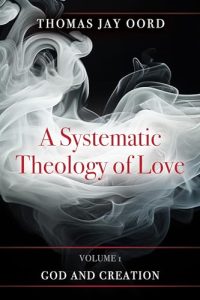
A Systematic Theology of Love: Volume 1 by Thomas Jay Oord Purchase Links: Paperback, Kindle Edition, Audible.com Audiobook
2 thoughts on “A Systematic Theology of Love: Volume 1 by Thomas Jay Oord”