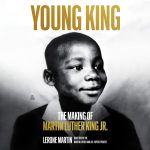
 Summary: An in depth look at MLK’s context and influences as he developed into an adult.
I have previously read Lerone Martin’s biography of J Edgar Hoover. So I preordered the audiobook without paying attention to who the narrator was. The narrator was Blair Underwood. I was in high school and college while he was on LA Law. I was never regularly watched the show, but it was impossible to not know who Blair Underwood was in the late 80s and early 90s. I didn’t know this until this book, but he has written or co-written three books and narrated about 20. I don’t want to take way from Lerone Martin’s writing, but once I got used to Blair Underwood’s style, I think he really helped to make the book. (Generally in a nonfiction book I prefer a fairly straight reading. Underwood did consistent voices for the regular characters, he laughed when the content suggested that the character would have been laughing and he did a very good impression of MLK’s voice. Not everyone could have pulled that off well, but Underwood did.)
I have read a number of biographies about MLK. I have written about Stephen Oates, and Jonathan Eig‘s full biographies and Piniel Joseph’s joint biography of King and Malcom X (and I have read but not written about Cone’s book on King and X). I have written about King’s sermon collection, A Gift of Love, The Radical King and his last book Where Do We Go From Here. And then there have been a number of books about aspects of King’s life, The Letter from a Birmingham Jail, the fallout of his death, Coretta’s memoir and a comparison of King and Bonhoeffer’s Christian ethics. The closest to Young King is Patrick Parr’s The Seminarian. The Seminarian is much more focused on King’s time at Crozier, but Young King is a far better book.
I think I would label Young King as a developmental biography. The point here isn’t what King did, but how he became the man that we now know. Contextually Lerone Martin is trying to paint a psychological and sociological picture of the boy and his community. Of course there are chapters on faith and family and racism, but I think it is also important that there were both long sections on how King was shaped by his father and the conflict he had with his father. Similarly, there were sections not just on how he was shaped by the Black church, but on the ways that he rejected the Black church as overly emotional and for a while was an atheist, before coming back into the church and eventually feeling a call to ministry. King was both brilliant and highly academically underprepared for both college and seminary, and that was made worse by his youth and immaturity (going to college at 15 and going to seminary for a masters at 19).
I glanced around at some reviews and there were some complaints about the speculation or contextualization of the book. One such speculation was that it appears that Malcolm Little (eventually Malcolm X) was selling suits to the tobacco workers in the same community where Martin Luther King was working in the tobacco fields when he was 15. There is no evidence that they met, but I think it was well worth noting that they were both working in the same area and there is evidence that Malcolm sold suits to men that Martin was working with. Much more common is that Lerone Martin is telling the broader story of the context that King grew up in. There are long descriptions of what train travel was like for Black people in the south during the era when King took the train by himself for the first time. Or what how the Hartford, CT area was receiving Black migrant workers in the era when King picked tobacco over two different summers.
I know a good bit about King, but I think Young King did a better job looking at who King was and his strengths and weaknesses than pretty much anything I have read. Eig’s book I think also was very clear about King’s weaknesses, but I think that Lerone Martin is exploring how he developmentally came to some of them. The womanizing, the sexism, the plagiarism, the style of speaking, the confidence and orientation toward “doing something big” are all explored here. That isn’t to say this is a book that overly focusses only on negatives, I think Eig and Lerone Martin, and what I know from Jeanne Theoharis’ approach in A More Beautiful and Terrible History or her narrow look at King’s Northern campaigns, all know King’s limitations were real.
As I read Young King, I was reading the first of Gary Dorrien’s trilogy on the rise of the Black Social Gospel movement. Flawed leaders within the Black civil rights community were not new. (There is no such thing as a non-flawed leader.) I think Lerone Martin has done a great service here focusing on the young King in a way that no full biography can. There are places where I would probably cut a bit, but there are always editorial decisions that have to be made. But Young King is well worth reading.
Young King: The Making of Martin Luther King Jr. by Lerone A. Martin Purchase Links: Hardcover, Kindle Edition, Audible.com Audiobook