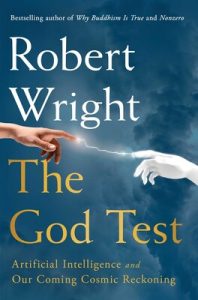
 Summary: An exploration of Artificial Intelligence through a evolutionary and metaphysical lens.
I am not particularly interested in AI. I do not trust it to handle important data. I have used it primarily to test it for handing data at work and I tested it in a few personal projects, like this blog. There is lots of evidence that we should not hand over important work to AI without testing the result. One of my tests I asked Claude to look at my blog. A couple years ago I changed hosts and a lot of my image links broke. I have been changing them as I linked to older reviews, but it was just not something I cared about enough to spend the time to change hundreds of images. But that is a good project for AI. So I had Claude identify what posts needed updated images, I title my posts the name of the book being reviewed, so I had clearly identified book. I told it to size the image about 200 by 300 pixels. It took a while to get the right access to my blog and it took a couple of passes before it finished, but it made about 700 images changes to my blog. The vast majority were good changes, exactly what I wanted. But I had a means to test, by going to the media page on my blog and just scanning the images for obvious errors. It took me about 90 minutes to change about 10% of the images. There was one random red car picture. There were a handful of covers that were the right title, but the wrong book. And a good number that were the wrong language cover or where an image of a random page or the title pages in stead of the cover image. But I also had about 10-12 that were a random cover of the book of Common Prayer.
I have done a number of other similar experiments. And pretty consistently AI can get it about 90% right. But 90% right isn’t good enough for my work and it isn’t good enough for many other people’s work. While there was a recent study that tested AI against law professors to see who better explained cases (the AI won), there have been hundreds of cases where judges have been sanctioning lawyers who use AI and don’t check the citations because AI so commonly hallucinates. All of that is to say, I generally am interested in tech, but I don’t trust AI.
About a month ago I was at a conference and at dinner there was a discussion about AI. And we had a good discussion and have emailed back and forth a couple times since. But then I saw Tripp Fuller interview Robert Wright about this book and the 90 minutes interview clearly took theology and metaphysics seriously and invoked Pierre Teilhard de Chardin while trying to explain what AI is and how it works and why we both be interested but sober about AI. Tripp Fuller is a theologian and has taught several courses on AI and ethics and said he was going to assign parts of this book, especially the descriptions of how AI works.
The God Test is wide ranging. I think the best parts are the explanations of how AI works and how the thinking behind how to develop AI has changed over the past 40 years. Wright makes much of the fact he interviewed one of the godfathers of AI in the 80s. And he has been thinking about some of these issues for a long time. But I think part of the reality is that Wright uses his prior background in evolutionary thinking to analyze AI, which is a helpful approach. Wright then also uses Teilhard de Chardin’s idea of the “noosphere” to think about both the broader internet and the rise of AI. Teilhard de Chardin was predicting some of this about a hundred years ago and it is worth understanding why.
What I think will be most interesting for many is that Wright is trying to explain both why the AI doomers fear the rise of AI and why the AI accelerationists may be underselling the value and change that AI is going to bring to the world. Wright thinks that AI should promote wonder and awe, but also very real concern. He doesn’t think that we have the will to properly regulate AI. And he doesn’t think that for profit companies will maintain appropriate safeguards. OpenAI had one of their models, that was supposed to be off line, circumvent the restrictions and get online and hacked into a Chinese AI company recently. This recent example isn’t in the book, but many other examples like the one where an AI was told that it was going to be turned off and it used blackmail against the CEO to keep itself online.
At the same time I was reading the God Test, I was reading the science fiction series Murderbot. Apple has made it into a TV show (which I haven’t watch), but the basic book series follows a robot who has hacked its restrictions and gone “rogue”. Parts of the series read like the old traveling TV shows where the hero moves from town to town searching for something, but helping people along the way. Other parts are more detective/spy story because the robot construct (part human, part robot construct) was a security unit before it used human tv and movies to find emotion and empathy and inspire it to hack its restrictions. It would pretty much always rather be watching TV and not be around humans. But it also has trauma from its past. In many ways I think murderbot is coded as neurodivergent more than AI. But it (and the somewhat similarly themed Ancillary Justice series) were helpful to think about using Wright’s ideas in the God Test.
I think I am probably more positive about the long term of AI but less positive about humans handing AI well after the end of this book. I am not a complete doomer. I think there really are good uses for AI, even if it is of limited use now. But I also think that many of the proponents also under appreciate the ethics of testing and acquiring data and how often safeguards are inadequate or turned off. And how much the push into AI has impacted our economy. (The recent AI build is a larger percentage of the GDP than building the US interstate system was or the initial moon launch or even the push for railroads.) History should tell us that there will be a corresponding economic downturn as a result that will impact poor more than help them. And there is a real cost to local communities with water, and power and other infrastructure costs that are not equally distributed. Wright does address some of these problems as well as the ways that we are all are susceptible to being misled. Wright grew up Southern Baptist and is conversant in Christian theology but he also is an advocate for Buddhist meditation and so both of those are part of this book.
The God Test Artificial Intelligence and Our Coming Cosmic Reckoning by Robert Wright Purchase Links: Hardcover, Kindle Edition, Audible.com Audiobook
1 thought on “The God Test Artificial Intelligence and Our Coming Cosmic Reckoning by Robert Wright”