Dust by Hugh Howey

Reposting this 2014 review because this book, and the two earlier collections that made up the trilogy are all on sale for $2.99 each on kindle (Wool Omnibus and Shift). Links to my reviews of the earlier books are at the bottom of the page. Summary: The story comes to an end. Hugh Howey broke into … Read more

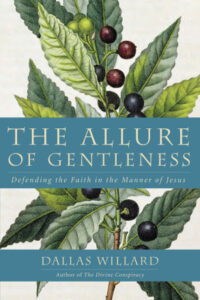
The Allure of Gentleness: Defending the Faith in the Manner of Jesus by Dallas Willard

the allure of gentleness cover imageSummary: The method of apologetics is intrinsically linked to the work of apologetics.

I like Dallas Willard. He has been very helpful, if not always directly, through the mentoring of various other authors and teachers I have been directly impacted by.

Dallas Willard passed away just over two years ago. This book was underway before he passed as a joint project between Willard and his daughter. She organized it based on a series of lectures he gave in 1990 and supplemented it in areas he thought needed further development using other lectures and writings. Despite that, this feels like a cohesive book.

Willard is trying to remind the apologist that the method (and life of the apologist) is important to the work of apologetics. In 1990, I think that was probably a much more needed message than today. We always need to be reminded of that, but I do not think that many apologists today would disagree with that basic summary.

Even so, the part that I most resonated with was that simple reminder. (Although I kept thinking that Unapologetic did a better job communicating the point and at least parts of Vanishing Grace did a better job reminding the reader of the importance of grace toward the non-Christian. )

Read more

Looking for Alaska by John Green

I am reposting my 2012 review because the audiobook is today’s Audible Deal of the day and on sale (no membership required) for $2.95 today only.
Looking for Alaska

Summary: John Green’s first coming of age novel.  A high school student goes away to boarding school in Alabama and tries to find his place in the world.

I am on a John Green kick.  This is the third book in three weeks.  There is only The Fault of Our Stars until I have read all of his books. (The Fault of our Stars is on a lot of people’s best book or best teen book of 2012 lists.  There are also two more books that Green has either co-written or contributed to.)

All of Green’s books are in one way or another coming of age books.  This one is no different.  Miles leaves his home and the school where he does not really have any friends to go away to boarding school at the beginning of his junior year of high school.

As is normal, Miles ends up being best friends with his roommate and his roommates friends.  As they move through the year one event ends up dominating the year.  The whole books either counts down to it, or moves on from it.  I will not spoil the event, but I did not see it coming until it was almost there.  (I am gifted with an inability to predict what is going to happen in books.  I think that is a good feature, but my wife is always amazed I didn’t see things coming).

Read more

Ender’s World: Fresh Perspectives on the SF Classic Ender’s Game

Ender's WorldSummary: A series of diverse essays about Ender’s Game, from leadership and military applications to how it has impacted children’s literature and a lot in between.

There are very few books that I am intimately familiar enough to read a series of 13 essays and a number of Q & A’s from the author and really be engaged throughout. I have a review of the variations of the Ender’s Game story over the years (and I should update that now that I have seen the movie), a full review of the audio play version and a review of the most of rest of the books of the series. I am pretty sure I have read Ender’s Game in one version or another at least a dozen times. (Also Emily Flury has a review of the movie.)

I think unquestionably, Ender’s Game is Orson Scott Card’s best book. I have read most of the rest of Card’s book looking for a book to equal it, and while I really enjoy many of his books, none have resonated with me nearly as much.

Ender’s Game is the story of Ender Wiggins, initially a six year old boy that goes to Battle School to train as a soldier. The Earth has been attacked twice by the Formics (or Buggers depending on which version you are reading). And now soldiers are being trained from childhood to win the next war.

This is the first book I really adored and from the essays, it is clear I am not alone. There are three different types of essays here. Essays on leadership and military, essays on writing or literature and essays on cultural impact. This is not a book for anyone that has not read (and loved) the book. This is a book for not only the fan, but the fan who enjoys geeking out (and listening to others geek out) about minutia of plots points and how they felt when they read it.

Read more

The Lightning Thief by Rick Riordan (Percy Jackson Book 1)

Lightning thief cover imageTakeaway: Fun young adult fantasy novel. There are some serious themes, but they are written in a way that is appropriate for 11 and up.

I have been reading a lot of fairly heavy theology recently. The heavier the theology books I am reading, the more likely I am to need light fiction to offset my brain. I share a Kindle account with some younger people, and they picked up and read the Percy Jackson series last spring. I have not seen the movie (although I probably will now) and did not know anything about the books going into them.

I am a fan. These are quick reads for adults; I do not think I have spent more than 2 or 3 hours on any of them. (I am in the middle of the fourth right now, all in a week.) I also think they are appropriate for kids age nine and up (depending on reading level).

The basic storyline is that Percy Jackson is a bad student.  He is always getting in trouble and has ADHD and dyslexia.  He loves his Mom, but he knows he is making her life difficult because he is always getting in trouble at school.  Eventually, we find out that one of the reasons Percy has a problem is that he is actually the son of one of the Greek gods (a half-blood).

Read more

A New Kindle Paperwhite

Update: Ken Edgerly of Kindle Chronicles has a video, the only one I have seen, comparing the 2nd generation Paperwhite, 3rd Generation Paperwhite and the Kindle Voyager that I think is helpful to seeing what is actually changed.

_________

Amazon quietly announced a new Paperwhite this morning. The new Paperwhite follows up on the original Paperwhite in 2012 and the second generation released in late 2013.

The 2015 Paperwhite keeps the same physical specifications as the first two Kindle Paperwhite generations and the same price.

The main differences are that the new Paperwhite has the same screen as the Kindle Voyager (300 dpi up from 212 dpi) and doubled the ram to 512 MB. The battery and storage space remain the same (and quite adequate).

The other differences are software. The new Bookerly Font that was released on the iOS apps recently will now be native on the Paperwhite. Also there will be a new layout engine that will more closely match the way print books look.

Read more

How to Be Rich: It’s Not What You Have. It’s What You Do With What You Have. by Andy Stanley

I am reposting this review from early 2014 because the Kindle Edition is on sale for $3.99 on Jan 3 and 4. The audiobook is discounted to $2.99 with the purchase of the kindle edition
How to Be Rich: It's Not What You Have. It's What You Do With What You Have.Summary: A short book focusing on how to be Rich (and we are all rich) by being generous.

If you are are a regular reader of this blog you might know that I am a member of Buckhead Church, one of the Northpoint Community Church campuses where Andy Stanley is the senior pastor.

I have read and reviewed a number of books by Andy (see below).  Where Andy shines as a writer is when he is focus on leadership, vision or talking about our churches.  How to be Rich is one of the later type of books.

How To Be Rich is based on the teachings found in an annual sermon series that Andy has preached since 2007.  These sermons focus on 1 Timothy 6:8, “Command them to do good, to be rich in good deeds, and to be generous and willing to share.”

The point of the series is not how to GET rich but how to BE rich.  The book starts by trying to convince the reader that they are rich.  If you have a household income of $37,000 a year, you are among the top 4% of earners in the world.  Andy later talks about the top 1% as a way for those of us that are not that rich to understand wealth.  But then continually comes back to the concept that whether we are top 1% of top 4% we are still rich in the eyes of most of the rest of the world (and God.)

Read more

Searching for Sunday by Rachel Held Evans

Searching for Sunday by Rachel Held EvansSummary: Roughly based on the seven sacraments of the Catholic church, Rachel Held Evans explores her history of leaving the church, helping to plant a church and then eventually finding another church.

I tend to think that people that do not like Rachel Held Evans’ writing are people that do not need Rachel Held Evans’ writing. This is circular I know, but Evans has a particular audience and I think that audience needs her or someone like her. But many others do not find encouragement from her and do not identify with her story, I think that people that are frustrated with Evans should consider themselves blessed.

Evans is a skeptic and doubter. She is a Christian and loves the church and even loves the Evangelicalism that shaped her (and scarred her). But she also is frustrated by the church and many in the church that have no place for doubt, investigation or marginalized people.

Anyone that knows of Evans is unsurprised that the book opens with her frustration with the church. Through the book, there is a clear arc. Evans grows up in the church, is “˜on fire for Jesus’, becomes skeptical, starts exploring the skepticism, eventually leaves the church because of her frustration with it, then helps to plant a church that attempts to live out what she believes the church should be, that church plant fails and over the next couple of years she slowly makes her way into the Episcopal church.

Read more

Mistakes Were Made (But Not By Me): Why We Justify Foolish Beliefs, Bad Decisions and Hurtful Acts

I am reposting this 2010 review because the audiobook is the Audible deal of the Day and on sale for $3.95
Mistakes Were Made (But Not By Me): Why We Justify Foolish Beliefs, Bad Decisions and Hurtful ActsTakeaway: The human brains ability to justify and rationalize mistakes is enormous, useful and incredibly dangerous. There are huge implications for every facet of life.

This is a wide ranging and enormously interesting book on memory, retention and and self justification. The basic idea is that our brains are designed to minimize Cognitive Dissonance. Our brains will re-write memory and selectively remember details or give us other means to repress or eliminate Cognitive Dissonance.

Early in the book there are a number of examples of government, journalism and scientists that believe that they did nothing wrong while external evidence suggest otherwise.  One of the most egregious, is the first study that showed a link between autism and vaccines.  The lead author of the study was being paid on the side by class action lawyers (over $800,000) as an expert witness and researcher into the connection between autism and vaccines. The link was not disclosed and the research study continues to be influential even after it has been widely disproven by additional studies.

Another interesting example are the gifts given to doctors by drug companies.  Drug companies know that small gifts are very effective in creating obligation to the drug companies, but large gifts, especially early in the relationship will make the doctors feel like they are being bribed. One of the important insights from this section is that often people do small things that are not wrong, but once they are a situation, end up doing many things that they would not have considered if they started with that action. For instance, Watergate did not start as a break in, but by the time all the players were in the game, it was easy to justify something that most of them would have never participated in had the idea of a break-in and cover-up been originally on the table.

Read more