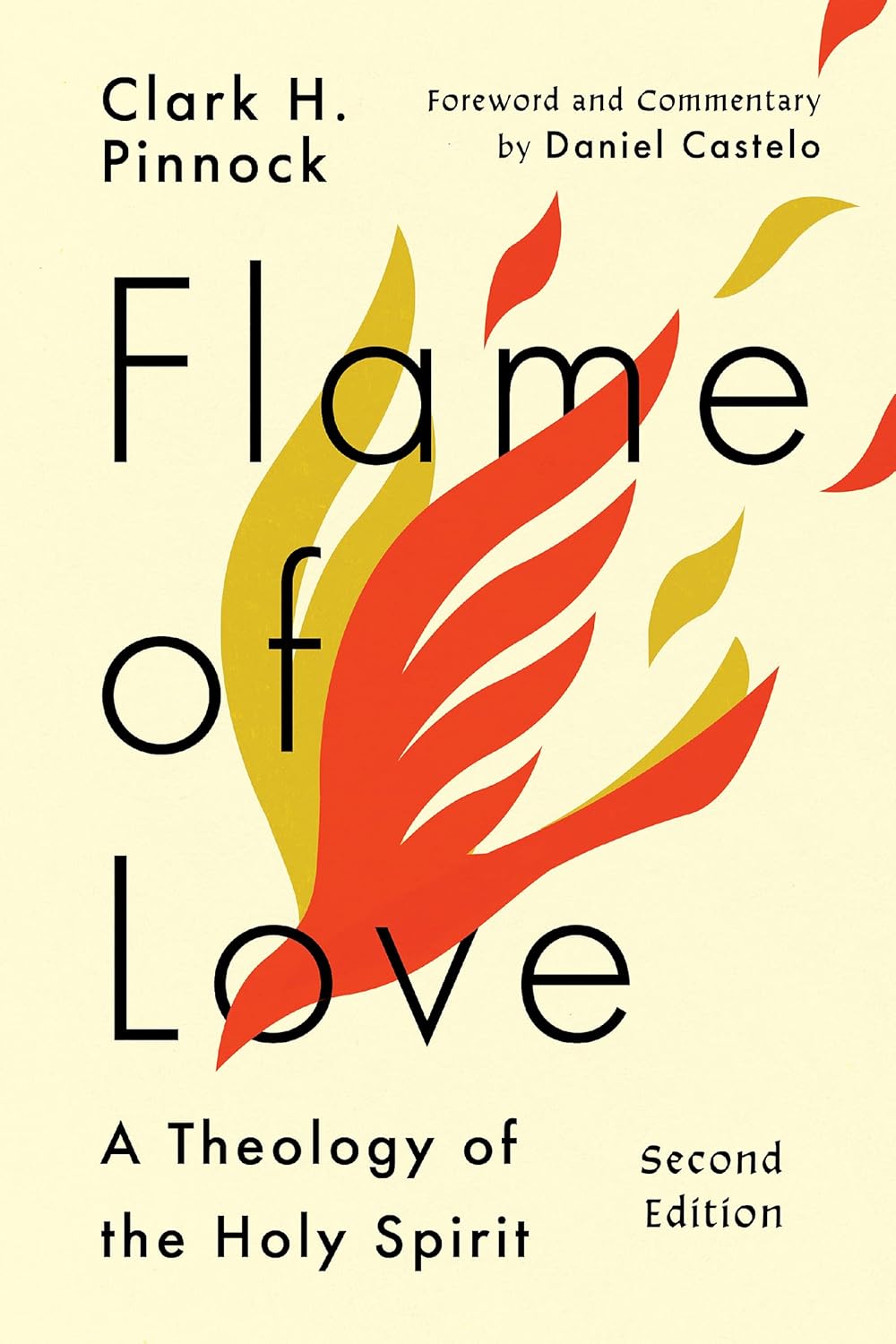
 Summary: A helpful, constructive theology of the Holy Spirit written from an Evangelical perspective.
I first ran across Flame of Love when Christian Century asked several theologians and biblical scholars for their lists of the Essential books of Theology of the last 25 years (in 2010). I compiled an Amazon wishlist of the books I wanted (and accidentally made it public), and a friend bought me a couple. I started with Flame of Love because Clark Pinnock wrote one of the preaching textbooks I read in seminary, and I remembered it as the best book I had read for that class.
I have been meaning to re-read Flame of Love nearly since I first read it, but it has taken me almost 13 years to get around to it. First, I was waiting until I could pick it up on kindle. And then, once I picked it up on Kindle, it sat on my bookshelf until I saw that a new edition was coming out. But again, the audiobook and some driving led me to pick it up.
Rereading that old review, I am struck by the fact that I compared Flame of Love to Francis Chan’s Forgotten God, a book I had completely forgotten. I have done a lot of reading since 2010, and I am aware of new connections in this second read. I was fairly new to atonement theories, and Pinnock and NT Wright were my limited introductions. Richard Beck and many others have expanded my understanding of the atonement, but I recommend The Crucifixion by Fleming Rutledge. She is a pastor, not an academic theologian (and I have read most but not all of the book), but as long as it is (and it is super long), it is very readable.
I find Flame of Love helpful because Pinnock highlights how the Holy Spirit is present in ways that Evangelicals tend to miss. There are seven chapters. The Spirit and Trinity, the Spirit in Creation, the Spirit and Christology, the Spirit and Church, the Spirit and Union, the Spirit and Universality, and the Spirit and Truth. Each chapter examines where the Spirt, who Pinnock sometimes talks about as “The Hidden God” instead of Chan’s “Forgotten God,” plays a prominent role.
Amos Yong’s commentary on the book of Acts is framed as the church, through the power of the Holy Spirit, doing the work that Christ had done in the book of Luke. And that framing, I think, makes a lot of sense of the type of work Pinnock suggests is common to the Spirit. It is not that the church does the work on its own in Acts. The church is being acted on by the Spirit and becomes the public face of God, but only because of the empowerment of the Spirit.
Read more

 Summary: A history of the loosely defined movement known as the Underground Railroad in and around New York City.