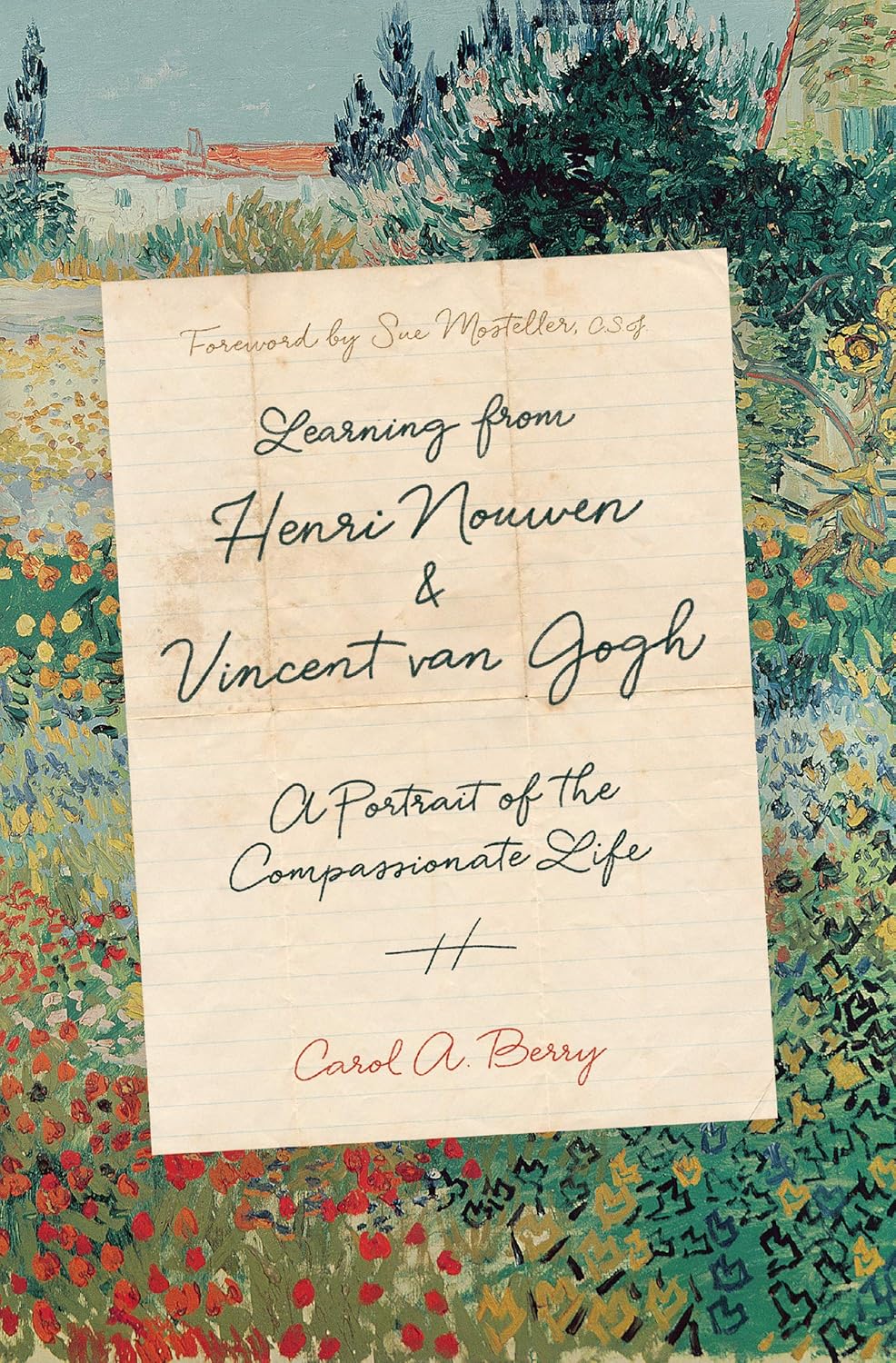
Learning from Henri Nouwen and Vincent van Gogh: A Portrait of the Compassionate Life by Carol A Berry

Summary: Reflection on Vincent Van Gogh, what Henri Nouwen taught and learned about Van Gogh, and some personal reflections of Carol Berry, a student of Nouwen.

I am not well educated in art history or art more generally. What I know of Van Gogh is that I can recognize his style of painting and that he cut off or injured his ear. I understood that he was likely mentally ill, which contributed to his suicide. Except he didn’t commit suicide but was probably killed by an accidental shooting when some young men (probably teens) were playing with a gun. And even that cutting off of his ear was probably an accident.

That is not to say that there wasn’t likely some mental illness in van Gogh’s life. But the focus of this book, channeling Nouwen’s thoughts, is primarily looking at van Gogh’s preparation for ministry and attempts at ministering to the poor and how eventually, his art grew to be a method of serving God and drawing attention to the plights of the poor.

Read more

Castle of Llyr and The Foundling and Other Tales

Summary: The Castle of Llyr is mostly a story about Taran coming to understand that he has feelings for Eilonwy. The Foundling and Other Tales is a book of short stories, more like Aesop’s Fables, but designed to give context to the Chronicles of Prydain. 

Every time my family goes to Disney, my wife paints our magic bands to be personalized. This year, I asked her to paint my band to the theme of Disney’s Black Cauldron. Like most people, my wife had never seen the Black Cauldron movie. When it came out it was the first Disney animated movie to be PG and it is fairly scary. We watched 30 minutes or so together to give her a sense of the art and context for her to paint the band. I went back later and watched the rest of the movie and was yet again disappointed that the movie was not better. It was not awful, but it changed the story too much combining the stories of the Book of Three and The Black Cauldron. And I think that while Taran and Eilonwy were presented well, I was not really a fan of any of the other character’s development.

Read more

Evangelical Anxiety: A Memoir by Charles Marsh

Summary: A memoir primarily focusing on mental health and its connection to religious faith.

I believe I have read two of Charles Marsh’s books and that I own two others. Marsh is the author of Deitrich Bonhoeffer’s biography, which I believe most people should start with. And he has written widely about social justice, especially the Civil Rights movement, and how Christianity has fueled the Civil Rights movement.

Because I enjoy reading memoirs of people writing late in their lives (especially theologians and authors), I preordered Evangelical Anxiety without reading anything else about it other than that it existed. Marsh is not that old; he is 64 years old. So he is not writing his last book like John Stott, John Perkins, Eugene Peterson, Howard Thurman, Charles Pearson, and Billy Graham. Or even a memoir giving a broader overview of their life like Philip Yancy, Nicholas Wolterstorff, Will Willimon, Julie Andrews, Stanley Hauerwas, Dovey Johnson Roundtree, Melba Pattillo Beals, or Thomas Oden did. Marsh is writing a memoir that gives an overview of his life but primarily focuses on how he has grappled with his mental health over his life, especially how his faith has interacted with his mental health.

Evangelical Anxiety is a book that I think many will not appreciate. Just like much Evangelical fiction is not very good because it has to meet the narrow boundaries of what is acceptable, evangelical memoirs and autobiographies tend to present a neat, problem-solved perspective on their lives. Charles Marsh’s memoir does not have a nice bow on it. He has grappled with debilitating anxiety, depression and other mental health issues, and the language and revelations will offend or scandalize many.

Read more

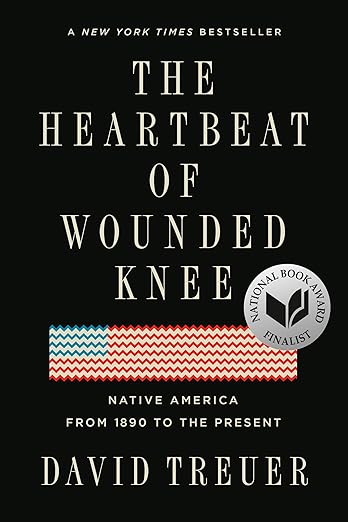
The Heartbeat of Wounded Knee: Native America from 1890 to the Present by David Treuer

Summary: A reframing of Native American History and reminding the world that Native American history did not end in 1890. 

I have intentionally focused my reading on Black American history, but I know that narrow focus limits my understanding of racial history in the US. The story of slavery and segregation of Black Americans is essential, but not the whole story. I have minimal background in Native American history. There were some good sections in Color of Christ, and Richard Twiss’ book Rescuing the Gospel from the Cowboys helps frame issues within Native American Christianity. And Kaitlin Curtice’s memoir Native is well worth reading. But The Heartbeat of Wounded Knee was the first attempt I have made at understanding a larger history.

David Truer is an English professor and fiction writer with a background in Anthropology, not a historian. And the framing of the book is a mix of personal stories to give context to history. Those personal stories of both David Truer and his family, as well as many others from various tribes (and a few from people outside of tribes), give the reader insight into the history and contemporary issues. Of course, no single book can do everything, but from my non-expert position, the breadth of issues and history in a single book is impressive.

There is insight into how US policy has created many of the problems (similar to the framing of Color of Law with housing segregation). Native American tribal government and authority structures are diverse. Still, Truer looks at both the successes and problems of how different groups have structured and how US policy has helped and interfered.

Read more

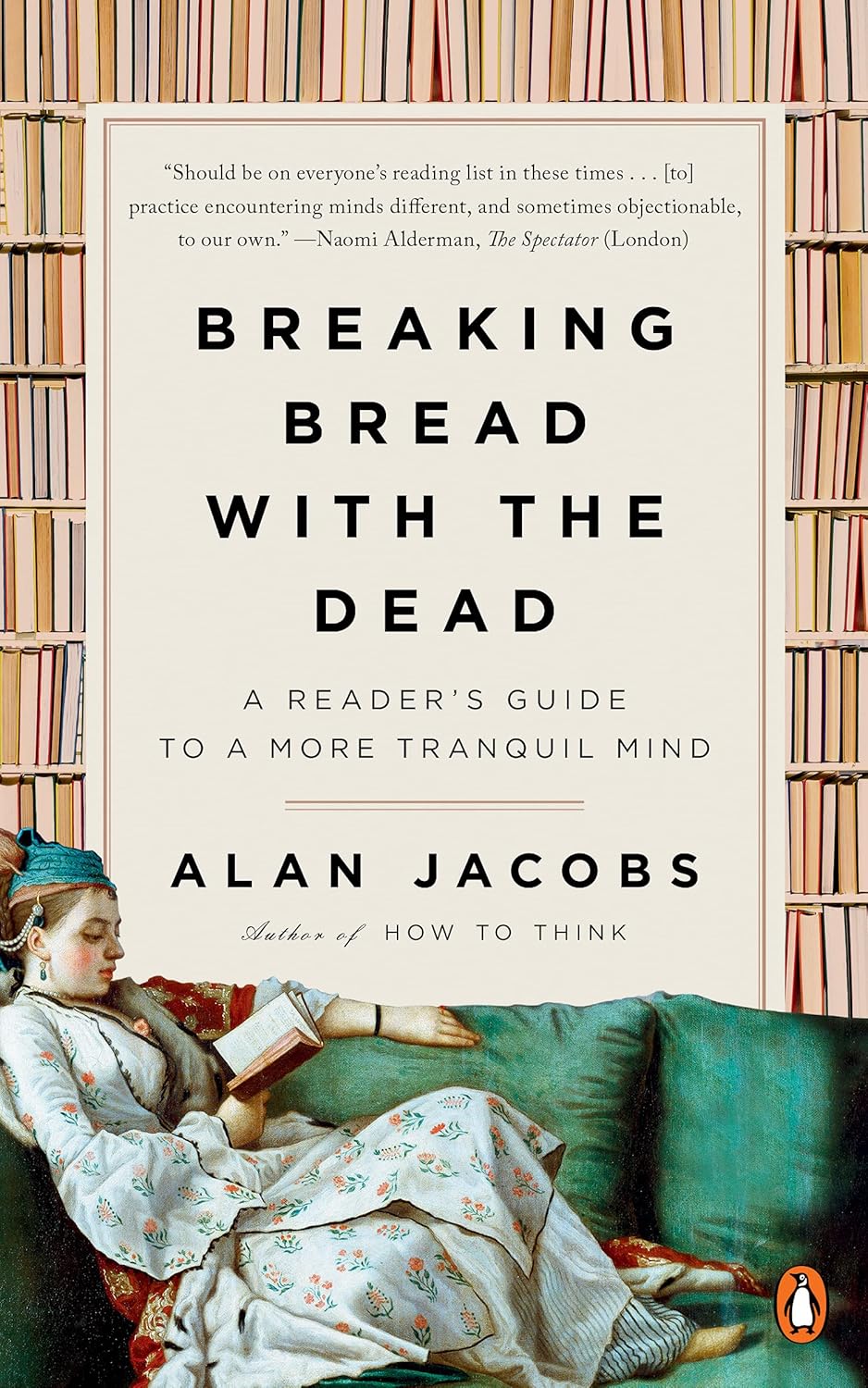
Breaking Bread with the Dead: A Reader’s Guide to a More Tranquil Mind by Alan Jacobs

Summary: A defense of reading old books as a way to counter an orientation toward bias. 

I have read many of Alan Jacobs’ books. I think he is one of the best essayists writing. I think I have read all of his books except a couple. Unlike some writers, he is not someone with one primary theme and hits that same theme repeatedly.

In some ways, Breaking Bread with the Dead could be considered an update to CS Lewis’ defense of reading old books from Lewis’ introduction to On the Incarnation by Athanasius. And if you have not read that one, you should. It is brief and accessible, and classic for a reason.

But Jacobs’ is not just updating Lewis, he is also expanding on why old books matter, especially today. One of the biggest reasons modern people object to old books, besides the orientation toward the new, is concern about how past sins are normalized in old books. Those sins, like the support of slavery or sexism, etc., are discussed extensively in a section about Frederick Douglass’ reading of an old book about public speaking that inspired Douglass’ work. I think Jacobs’ is working well here, but his reasoning did not entirely convince me. Part of the argument I agree with is that different eras have different orientations, and we need different orientations. And I appreciate that Douglass was inspired by a book not written in his own context.

But it is different for Douglass to read a book that had a section about an enslaved person being freed and finding those words to inspire his own freedom, and readers today reading books by people that justified slavery. In Douglass’ case, he had minimal access to books and only a few books that he could have read. Today we have almost unlimited access to books. I am not saying we should never read books by people that have views that we disagree with. But I do think that in making his argument for reading things that we may disagree with, Jacobs made some leaps that were unpersuasive, even as his larger argument, I do agree with.

Read more

Gaudy Night by Dorothy Sayers

Gaudy Night cover imageSummary: Harriet reluctantly returns to Oxford after her murder trial and encounters a mystery that might end up as a murder.

I have been slowly working through the Peter Wimsey mystery series over the past several years. When I have seen people talk about the series, they generally say that either Strong Poison or Gaudy Night is their favorite book. However, since I recently reread Strong Poison to prepare to finish reading the series, I can more directly compare them.

Strong Poison introduces the character of Harriet Vane, Peter Wimsey’s love interest. Harriet Vane is a mystery writer, and I think most people think she is a bit of a stand-in for Dorothy Sayers herself. Gaudy Night is the only book I have read that focuses on Harriet. Harriet is a character in the other books, but Peter is still the main focus. I believe that only Gaudy Night is told from Harriet’s perspective for most of the book.

Even as it is told from Harriet’s perspective, it is a lot of exploration of Harriet’s lack of confidence in her ability to be a detective and her wishes for Peter. Part of the wishing for Peter is her coming to understand that she does love Peter. (Gaudy Night leads directly into Busman’s Holiday, which I read out of order and know is about their honeymoon.) But apart from the romance angle of Gaudy Night, I appreciate the development of Harriet’s character. Still, I wish more full novels were past Busman’s Holiday because Harriet is underdeveloped. She feels to me like she was never fully the partner to Peter that she is intended to be. Peter is still the main character, who Harriet supports as the sidekick.

Read more

The Swarm by Orson Scott Card and Aaron Johnston (Second Formic War Series #1)

The Swarm by Orson Scott Card and Aaron Johnston (Second Formic War Series #1) cover imageSummary: Prequel series that goes back before the start of Ender’s Game. 

I am in a data entry season at work, and these are the times when I look for fiction to listen to. Orson Scott Card’s books are produced by Stefan Rudnicki and have a full cast, including Stefan Rudnicki. In the Acknowledgments to Card’s most recent book, he thanks Rucknicki and says that the series has become an audiobook series primarily. The voices and high-quality production are consistently among the best audiobooks I listen to, even if the actual writing is not always up to the same quality.

A decade ago, Aaron Johnson started on these two prequel trilogies (a trilogy for each of the first two Formic Wars). And although I am a huge fan of Orson Scott Card generally, I was getting tired of Card’s politically orientated fiction (Empire and Hidden Empire) and how some of the Ender series felt like it was just recycling old storylines. And a number of the reviews from Ender fans were not favorable. So I never picked them up. I eventually picked up The Swarm when it was in a sale but did not listen to it for months after I purchased it.

I should have realized that these are interconnected trilogies, but I did not. The Swarm is the first of a second trilogy, but primarily the characters were introduced in the first trilogy. So I was getting dropped into the middle of the story. This is a prequel series, so as Aaron Johnston says in the afterward, the reader knows where the story ends, just not how it gets there. Mazer Rackam, the mentor to Ender in Ender’s Game, was the hero of the first and second Formic Wars. But he was relatively unknown at the time of the two wars because his work was classified. Again, as Aaron Johnston talks about in the Afterward, primarily what we know of Mazer Rackam’s background was in a single sentence of Ender’s game. That meant that Johnston, with consultation from Card, had to pay attention to that canon content (because super fans will) and yet still make the story engaging and coherent.

Read more

Strong Poison by Dorothy Sayers (Lord Peter Wimsey Mysteries #6)

Strong Poison cover imageSummary: Harriet Vane is introduced to the Lord Peter Wimsey mystery series.

I read the final book of the Lord Peter Wimsey mystery series last week, and that inspired me to go back and listen to the audiobook of Strong Poison, the book where Harriet Vane was introduced. Unfortunately, I continue to not really be a fan of Ian Carmichael’s audiobook. They are fine, but not as well narrated and engineered as I think they should be.

There is not much different from this second reading of Strong Poison than my thoughts after the first reading. I was mostly interested in getting the details of the book, so I could read the books between Strong Poison and Busman’s Holiday over the next couple of weeks. I also wish that Harriet was more present in this book. She is basically a damsel in distress here. She is in jail for virtually the entire book. People know her and reference her, but she is not a strong character. She is more present in Have His Carcase, but that is still mostly told from Peter’s perspective. I still have not read a number of the short stories, and I am currently in the middle of Gaudy Night (which is told from Harriet’s perspective). Gaudy Night and Busman’s Holiday prove that this could have been a good series that focuses on the two of them, not just Harriet as a sidekick.

Read more

A Heart Lost in Wonder: The Life and Faith of Gerard Manley Hopkins by Catharine Randall

A Heart Lost in Wonder: The Life and Faith of Gerard Manley Hopkins cover imageSummary: Brief biography of a Catholic Priest/Poet who was only published posthumously. 

I am not a very good poetry reader. I appreciate poetry theoretically and enjoy the technical work of the poet. I am fascinated by the rhyme schemes and structure. I believe in how poetry forces us to think and process words that have multiple meanings. However, I just do not read poetry as much as I should because it takes more work and time. But that very work and time is part of why I theoretically appreciate poetry even if I do not practice what I value theoretically.

Gerard Manley Hopkins is one of those Christian poets that, if you have a little bit of knowledge of his poetry, you will see references to it all over the place. Several of Eugene Peterson’s book titles are references to his poetry. And many other modern authors also reference his lines of poetry. Hopkins died young. He converted to Catholicism against his family’s wishes in the mid 19th century as a young man. He fairly quickly became a Jesuit priest, following in the steps of John Henry Newman.

Gerald Manley Hopkins loved writing but also was conflicted about his writing because he thought, at times, it distracted him from his devotion to God. At least once, Hopkins destroyed a significant amount of his poetry. And his Jesuit order destroyed a significant amount of his poetry at his death. After his death, his friend Robert Bridges and others published his poetry, often collecting it from letters.

Read more

The Black Church: This Is Our Story, This Is Our Song by Henry Louis Gates Jr

Takeaway: Watch the documentary, skip the book. 

Books attached to documentaries are very mixed in quality and value. Some are designed to be companions and provide additional context and background and might be worth reading even if you have never seen the documentary (American Conscience about Reinhold Neibuhr). And some are essentially the script of the documentary (I Am Not Your Negro) or literally the audiotrack of the documentary (NT Wright and Micheal Bird’s audiobook). The Black Church is more than just a transcript, but there is not much additional value if you have already watched the documentary.

I watched all four documentary episodes live as they were released, and I listened to several podcasts and read articles about the documentary. The original documentary was four hours long. The audiobook was seven hours long. Except for the epilogue, it was hard to remember anything about the audiobook that was not mentioned in the documentary. I am sure there were some additional quotes and context. But it felt like most of that difference in three hours gave context to what was visual in the documentary. For instance, the book has to introduce everyone that is quoted, but in the documentary, their name and affiliations are just a subscript on the screen.

Read more