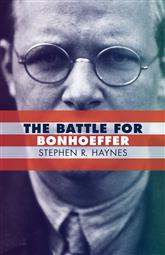
The Battle for Bonhoeffer by Stephen Haynes

Takeaway: While Bonhoeffer is treated by many as a Rorschach test, there actually was a real person that should be dealt with honestly.
Dietrich Bonhoeffer is one of the most respected Christian figures of the 20th century. But it would not be surprising that his legacy is debated. Bonhoeffer’s works span 16 volumes in the complete works. Those works include letters, books, fiction, sermons, academic papers, and more. In the breadth of his work over time, it is unsurprising that there were significant changes in thought, even in his short life.

What may be surprising for many is how recent the interest in Bonhoeffer is. There is a good chapter by Timothy Larson in Bonhoeffer, Christ and Culture, that traces Evangelical reception to Bonhoeffer. And Martin Marty’s biography of the book Letters and Papers from Prison has a long section that traces the history of how Bonhoeffer was received as well.

The Battle for Bonhoeffer is a book-length expansion of the use and misuse of Bonhoeffer that both mentioned books discuss in shorter sections. And for the most part, Battle for Bonhoeffer is a scathing critique of the misuse while noting some of the better uses.

Bonhoeffer’s ideas have been widely appropriated by different movements from the start. John Robinson’s very controversial book Honest to God used Bonhoeffer’s concept of religion-less Christianity. But in 1963, when Honest to God was published, Bonhoeffer was not widely known, and he was tainted in conservative circles because of his attachment to Honest to God.

Haynes carefully examines how different groups have used (and often misused or distorted) Bonhoeffer for their own purposes. This is a brief but helpful reminder that the broader context of a person’s life and work is essential to rightly understanding and using a person’s ideas. My most significant takeaway from Battle for Bonhoeffer is understanding the subject before discussing it.

Read more

All That’s Good: Recovering the Lost of Art of Discernment by Hannah Anderson

Takeaway: Discernment is about practice, wisdom, and intention. 

For regular readers of my reviews, it will be repetitive to say that Christianity is not just about being saved from our sins and going to heaven. It is also about abundant life on earth now. When Jesus gave his commission after the resurrection, he said, “Make disciples” in Matthew. Evangelism is essential, but it is the start, not the end, of the great commission.

Hannah Anderson is continuing this exploration of discipleship that she started in her earlier two books with a focus on discernment in All That’s Good. The blurb on the back of All That’s Good says in part, “Discernment is more than simply avoiding bad things; discernment actually frees you to navigate the world with confidence and joy by teaching you how to recognize and choose good things.”

I so much appreciate that Hannah Anderson starts All That’s Good with an exploration of a vision for goodness, “…in trying to keep myself safe, in obsessing over making the “right” choices, I found myself making a whole lot of wrong ones. Because I lacked a vision for goodness, I also lacked discernment.” (page 12)

The main section of All That’s Good (pages 63 to 154) is an extended meditation on Philippians 4:8, “whatever is true, whatever is noble, whatever is right, whatever is pure, whatever is lovely, whatever is admirable”, ”if anything is excellent or praiseworthy”, ”think about such things.” (NIV) In many ways (all good), this feels like the type of meditation on scripture that Eugene Peterson writes. It isn’t a word-for-word bible study; it is a practical exploration, not just the biblical concepts of the passage, but also of what that means to how we live our lives.

The practice of discernment as it is explored is not primarily thought of as a spiritual gift given to some (although that is one aspect of discernment for some people) but a skill developed over time. That skill, along with necessary components of humility, wisdom, virtue, the correct understanding of goodness, not just the avoidance of evil but the knowledge of good, and a touch of shrewdness, allows us to see the world around us rightly.

Read more

Audible on Apple Watch

Just over a week ago, Audible released its first Apple Watch app. Considering the Apple Watch has now been out about 3.5 years now, Audible has not rushed an app to market. In many ways, I do not think the Apple Watch has been ready for an Audible app until the last generation or two of Apple Watches and software.

The app was quietly released and I did not see it until it had been out for two days. I am a heavy Audible user. (I buy 30+ audiobooks a year and have a library over around 700 audiobooks. I have been a continuous member of Audible since 2004 or 2005.) I honestly was not sure that Audible needed an Apple Watch app because I have been pretty happy with my iPhone app.

Last year, Amazon released the Kindle Oasis with a Bluetooth wireless connection and an Audible app. But while I tried it, I primarily still listen to the iPhone because that is the device that I always have with me.

But the Apple Watch is different. When I am awake, I have the Apple Watch with me, even more than my iPhone. About six months ago I bought a used pair of AirPods, which has been the best purchase I have made for a long time. The AirPods are now always in my pocket. They instantly connect to my iPhone or Apple Watch. I almost always only keep one ear in at a time because I am a stay at home Dad and do not want to isolate myself. Alternating ears, I have never completely drained the battery of the AirPods.

Read more

The Children of Men by PD James

Takeaway: Only similar to the movie in the very broadest outlines.

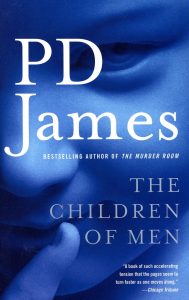
It has been a while, but I really liked the 2006 movie version of The Children of Men with Clive Owen. I picked up the audiobook of Children of Men recently because I had read two of PD James’ mysteries and wanted to see her approach to a dystopian scifi thriller might be different. Other than the broadest outlines, the book and the movie are very different. I am not really going to compare them (because it has been too long since I have watched the movie), but I will note a few things.

The main character, Theo Faron in the book is a 50 something academic. He is the cousin of the dictator and a former informal advisor. The book is set in a dystopian UK. For an unknown reason, there have not been any children born for nearly 20 years anywhere in the world. The UK, because of its governmental system and relative wealth is broadly comfortable, but the population is aging and there is a broad hopelessness. Foreigners are uses as servants that are little better than slaves. The shrinking population (both because of natural aging and large numbers of suicides) is being moved toward population centers.

Read more

Defining Moments in Black History: Reading Between the Lies by Dick Gregory

Summary: How we tell stories matters to how we see the world.

Just a little over a year ago Dick Gregory passed away. Defining Moments in Black History was his last book. Dick Gregory was most well known as a comedian. His comedy albums in the 1960s and 1970s as well as his comedy tours and TV appearances made him nationally known. But Gregory was also a political activist. He ran for Chicago mayor against Richard J Daley in 1967. He was signficantly involved in the Civil Rights movement.

And as you hear throughout this book, he was at or participated in or knew personally many of the people or events that he is talking about.

I have no idea how to really talk about this book. Much of it is just standard recounting of the parts of history that are routinely ignored or white washed. But other parts are just crazy town conspiracy theories. I think that is part of what Gregory is known for. What is hard to talk about is that not all of the conspiracy theories he is talking about are simply theories. Plots against MLK by the FBI are not conspiracy theories. Cointelpro and the Tuskegee Syphilis Experiment are not conspiracy theories.

And then there are the parts that may have some validity, but are unlikely. Coretta Scott King and many others believe that there was a broader conspiracy to kill Martin Luther King Jr. From what I can tell, there is circumstantial evidence, but not definitive proof that the FBI, the Memphis Police or other government agencies played a role in MLK’s assassination. But there is enough evidence for the discussion.

Read more

The Scroll by KB Hoyle (Gateway Chronicles #5)

Takeaway: Well-crafted stories are a joy!

The Scroll is the fifth book in the series. Discussing the book without giving away some spoilers from earlier books is impossible. So, if you have not read the earlier books, you may want to stop and read my reviews (in order) of The Six, The Oracle, The White Thread, and The Enchanted.

Part of what I like about good fiction, and this series is a great example of good fiction, is that there is more than surface-level meaning. Real ideas are being discussed. Hoyle is a Christian, but this is not being written as “Christian fiction” in the sense of pat answers and veiled presentations of the gospel. However, Tolkien wrote Christian fiction, with well-written, complex stories that present the world well but are influenced by the Christianity of the author.

The most obvious top-level idea in the book, which is likely influenced by Christianity, is the prophecy. The Six were called Alitheia. Almost as soon as they arrived, they learned of the prophecy that they were thought to be the fulfillment of. That prophecy included the marriage of Darcy (from our world) to Tellius (then Prince, now King Alitheia). As young teens, neither Tellius nor Darcy were interested in marriage or being told who they had to marry. The Christian concept of election and God’s action in the world through prophecy has a long and complicated history. But as Darcy and Tellius are around one another over a couple of books, they realize they actually love one another. They do want to get married. And even if it was foretold, they have made the choice on their own as part of who they are.

In the first book, Darcy is tricked and captured by Tselloch, the bad guy of the series. Tselloch is from a third world, not Earth or Alitheia. He is trying to control Earth and Alitheia by building gateways between the world and gaining control. Humans can give themselves over to Tselloch and become Tsellochim. After months of torture, Darcy had decided to give herself over and touch Tselloch, but was rescued at the last second. However, in the immediate seconds before rescue, she did touch Tscelloch, and that touch, normally enough for her to have become a Tsellochim instantly, has haunted her since. Most people become Tsellochim immediately, but Darcy has spent the next four books feeling effects as the touch crawls up her arm, but not fully being given over to the change.

Read more

So You Want to Talk About Race by Ijeoma Oluo

So You Want to Talk About Race by Ijeoma OluoSummary: “A lot of people want to skip ahead to the finish line of racial harmony. Past all this unpleasantness to a place where all wounds are healed and the past is laid to rest.” (Page 140)

Race can be difficult to talk about clearly. Many Whites are reluctant to talk about race because they do not want to accidentally say something offensive. Many minorities are reluctant to talk about race because they are tired of the conversations that do not seem to actually get anywhere. In So You Want to Talk About Race, Ijeoma Oluo steps into the gap with a primer on race discussions.

With each new book I read, I have a tendency to say, ‘this is the best so far’. This is in part a bias toward newness. But I think it is also my tendency to see where each new book I read brings something slightly different and unique to the discussion.

So You Want to Talk About Race is very straight forward. The first chapter defines race. The second chapter talks about what racism is. The third chapter talks about why we should talk about race and the fear of doing it wrong (short version, if you want a real relationship, you have to talk about real issues.) Each of the chapters cover a fairly narrow topic and build on the previous topic. Privilege, intersectionality, police brutality, affirmative action, school to prison pipeline, the ‘N’ word, cultural appropriation, hair, microaggressions, anger, the myth of the model minority, I got called a racist, etc round out the book.

There are a lot of books on race. And very few of them would not be helpful to at least someone. One of the benefits of a wide variety of books from a wide variety of authors is that they can target particular audiences and bring different perspectives to show that there is not a single perspective on race and racism.

So You Want to Talk About Race has one of the better treatments on intersectionality. There is a lot of misunderstanding about what intersectionality is. A recent blog post I read suggested that intersectionality is a competition to see who is most oppressed, the winner gets to tell everyone else that their opinions do not matter. That, of course, is a ridiculous misunderstanding of the concept.

In an overly short form, intersectionality is the concept that different types of discrimination impact people differently and they cannot be all handled the same. For instance, a woman that experiences sexism is discriminated differently from someone that is in a wheel chair. It would do no good to tell the woman that is discriminated against because of her gender that the way to solve her problem is to have more accessible workspace with more ramps and bathrooms and a good health plan. But in addition to recognizing that there are different types of discrimination, one person may be discriminated against in multiple different ways at the same time.

Read more

The Year of Our Lord 1943: Christian Humanism in an Age of Crisis by Alan Jacobs

The Year of Our Lord 1943: Christian Humanism in an Age of Crisis by Alan JacobsTakeaway: Education as virtue development has been on the horizon for a while.

I feel inadequate to comment on The Year of Our Lord 1943. I spent about two weeks reading it. I have been thinking about it for a week since I read it. And I think I probably should go back and read it again before I try to write about it. But do not really have time to do that. This is a book that needs a second reading. It is not that Alan Jacobs is hard to read. He is not difficult to read, he writes clearly and well. And he is not dense in the way that some writers are dense. But every time I read Jacobs I appreciate that I am not really as well read or as smart as many people in this world. Jacobs puts ideas and people together in ways that I just would not on my own. Which is why he is so helpful to read.

Read more

Four Funerals and Maybe a Wedding by Rhys Bowen (A Royal Spyness Mystery #12)

Four Funerals and Maybe a Wedding by Rhys Bowen (A Royal Spyness Mystery #14)Summary: She gets married. Finally.

I have really enjoyed these light cozy mysteries as a change of pace. Four Funerals and Maybe a Wedding is the twelfth in the series. Like any series, there is some unevenness in the books. And although I do think this is one of the better books recently, there are parts that drive me nuts. Georgie’s continued assumption that Darcy is cheating on her, when every time, it is part of his job as a spy or another very explainable reasons is tiring. Georgie is smart and this thing about making her doubt herself all the time doesn’t really work. Some self doubt is natural, the extent of her doubt in Darcy is not.

In the last book, as someone in directly line to the throne (35th, but still direct), Georgiana had to receive permission from the King and Parliament to remove herself from the line to the throne so that she and Darcy could marry (since he is Catholic). Having been given that permission, this book is about the planning for the wedding. I already said above that the wedding happens. There have been enough delays in this series already, so I at least would want to know if it was going to be delayed again.

Read more