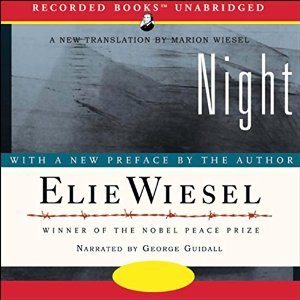
 Takeaway: A book everyone should read to remind us that suffering is not a reality show or an abstract discussion.
I have never read any of Elie Wiesel‘s books. I have known of him and that he was a Nobel Prize winner and writer, but not a lot more. I ran across his first book, Night, when looking for audiobooks on Overdrive. (Overdrive is a library system that allows you to check out ebooks or audiobooks over the internet just like your regular library books.)
I ran across it months ago and kept putting it off. I knew it was about the holocaust and I just did not want to read a depressing story. Finally, I decided to go ahead and start it. I was transfixed. I listened in less than 24 hours.

 Takeaway: Jesus’ life on earth was for more than just taking us to heaven.
 Takeaway: Sometimes not having something really allows you to look and understand.
 Summary: A scandalous death and the threat of devil worship shake up the quiet village of St Denis.
 Summary: Finding spiritual practices for those that have become dead to spiritual practices.