Summary: Inspector Gamache and his wife may be on vacation for their anniversary, but murder still follows them.
I am a big fan of the Inspector Gamache series, but I have not re-read any of the books until now. I am contributing to a series of essays in celebration of the series for the release of the 19th book, so now I have a reason to re-read. I did not pick up A Rule Against Murder for a reason other than it was the earliest book in the series available at my library. I checked out all of the early books from the library and only started purchasing the later books. About halfway through the book, I noticed that the early books in the series had been added to the Kindle Unlimited library. I think I will re-read the next book in the series and then go back and start the series from the beginning.
It has been about seven and a half years since I first read A Rule Against Murder. Most of the books I have listened to as audiobooks. And I again picked this up as an audiobook, although I finished the last hundred pages in print. Ralph Cosham was an excellent narrator for the series, but he passed away between books 10 and 11, and Robert Bathurst has narrated the books since that point.
I never really know how to write about fiction. With fiction, especially the mystery/thriller genre, there is value in not knowing much about the story before you read it. I tend to read authors I trust without knowing anything about the books. I am far enough away from the first reading that although I remembered the basic storyline, I did not remember who did it until the book revealed the killer. I am not a reader that attempts to figure out the mystery before it is revealed. An author can choose to misdirect or reveal beyond my skill, and so I tend to allow the book to unfold on its own.
Summary: Intro to the work and context of JRR Tolkien.
When I tend to get too ambivalent with my current reading (both interested in the topic but not wanting to pick up the book), I often turn to lecture series like the Great Courses on random subjects to either distract me or to be in conversation with whatever I am currently reading. Picking up The World of JRR Tolkien is clearly an attempt at something completely different. (And an attempt to prepare for the Amazon series coming up soon.)
The World of JRR Tolkien is shorter than most Great Courses at only ten lectures and not quite 5 hours. I listened to it in just a couple of days. I am not a Tolkien scholar, and while I did revisit the Lord of the Rings earlier this year, that was the first time I have read the books in about 20 years. And I have not previously read a biography of Tolkien or books about him. So this was mostly new material for me. I am very familiar with CS Lewis and the Inklings, so I am not entirely new, but almost nothing in this lecture series by Dimitra Fimi repetitive to what I have previously read or listened to.
The first lecture is about how Middle-earth is both medieval and modern and gives a general introduction to the series and Tolkien. The second lecture caught me off guard; it is about how Tolkien initially attempted to create a mythology for England that would draw together the country in ways not unlike what was intended for the Book of Common Prayer. That is not just audacious, but it is concerning from our 21st-century vantage point, given the ways shared memory, and a common mythology was misused with the Nazi regime and the Lost Cause mythology in the US.
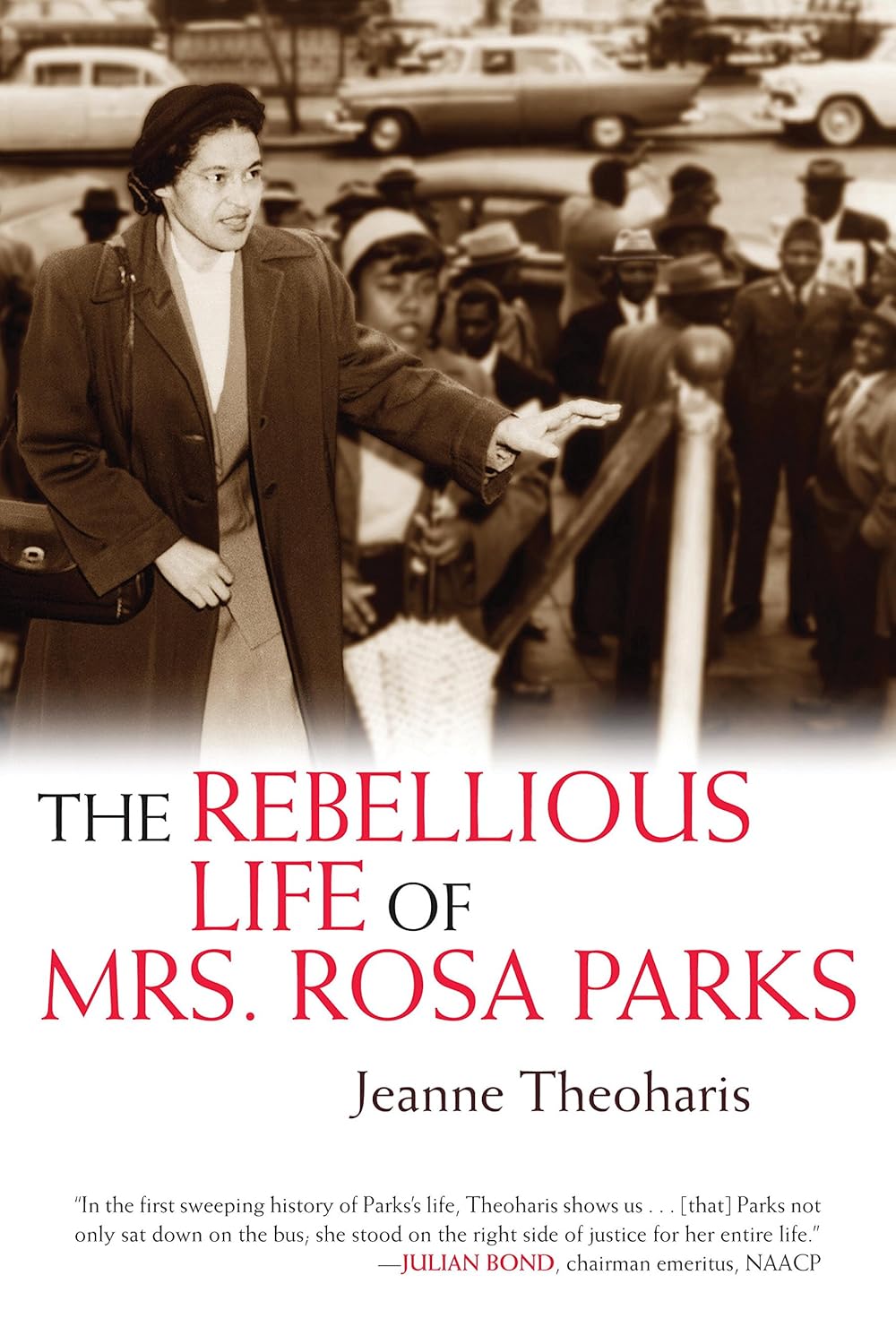
Summary: A nuanced and detailed biography of a woman that has primarily been reduced to a single act.
I have read Jeanne Theoharis’ books out of order. Her more recent book, A More Beautiful and Terrible History: The Uses and Misuses of Civil Rights History, has many themes hinted at in The Rebellious Life of Mrs. Rosa Parks but more fully fleshed out in the second book. Both books are well worth reading, although there is some overlap. There is a running joke among Civil Rights historians that quite often, the history of the civil rights moment is presented as that one day the Supreme Court announced the end of school segregation, and then the next day Rosa Parks sat down. A day later, MLK stood up to give his I Have a Dream Speech. Then the Civil Rights Act of 1964, the Voting Rights Act of 1965, and the Fair Housing Act of 1968 were passed, and MLK was assassinated. The real history of the Civil Rights Movement is much more complicated and much longer.
In some ways, it is hard to categorize the boundaries of the movement because, as with all history, events influence other events. Both The Rebellious Life of Mrs. Rosa Parks and At the Dark End of the Street: Black Women, Rape and Resistance-a New History of the Civil Rights Movement from Rosa Parks to the Rise of Black Power emphasize that by 1955, Rosa Parks had been participating or leading on civil rights issues for nearly 20 years. The December 1, 1955 events may not have been explicitly planned as an NAACP action, but it was not a random event that did not have a larger context. Several events had to work together. Rosa Parks tended to avoid James Blake’s bus because she had had run-ins with the bus driver before. Other events around the country like the lynching of Emmett Till, the Interstate Commerce Commission’s ruling banning “separate but equal” regarding interstate bus travel, and Rosa Parks’ recent participation in the Highlander Folk School training all likely had some effect. In the end, Rosa Parks refused to get up from her seat. City policy should have meant that she did not have to move because no other seats were available. Instead, the bus driver called the police, and she was arrested. Because this is such an essential part of Rosa Parks’ legacy, the event and the bus boycott are significant parts of the biography. But the biography also clarifies that Rosa Parks was far more important than just her single act, even if that act is what she is known for.
The Rebellious Life of Mrs. Rosa Parks and many other books about less well-known figures of the Civil Rights movement show the considerable cost that everyday people suffered. Money is not everything, but it is one illustration. According to tax records, it took ten years for the couple to recover their income from before the bus boycott, and they were not a wealthy family. At the low point, their income was cut by 80%. Even so, during this time, they were forced to move to Detroit to escape the harassment and job discrimination once the boycott was completed. Rosa Parks spent nearly two years working as a receptionist at the Hampton Institute in Virginia (a historically black college) away from her husband and mother because it was the only job she could find (and the Hampton Institute did not provide housing for the whole family). It was not until a year after the newly elected congressman John Conyers hired her as a congressional staffer in 1965 that their income reached above the pre-1956 income.
Summary: A good overview of the Old Testament, not just the content of the Old Testament, but interpretative methods, ancient culture, and ways scholarship interacts with ancient texts.
I am a fan of Great Courses and “Very Short Introduction to” books. But one of the most common weaknesses is that in a brief survey, the book/lectures can be primarily about the academic study of the subject, not the subject itself. For example, in The Bible: A Very Short Introduction by John Riches spends very little time introducing the content of the bible and instead spends almost all of his time on the academic study of how it was written or compiled into the canon or how it is studied. All of those things are helpful in the proper context. But in a brief survey, I think the primary focus should be an overview of the content.
I have wanted to read a book by Amy-Jill Levine. She is a well-known author and writer. She is Jewish but is known partly for her Jewish presentations to Christian audiences. She takes the spiritual reality of the Old Testament/Hebrew Bible seriously. Still, she is an academic presenting in a way that primarily focuses on what can be known naturally (in the sense of non-spiritual). And this is what most of the negative reviews on Audible are about. For example, she says that at this point, there is no archeological evidence that David was a real person and that she tends to think that he was an archetypal figure. That does not mean that there never will be archeological evidence of David. But I think Christians must grapple with the reality of how modernism has impacted our faith. Modernism wanted to dismiss not just the possibility of supernatural actions of God but dismiss anything that could not be proven naturally. And those Christians that reacted against modernism accepted many of the same premises, but in the other direction, trying to prove through modern scholarship that all of the supernatural events actually happened and the bible was only historical in a modern understanding of that idea.
One of the strengths of this presentation is that in the process of giving an overview of the content of the Old Testament, Levine illustrates different models of understanding and studying ancient texts. She uses the Historical-Critical method and brings comparative stories from other cultures. She spends a lot of time on genre and points out how the author’s intention (at least what we can reconstruct of intention) should play into how we understand a text today. She introduces the idea of etiological myth, a story that explains how something came to be. One example of this is the story of Lott and his two daughters; the children born to Lott and his daughters are Moab and Ammon, the names of two of the people groups around Israel. And a story about how those people groups were derived from incest and drunkness seems like it very well may be an example that was intended to be an etiological myth (an explanation of how something came to be) and not an example of modern history.
Summary: Even in civil rights history, the role of women, especially their work to end sexualized violence, has been under-appreciated.
I have owned At the Dark End of the Street for years, and I have not picked it up because I knew that it would be a difficult book to read. However, taking the concept of trigger warnings seriously, this is a book that discusses sexual violence and rape frequently. It is not described luridly, but in discussing the reality of the use of rape as a form of terrorism and an expression of white supremacy (in the sense of racial superiority), sexual violence is described regularly throughout the book. But as I continue to interact with people about race and historical issues, I am convinced that these difficult topics have to be discussed because the lack of discussion is part of what whitewashes history.
At the Dark End of the Street is a reworking of Danielle McGuire’s dissertation. The broad thesis is that the civil rights movement has suppressed or at least under-appreciated the role of women organizing against sexual violence.
“Between 1940 and 1975, sexual violence and interracial rape became one crucial battleground upon which African Americans sought to destroy white supremacy and gain personal and political autonomy. Civil rights campaigns in Little Rock, Arkansas; Macon, Georgia; Tallahassee, Florida; Washington, North Carolina; Birmingham and Selma, Alabama; Hattiesburg, Mississippi; and many other places had roots in organized resistance to sexual violence and appeals for protection of black womanhood. And yet analyses of rape and sexualized violence play little or no role in most histories of the civil rights movement…”
Many people know Rosa Park’s work for the NAACP in the 1940s and 50s before the Montgomery Bus Boycott. And many people may be aware that one of the early roles of Rosa Parks as the secretary of the Montgomery chapter of the NAACP was to investigate cases of rape as terrorism. In 1944, Recy Taylor, a 24-year-old woman, married, with a young daughter, was kidnapped while walking home from church. Four men repeatedly raped her. Taylor, and a friend who was walking with her, were able to identify the car and the men. The men admitted to “picking up” Taylor. Still, because of the ways that Black women were stereotyped as universally sexually immoral, their claim that they had paid her for sex was accepted by the police. Because of how badly beaten Recy Taylor was, and the work of Rosa Parks and others in publicizing the case nationally, a grand jury was convened. The grand jury heard Recy Taylor’s testimony and the men’s admissions but refused to indict them. (Having picked up At the Dark End of the Street while I was reading The Bill of Rights Primer, the discussion by Adams and Amir about the grand jury as a means of holding the government accountable for abuse was prescient. The problem with the system of grand juries is that they do not work if there is widespread discrimination within the community.)
Eventually, a second grand jury was held because of national outcry, and the grand jury refused to indict the men again. But this national campaign was only the start of women in the Montgomery area resisting sexual violence. That sexual violence was not just random men terrorizing women but also official actors using sexual violence as part of their official role. Police in Montgomery (and throughout the south) regularly raped Black women, making it hard for the Black community to have anyone to turn to. And the buses were not an incidental target for a boycott. The bus drivers exposed themselves to black women as a form of sexual harassment. They were legally authorized to carry guns and use them with little accountability. There were multiple cases of bus drivers killing passengers in Montgomery (and around the south). And again, bus drivers regularly called the police to remove black passengers. There were multiple cases of police raping the women who were removed as a form of intimidation, harassment, and community terrorism.
Martin Luther King Jr was the dominant public figure in the Montgomery Bus Boycott and played an important role. But the organizational work of the boycott (publicizing it, setting up alternate transportation systems, and the many of the actual drivers in those alternate systems) were primarily women.
“The enormous spotlight that focused on King, combined with the construction of Rosa Parks as a saintly symbol, hid the women’s long struggle in the dimly lit background, obscuring the origins of the MIA and erasing women from the movement. For decades, the Montgomery bus boycott has been told as a story triggered by Rosa Parks’s spontaneous refusal to give up her seat followed by the triumphant leadership of men like Fred Gray, Martin Luther King, Jr., E. D. Nixon, and Ralph Abernathy. While these men had a major impact on the emerging protest movement, it was black women’s decade-long struggle against mistreatment and abuse by white bus drivers and police officers that launched the boycott. Without an appreciation for the particular predicaments of black women in the Jim Crow South, it is nearly impossible to understand why thousands of working-class and hundreds of middle-class black women chose to walk rather than ride the bus for 381 days.
Summary: A discussion of the history and role of the Bill of Rights.
I have previously read Akhil Amar’s America’s Constitution: A Biography. One of my complaints about that book was that I thought it did not have enough focus on the Bill of Rights. I didn’t realize when I read it that Akhil Amar had already written a long book on the Bill of Rights. This book, The Bill of Rights Primer, is designed to be a more popular level book covering the same rough content.
This oversimplifies, but the rough thesis of the book is to give a history of how the Bill of Rights was developed and understood by the original writers. And then a discussion of how the 14th Amendment and the Reconstruction Era changed how the Bill of Rights was understood and used. I decided to pick up this book after I listened to a podcast with Amar on Advisory Opinions. Primarily they discussed constitutional interpretation. Amar is a liberal originalist and one of the early members of the Federalist Society, which is generally a conservative legal group. That podcast helped me understand Amar’s approach to America’s Constitution and The Bill of Rights Primer. While I think that Amar raises legitimate points to critique constitutional interpretative theory, especially of liberals, I still found weaknesses of originalism’s approach to be under-discussed.
That being said, it is very helpful to understand how the Bill of Rights has changed because of the 14th Amendment. I think one of the weaknesses of the modern originalist framework is that it seems to prioritize the original writer’s understanding, not the Reconstruction Era revision. The original authors of the Constitution were primarily slaveholders, did not believe that women should vote, and mostly did not believe in direct democracy. I tend to think we should prioritize interpreting the earlier amendments through the later amendments.
Summary: A summary of the history of Global Christianity since the reformation.
I am not unfamiliar with Christian history. But this audiobook lecture series (18 hours, 36 lectures) on the history of global Christianity since the reformation was well done. Starting with the pre-reformation and then quickly running through various aspects of the reformation, I still learned things in an area that I had a good background on.
Part of what I wanted from this was the global aspects that I have less background on. The overview of Eastern Orthodoxy in lecture 10 was excellent as was the overview of the church in the Russian revolution and Liberation theology in Latin America. By my count, there was really only nine lectures that were not US/European focused. These are the areas I was less familiar with and more interested in, although I am not unfamiliar with aspects that did get covered. I wish there was more non-US/Europe lectures.
Summary: From the isolation of covid-19 (in NYC) a book-length discussion of the nine women that Wilkinson would like to have dinner with.
I think Alissa Wilkinson is one of the best critic of the arts writing today. Primarily she writes about movies at Vox, but she previously was the head movie critic at Christianity Today. She is also a professor of English and humanities at King’s College. I loved the book that she co-authored with Robert Jousstra, How to Survive the Apocalypse: Zombies, Cylons, Faith, and Politics at the End of the World. So I preordered Salty without even reading the description (as I like to do with authors I enjoy.)
Wilkinson lives in NYC with her husband and a roommate in a small apartment. During the covid lockdowns, many people fanaticized about gathering with others for meals or parties. Wilkinson turned that fantasy into a book about her dream dinner party. Salty is nine mini-biographies, with recipes. Many, but not all of the characters have some food background in food or food writing. Wilkinson, primarily known as a writer and movie critic, loves cooking. So she wrote a book that considers her love of food, along with her desire for good conversation.
Summary: A pollster and social science researcher looks at the relationship between Christianity and white supremacy in the US. (White supremacy in the sense of a belief in racial hierarchy and superiority). The title of the book comes from a quote from James Baldwin. Baldwin is particularly relevant to our current age, which has been … Read more
Summary: Reflection on Vincent Van Gogh, what Henri Nouwen taught and learned about Van Gogh, and some personal reflections of Carol Berry, a student of Nouwen.
I am not well educated in art history or art more generally. What I know of Van Gogh is that I can recognize his style of painting and that he cut off or injured his ear. I understood that he was likely mentally ill, which contributed to his suicide. Except he didn’t commit suicide but was probably killed by an accidental shooting when some young men (probably teens) were playing with a gun. And even that cutting off of his ear was probably an accident.
That is not to say that there wasn’t likely some mental illness in van Gogh’s life. But the focus of this book, channeling Nouwen’s thoughts, is primarily looking at van Gogh’s preparation for ministry and attempts at ministering to the poor and how eventually, his art grew to be a method of serving God and drawing attention to the plights of the poor.
 Summary: Inspector Gamache and his wife may be on vacation for their anniversary, but murder still follows them.