Ender’s World: Fresh Perspectives on the SF Classic Ender’s Game

Ender's WorldSummary: A series of diverse essays about Ender’s Game, from leadership and military applications to how it has impacted children’s literature and a lot in between.

There are very few books that I am intimately familiar enough to read a series of 13 essays and a number of Q & A’s from the author and really be engaged throughout. I have a review of the variations of the Ender’s Game story over the years (and I should update that now that I have seen the movie), a full review of the audio play version and a review of the most of rest of the books of the series. I am pretty sure I have read Ender’s Game in one version or another at least a dozen times. (Also Emily Flury has a review of the movie.)

I think unquestionably, Ender’s Game is Orson Scott Card’s best book. I have read most of the rest of Card’s book looking for a book to equal it, and while I really enjoy many of his books, none have resonated with me nearly as much.

Ender’s Game is the story of Ender Wiggins, initially a six year old boy that goes to Battle School to train as a soldier. The Earth has been attacked twice by the Formics (or Buggers depending on which version you are reading). And now soldiers are being trained from childhood to win the next war.

This is the first book I really adored and from the essays, it is clear I am not alone. There are three different types of essays here. Essays on leadership and military, essays on writing or literature and essays on cultural impact. This is not a book for anyone that has not read (and loved) the book. This is a book for not only the fan, but the fan who enjoys geeking out (and listening to others geek out) about minutia of plots points and how they felt when they read it.

Read more

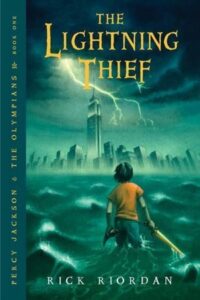
The Lightning Thief by Rick Riordan (Percy Jackson Book 1)

Lightning thief cover imageTakeaway: Fun young adult fantasy novel. There are some serious themes, but they are written in a way that is appropriate for 11 and up.

I have been reading a lot of fairly heavy theology recently. The heavier the theology books I am reading, the more likely I am to need light fiction to offset my brain. I share a Kindle account with some younger people, and they picked up and read the Percy Jackson series last spring. I have not seen the movie (although I probably will now) and did not know anything about the books going into them.

I am a fan. These are quick reads for adults; I do not think I have spent more than 2 or 3 hours on any of them. (I am in the middle of the fourth right now, all in a week.) I also think they are appropriate for kids age nine and up (depending on reading level).

The basic storyline is that Percy Jackson is a bad student.  He is always getting in trouble and has ADHD and dyslexia.  He loves his Mom, but he knows he is making her life difficult because he is always getting in trouble at school.  Eventually, we find out that one of the reasons Percy has a problem is that he is actually the son of one of the Greek gods (a half-blood).

Read more

Girl On The Train by Paula Hawkins

The Girl on the Train by Paula HawkinsGirl On The Train by Paula Hawkins is an exciting thriller about what you might notice when you are looking out the train window on your daily work commute. Girl on The Train is a book that has a similar feel, at least at first, to the Hitchcock classic Rear Window. Whether right or wrong, Rachel, the observant commuter, inserts herself into the lives of the people who live outside her train window. Rachel begins watching this couple because she sees how perfect and loving they are towards each other. But, the more she watches what is going on outside her window, the more she notices the cracks in the façade.

The novel Gone Girl by Gillian Flynn has been talked about and praised since its publication for its style, intrigue, and social commentary. When this book was published in February of 2015, it was immediately compared to Gone Girl. The reasons it is being compared is because both books have strong female characters, and both books include multiple points of view, which is a very intriguing and unique method when mysteries are involved. Just as there was a lot of hype surrounding Gone Girl, there is a lot of hype with this book. I liked Girl on The Train a lot, but it is not Gone Girl. It does not strive to make any strong social statements and perhaps it is better for it. Unlike Gone Girl where a lot of what we see is the façade, the flaws of Rachel make this a really exciting story. Not only do we see what it might be like for someone with an addiction (Rachel is an alcoholic), but we also learn that we can’t necessarily trust the main character’s point of view. As Rachel attempts to piece together her alcohol soaked memories of what she has seen, we are right there with her trying to make our way through the fog. I found myself becoming just as frustrated as Rachel became as she struggled to solve the mystery with only bits and pieces of a memory to deal with.

Read more

Searching for Sunday by Rachel Held Evans

Searching for Sunday by Rachel Held EvansSummary: Roughly based on the seven sacraments of the Catholic church, Rachel Held Evans explores her history of leaving the church, helping to plant a church and then eventually finding another church.

I tend to think that people that do not like Rachel Held Evans’ writing are people that do not need Rachel Held Evans’ writing. This is circular I know, but Evans has a particular audience and I think that audience needs her or someone like her. But many others do not find encouragement from her and do not identify with her story, I think that people that are frustrated with Evans should consider themselves blessed.

Evans is a skeptic and doubter. She is a Christian and loves the church and even loves the Evangelicalism that shaped her (and scarred her). But she also is frustrated by the church and many in the church that have no place for doubt, investigation or marginalized people.

Anyone that knows of Evans is unsurprised that the book opens with her frustration with the church. Through the book, there is a clear arc. Evans grows up in the church, is “˜on fire for Jesus’, becomes skeptical, starts exploring the skepticism, eventually leaves the church because of her frustration with it, then helps to plant a church that attempts to live out what she believes the church should be, that church plant fails and over the next couple of years she slowly makes her way into the Episcopal church.

Read more

Mistakes Were Made (But Not By Me): Why We Justify Foolish Beliefs, Bad Decisions and Hurtful Acts

I am reposting this 2010 review because the audiobook is the Audible deal of the Day and on sale for $3.95
Mistakes Were Made (But Not By Me): Why We Justify Foolish Beliefs, Bad Decisions and Hurtful ActsTakeaway: The human brains ability to justify and rationalize mistakes is enormous, useful and incredibly dangerous. There are huge implications for every facet of life.

This is a wide ranging and enormously interesting book on memory, retention and and self justification. The basic idea is that our brains are designed to minimize Cognitive Dissonance. Our brains will re-write memory and selectively remember details or give us other means to repress or eliminate Cognitive Dissonance.

Early in the book there are a number of examples of government, journalism and scientists that believe that they did nothing wrong while external evidence suggest otherwise.  One of the most egregious, is the first study that showed a link between autism and vaccines.  The lead author of the study was being paid on the side by class action lawyers (over $800,000) as an expert witness and researcher into the connection between autism and vaccines. The link was not disclosed and the research study continues to be influential even after it has been widely disproven by additional studies.

Another interesting example are the gifts given to doctors by drug companies.  Drug companies know that small gifts are very effective in creating obligation to the drug companies, but large gifts, especially early in the relationship will make the doctors feel like they are being bribed. One of the important insights from this section is that often people do small things that are not wrong, but once they are a situation, end up doing many things that they would not have considered if they started with that action. For instance, Watergate did not start as a break in, but by the time all the players were in the game, it was easy to justify something that most of them would have never participated in had the idea of a break-in and cover-up been originally on the table.

Read more

A Dirty Job: A Novel by Christopher Moore

Reposting this 2011 review because the Kindle Edition is the Amazon Deal of the Day and on sale for $1.99 today only.
A Dirty Job: A NovelTakeaway: Funny, but very irreverent look at the life of a ‘death dealer’.

This is my second Christopher Moore book. I picked up Lamb: The Gospel According to Biff, on the recommendation of a friend. It is a novel about Jesus narrated by his childhood friend Biff.  You can assume it was irreverent. But I enjoyed the humor and all in all, I thought Jesus was treated fairly respectfully in a satirical novel.

In A Dirty Job, Asher, a resale shop owner becomes a “Death Dealer”. Death Dealers are people that take soul containers (the physical objects that hold people’s souls once they die, usually a beloved possession) and then pass them on to a new person.  The theology behind this is an odd bit of Tibetan Buddhism with Karma and reincarnation but unlike any actual religion that I am aware of.

There is some slight overlap between Piers Anthony’s On a Pale Horse, which also deals with a man that assumes the position of death. But in A Dirty Job, Asher is one of many regular people that become death dealers. Of course the concept of death and life are explored. But Moore seems more interested in the concept of the Beta Male, the guy that is never in charge and never stands out, but is always doing what it takes to get by. Asher is a good example of a Beta Male. He is a good father and would have made a good husband, but his wife dies immediately after childbirth which in some way leads to him originally becoming a Death Dealer.

Read more

Introverts in the Church: Finding Our Place in an Extroverted Culture

I am reposting a lightly edited version of my 2010 review because the Kindle Edition is on sale for $2.99. This is the first time the book has been on sale since 2013 according to ereaderiq’s price history.

Summary: A look at how the church needs introverts and how introverts can survive the church.

Some books have important ideas but others books are important for a more personal reason. I do think this is an important book, but it is also one that even early on really is causing me to think about my own Christian life.  Hello world, I am an introvert.  I have been identifying more and more introverted tendencies in my life over the past few years.

The author starts by showing examples of how United States (and in general western culture) and particularly Evangelical culture is oriented toward extroverts.  He gives many examples about how participation oriented US churches are extroverted (and why introverts often resist the strong participatory oriented focus.)

One of the strongest points of the book is how much the author relies on his own story and the stories of a large number of people interviewed for the book. The real stories give the book weight that would not be the case with just statistics. On the negative side, I think that for some extroverts and even some mild introverts the stories will occasionally seem like complaining. But that is at least part of the point. Different people have different tolerances for different activities and they are made by God to be that way.

Read more

Seven Men: And the Secret of Their Greatness by Eric Metaxas

Reposting this 2014 review because the Kindle Edition of Seven Men is on sale for $1.99.
Seven Men: And the Secret of Their Greatness by Eric MetaxasSummary: Short Biographies of seven men that Metaxas thinks we should view as role models and heroes.

Seven Men is the third books I have read by Eric Metaxas.  I liked Metaxas Bonhoeffer biography (although even I as a non-Bonhoeffer scholar caught several mistakes.)  But I really was not a fan of his William Wilberforce biography. Mostly that was because it felt more like hagiography.

But after reading Seven Men I realize that the Wilberforce book was his first biography. Bonhoeffer was significantly better than Wilberforce. And Seven Men I think corrected several of the problems of the Bonhoeffer biography.

The men included in this book are George Washington, William Wilberforce, Eric Liddell, Dietrich Bonhoeffer, Jackie Robinson, Pope John Paul II and Charles Colson (presented in historical order). I am pleased that Metaxas included John Paul II. Too many Evangelicals want to ignore Catholics. I definitely view that as a point in Metaxas’ favor.

Read more

Prayer: Experiencing Awe and Intimacy With God by Tim Keller

Prayer: Experiencing Awe and Intimacy with God by Timothy KellerSummary: It is much easier reading about prayer than actually praying.

I have read a ton of books on prayer. About a year ago, some book that I don’t remember suggested that we as Christians should stop reading about things we are not prepared to put into practice immediately (because it can inoculate us against actual change.) So I have tried, somewhat successfully, to lay off of Christian Living books and focus on Christian history, biography, informational non-fiction and fiction. Roughly 2/3 of the books I have read this year have been either fiction or Christian History/Biography.

But after virtually universal 5 star reviews, when I saw Prayer by Tim Keller as an audiobook on Scribd’s subscription program I picked it up. It would have been a very different read if I had not just read Rowan Williams’ book on CS Lewis and Narnia. Williams was such a good example of generous reading that I really was conflicted about how often I was frustrated by this book.

I want to start positively. Toward the end of the book there is a significant section about prayers of repentance and confession. I do not think I have ever read a general book on prayer that also spent time on confession and repentance, and Keller did it well. I was convicted, but also I think Keller did a great job helping to illustrate what it means to truly repent.

That was followed up by an even better practical section on how to actually pray and put into practice the theological reflections of the majority of the rest of the book. It was practical, still based in theological understanding of what we are doing and why we are doing it, and I think what many were probably looking for when they picked up the book. The problem is that many of the people that were looking for the practical prayer suggestions, probably did not make it to the end of the book.

Read more