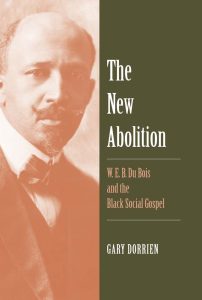
 Summary: A sweeping history of Black Social Gospel movement from the end of the Reconstruction through the 1930s.
This is the first of Gary Dorrien’s long books that I have read. I have read his memoir, which I think is one of his shortest books. And I took Homebrewed Christianity’s class on Gary Dorrien, Theology for Troublemakers. I have the second book in this trilogy as well as The Spirit of American Liberal Theology. But that is just scratching the surface of his writing. A friend I talked with last week recommended his The Remaking of Evangelical Theology and I want to many more including his book on Anglicanism.
I think that The New Abolition is going to be too long and detailed for many readers, but this is a nuanced history. There are a lot of players to the story, some that are fairly familiar like Booker T Washington, Walter White or Ida B Wells, but many are lesser known like Bishop Reverdy Ransom or educator Richard Wright.
Raphael Warnock’s book tells a shorter history of the tension in the Black church between personal piety and social activism, but this is a much thicker history that grapples with ways that often the same people changed over time. WEB DuBois argued against Washington’s accommodationist tendencies but at other times used very similar rhetoric. Washington preached accommodation, but also quietly supported more active community organizing. Many arguing against the white supremacy of the time still accepted some level of racial hierarchy. Similarly much of the Black Social Gospel movement was either patriarchal in its assumptions, or was in favor of women’s suffrage, but still assumed a gender hierarchy or opposed gender hierarchy had regular affairs. There was a number of the social gospel proponents who were holiness absolutists who had very high standards of morality that seem to suggest a type of politics of respectability which also assume hierarchical class assumptions. And it was fairly common in this history to see alcoholism, which I think is in part a trauma response to the reality of this history.
I do not want to draw too many parallels to the anti-DEI backlash that is going on today with the rise of the post Reconstruction Jim Crow world, but often the story of civil rights in America is told from the perspective of ever increasing civil rights. This is an era where rights were being lost and I think we need to remember that backlashes exist (see White Rage for a history of that.)
All history is a history of imperfect people, but I think it is helpful for Dorrien’s type of long detailed (and maybe a bit rambling at times) narrative history to include the details of the imperfections because it helps remind the readers that modern movements will also be imperfect. There will be people that break up organizational partnerships over personality conflicts not ideology. There will be people who self-sabotage and bring down movements that are already disfavored in society because of personal addictions or other bad behaviors.
At the same time, this book is filled with brilliance and self sacrifice. Ida B Wells stood against not only the white culture that assumed that lynching was done for cause, but also against much of the Black leadership who also assumed that lynching was largely done for cause. Du Bois was brilliant even if he didn’t get along with others very well. And many of these lesser known church officials were nearly superhuman in their work to organize the Black church not just internally, but for community empowerment. The prime movers of the Black Social gospel were not just organizing for civil rights, they were also organizing their own denominations at a very basic level. And they were almost always underpaid and under appreciated and opposed inside the Black community as well as outside of it.
I spent a month reading this 600 page history and I will pick up the second volume soon, which is several hundred pages longer. I did originally get this as an interlibrary loan because I didn’t want to spend the $30 for a kindle book. But my reading habits are such that I just can’t read long paper books. I broke down and bought the kindle edition because I need the adjustable print and the better lighting. I was talking to a friend last week who is the exact opposite. He has largely given up on kindle books because the paper works better for his eyes and reading methods. We have different preferences. I am just glad that in most book there are options.
The New Abolition: W. E. B. Du Bois and the Black Social Gospel by Gary J. Dorrien Purchase Links: Paperback, Kindle Edition