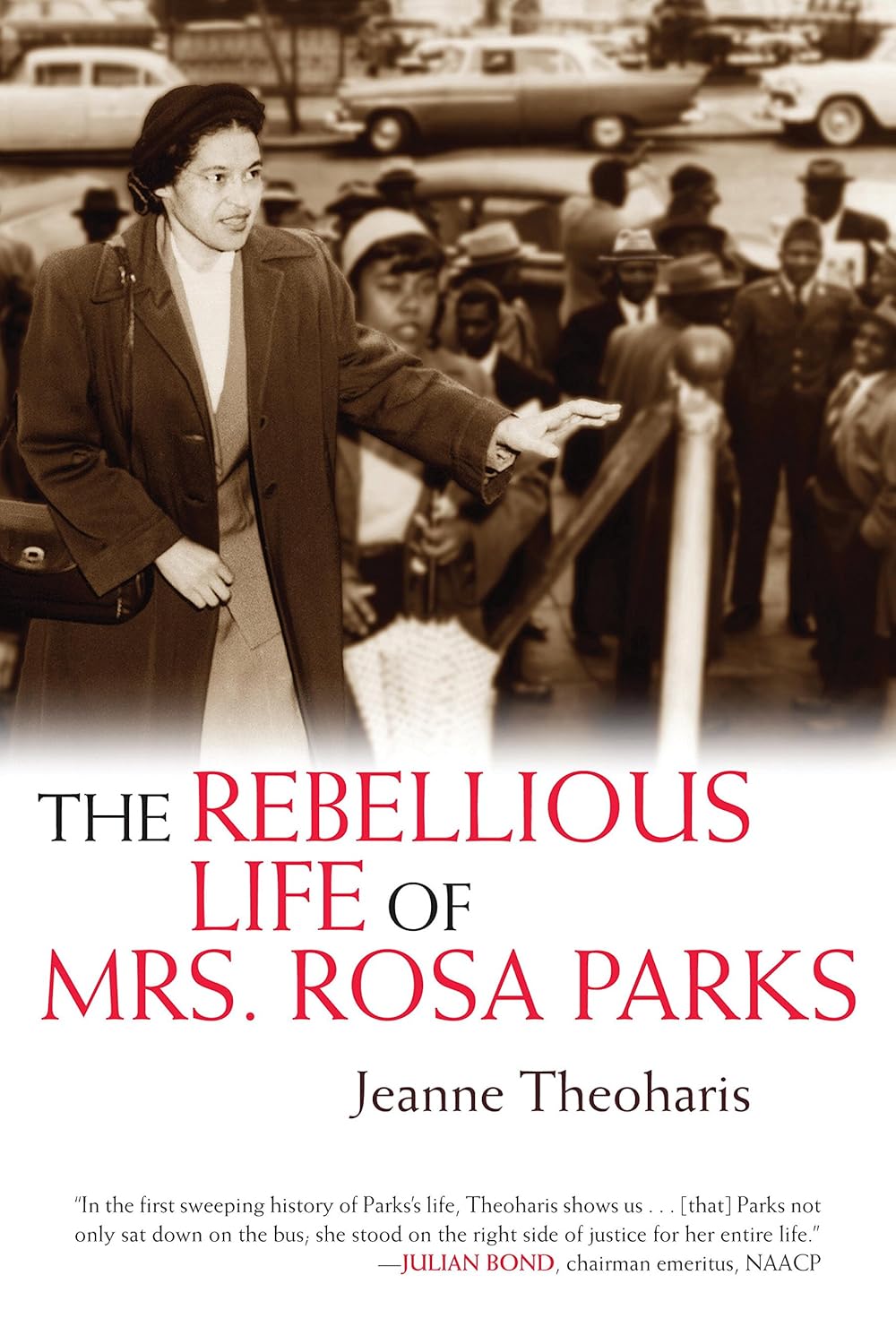
 Summary: A nuanced and detailed biography of a woman that has primarily been reduced to a single act.
I have read Jeanne Theoharis’ books out of order. Her more recent book, A More Beautiful and Terrible History: The Uses and Misuses of Civil Rights History, has many themes hinted at in The Rebellious Life of Mrs. Rosa Parks but more fully fleshed out in the second book. Both books are well worth reading, although there is some overlap. There is a running joke among Civil Rights historians that quite often, the history of the civil rights moment is presented as that one day the Supreme Court announced the end of school segregation, and then the next day Rosa Parks sat down. A day later, MLK stood up to give his I Have a Dream Speech. Then the Civil Rights Act of 1964, the Voting Rights Act of 1965, and the Fair Housing Act of 1968 were passed, and MLK was assassinated. The real history of the Civil Rights Movement is much more complicated and much longer.
In some ways, it is hard to categorize the boundaries of the movement because, as with all history, events influence other events. Both The Rebellious Life of Mrs. Rosa Parks and At the Dark End of the Street: Black Women, Rape and Resistance-a New History of the Civil Rights Movement from Rosa Parks to the Rise of Black Power emphasize that by 1955, Rosa Parks had been participating or leading on civil rights issues for nearly 20 years. The December 1, 1955 events may not have been explicitly planned as an NAACP action, but it was not a random event that did not have a larger context. Several events had to work together. Rosa Parks tended to avoid James Blake’s bus because she had had run-ins with the bus driver before. Other events around the country like the lynching of Emmett Till, the Interstate Commerce Commission’s ruling banning “separate but equal” regarding interstate bus travel, and Rosa Parks’ recent participation in the Highlander Folk School training all likely had some effect. In the end, Rosa Parks refused to get up from her seat. City policy should have meant that she did not have to move because no other seats were available. Instead, the bus driver called the police, and she was arrested. Because this is such an essential part of Rosa Parks’ legacy, the event and the bus boycott are significant parts of the biography. But the biography also clarifies that Rosa Parks was far more important than just her single act, even if that act is what she is known for.
The Rebellious Life of Mrs. Rosa Parks and many other books about less well-known figures of the Civil Rights movement show the considerable cost that everyday people suffered. Money is not everything, but it is one illustration. According to tax records, it took ten years for the couple to recover their income from before the bus boycott, and they were not a wealthy family. At the low point, their income was cut by 80%. Even so, during this time, they were forced to move to Detroit to escape the harassment and job discrimination once the boycott was completed. Rosa Parks spent nearly two years working as a receptionist at the Hampton Institute in Virginia (a historically black college) away from her husband and mother because it was the only job she could find (and the Hampton Institute did not provide housing for the whole family). It was not until a year after the newly elected congressman John Conyers hired her as a congressional staffer in 1965 that their income reached above the pre-1956 income.