 Summary: Spiritual formation oriented toward the particularities of the middle part of life.
Reading a book by yourself is just different from reading it in a group. I read this a few years ago and I had a generally positive impression but it was a point when I was too busy and I didn’t previously write about it. This time, when reading it with a group I was much less positive about the book in part because the group helps to identify weaknesses that I wasn’t paying attention to in my first reading.
The second part of being less happy with this book on a second reading is that I read it at the same time as I was reading The Way of the Spirit: Recognizing and Responding to God’s Subtle Movements by Jeremy Daniel Sims. They were not exactly the same thematically, but they had a lot of overlapping content. Sacred Fire is the middle book of a loose trilogy of books about spiritual formation. They do not need to be read as a trilogy, but they are about spiritual formation at three points in life. Sacred Fire is about spiritual formation in the middle years of life. Insane for the Light: A Spirituality for Our Wisdom Years came out in 2026 and is about spiritual formation in later life and The Holy Longing: The Search for a Christian Spirituality is about early spiritual formation.
Rolheiser is a Catholic priest, and as a protestant there are going to be places where I disagree. But I think that it is helpful to read across traditions in part to help you understand your own tradition in contrast. The group I read this with is mostly Catholics with a handful of Episcopalians. My disagreements do have some to do with his Catholic theology. In many cases I agree with the conclusions that he reaches, but not how he got there. One of the clearest examples of that is in his framing of the third season of life he talks about how we need to learn to “give away our death” and then uses Jesus’ death as the example that we should follow. I don’t disagree with what he means about giving away our death, but I do not think that we should be following after Christ’s death as an example. Jesus’ death was a result of sin not something we should strive to emulate. I think he could have gotten to the same place with Phil 2 as his model and avoided the problem of making Jesus’ death something to emulate.
I think part of the problem is that he was framing this book as a type of apologetics, “I want a book on apologetics, but with a different bent,” but that is a framing problem for a book about spiritual formation. Apologetics has become a type of argument and spiritual formation is primarily about helping people to see a new perspective on life. Given his age and upbringing, it is not surprising that he defaults to a lot of stereotypical stories and illustrations, but it does become distracting how stereotypical that the book often is.
Another problem with the method of the book is that he often was trying to make nuanced points, but he did it by using two words that we tend to use as synonyms and then pitting them against one another. One example is that he suggested that we should be in “awe” but that we should not be “amazed” because awe was a type of wonder and amazement was a type of shock. I can understand the distinction he was trying to make, but the method was unhelpful.
Again, I ended up agreeing with a lot of conclusions, but so much of the book was framed as a type of command or argument that as a reader I ended up arguing with how he got there instead of seeing his point as an alternative to give me a broader perspective of the world. As I said to the group, The Way of The Spirit framed spiritual formation as an invitation that we are invited to participate in as a gift or a joy to be embraced. But Sacred Fire often felt like a command. One woman described it as like listening to her Uncle Joe that always was complaining about how everyone did everything. In another discussion I had with a Lutheran pastor I know, I described the book and he said it sounded like the Lutheran distinction between law and grace. I would not have described it that way myself, but I think it is a good distinction.
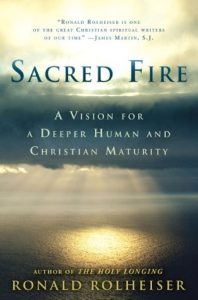
Sacred Fire: A Vision for a Deeper Human and Christian Maturity by Ronald Rolheiser Purchase Links: Paperback, Kindle Edition, Audible.com Audiobook