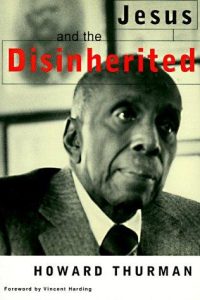
 Summary: A pre-civil rights movement book that influenced the shape of the movement.
This past year one of the book clubs I am in has been reading old books after reading James by Percival Everett. We read James Baldwin’s The Fire Next Time, WEB DuBois’ Souls of Black Folk and now Jesus and the Disinherited. It has been about a decade since I wrote about first reading Jesus and the Disinherited. I read it again about five years ago but didn’t write about it at the time. The summary of my thought on reading it with the book group is that I am glad we read it, it is a challenging book, and that I am clear why it was so influential and why the group liked it the least of the books we have read this year.
I have a pretty good background on Howard Thurman. I have read his memoir and both Paul Harvey and Peter Eisenstadt full biographies. And I have read Anthony Hunt and Lerita Coleman Brown books which are about Thurman’s theological project more than about his biography. And I have read two complete collections of his sermons and several of his books as well as listened to a selection of audio clips from talks and sermons so I have a sense of his actual voice. I am strongly influenced by Thurman, while at the same time know that he was speaking to a particular time and place and I know that not everything he is writing, was written to me, so I can know going in that I am not going to find everything easy.
I think this was the hardest book for the group to read. Thurman was an academic and even though he was a pastor to non-academics, and he could often be quite clear, there are times when he is hard to understand. My general approach to this book club is that I tend to listen to the reading on audiobook on Monday or Tuesday before our Thursday meeting. And then read a print version on Wednesday night or Thursday. Because I have said that to the group, several of the group have started doing the same when they have time. And a number said that (in part because the chapters were fairly short), they would read and/or listen to the chapter two or three times before we talked about it.
I think almost universally, the first chapter was what most people really liked. It laid out what his project was. Thurman discussed the context of Jesus and why it was important to think of Jesus as one of the disinherited, and someone with “his back against the wall” as Thurman put it. But the next three chapters were harder and I agree were not as good. (I think Fear and Hate are better than Deception.) And then Thurman concludes the book with his prescriptive chapter, Love. The middle three chapters were Thurman’s diagnosis of the problems of the disinherited. He was not saying these were either things that should be done or never done, but trying to describe why racism leads to fear, deception and hate being the default responses to racism or other types of social harm or persecution. I think they were both too vague and needed fleshed out more what he was and was not saying, and at the same time too long because in moving this from an article to a book, I think there was some fluff left in.
I think the Deception chapter was most illustrative of this. Thurman opposes the disinherited deceiving those who are oppressing them even as he says exactly why they are doing it, safety. I wish that Thurman had grappled with some biblical examples of deception. There are a number of examples that could be pointed to in the bible, the midwives in Egypt, Rahab, or Jesus. I wanted Thurman to grapple with how Jesus tells parables that he says are not supposed to be understood by all or how Jesus responded to questions from Scribes and other religious officials where he responded with questions or didn’t answer them clearly. I think it is pretty clear that there are times when deception is sin. But Jesus lived without sin and both Rahab and the Egyptian midwives are commended for their deception. Thurman’s main point here seems to be that we are shaped by what we do, and if we get into a pattern of lying to those around us, it will impact us. But I also think that not all deception is sin. There are times when wisdom and understanding call for a lack of overt truthfulness if that overt truthfulness will cause harm. Concealment is a form of deception and I think the chapter would have been better if he had spent more time grappling with the tension that is always in the lives of the disinherited around this.
I also want to note that in his memoir (and also mentioned in the biographies) that getting this published was hard. A publisher came to him as a result of reading a 1935 journal article. Thurman had a draft of the book by the early 1940s but it took nearly a decade for it to be actually published. I assume that there are extant drafts that give more detail about what was cut or changed, but I have not looked up to see if that exists. The original acquisitions editor, and the person who Thurman was so frustrated with, Nolan Harmon, was one of those who Martin Luther King Jr was responding to in Letter from a Birmingham Jail. He was an example of the “white moderate” that was involved in racial justice issues but not fully transformed enough to understand the point of Thurman’s book and apply it. About 20 years after Harmon first read a draft of this book, he signed onto A Call for Unity, calling for MLK Jr and the civil rights movement to stop protesting and be patient.
The final chapter, Love, tries to take seriously Christ’s command to love both your enemy and your neighbor as well as contextualize that to the world that Thurman was writing to. Jesus’ command to love is never easy. We had lots of discussion in the group about how it is hard and how Thurman is calling on the disinherited to do much of the work of reconciliation while being in a position of being discriminated against, having less resources, and more pressure to survive. Thurman is not suggesting that it is fair or good, but Thurman is primarily writing to the disinherited. At the same time, Thurman is calling on white people to do the work to be prepared to also do what is necessary to be reconciled and to live out what it means to be both the church and to follow Christ as individuals as we should.
I want to be clear, I do think that Thurman is largely right in Jesus and the Disinherited. But I also think that he is writing to a context which was calling on the church to live out its faith and knew that many white Christians were not going to do the right thing. Thurman was not excusing either white apathy or overt racism, but he was trying to point a way forward. I think the civil rights movement was strongly influenced by this book. All work of freedom and liberation requires change from not just the disinherited, but also those who are doing the oppression. When Jesus preached in Nazareth about God’s favor toward foreigners he was nearly killed. There has been discussion about the difficulty in following Jesus for millennia.
This weekend there was a “Christ is King” conference with a bunch of Christian Nationalists including Nick Fuentes, an open white nationalist, as the final keynote speaker. The message of Thurman, that we should pay attention to loving both neighbor and enemy, is countered by clips from the conference. The clips I saw were about how it is okay to hate enemies and how white nationalist talking points of racial realism and xenophobia are consistent with their understanding of Christianity that is rooted in nationalism and white supremacy. What I had heard from the “Christ is King” conference is obviously different from the Christianity that Howard Thurman was teaching.
One of the reasons we need to read old books is to understand the history of where we have been and where we are now. It was very easy for our book group this past year to draw parallels between our modern world and the antebellum/early Civil War era (James) or the rise of Jim Crow (Souls of Black Folk) or the pre-civil rights movement (Jesus and the Disinherited) or the main civil rights movement (The Fire Next Time). It is easy to think that either nothing has changed or that so much has changed that we no longer need to think about these older calls for justice. Part of what I always see when I read about these Christian Nationalist movements is historical ignorance. To paraphrase the line made famous by King, the arc of the moral universe needs us to know where it is going and where it has been, if we are going to keep working to help it bend in the right direction.
Jesus and the Disinherited by Howard Thurman Purchase Links: Paperback, Kindle Edition