Stamped: Racism, Antiracism, and You by Jason Reynolds

Stamped: Racism, Antiracism, and You: A Remix of the National Book Award-winning Stamped from the Beginning by Jason Reynolds and Ibram KendiSummary: Jason Reynolds has taken the ideas of Ibram Kendi and written a young adult book about the history of racism.

I have read a couple of Jason Reynold’s books, and I like his young adult writing, even if I am not reading much young adult literature lately. And I have appreciated the two of Kendi’s books I have read (Stamped from the Beginning and How to Be an Antiracist).

Stamped is clearly Kendi’s ideas and Reynold’s words and style. It is framed in Kendi’s structure of there being three approaches to race, segregation, assimilation, and antiracism.

The antiracists say there is nothing wrong or right about Black people and everything wrong with racism. The antiracists say racism is the problem in need of changing, not Black people. The antiracists try to transform racism. The assimilationists try to transform Black people. The segregationists try to get away from Black people.

But what is helpful with Kendi’s approach is that he does not understand these three positions as fixed identities, but as he says in How to be an Antiracist, these are more like a “sticky name tag” that you can put on and take off, sometimes in a single day.

Read more

Native: Identity, Belonging, and Rediscovering God by Kaitlin Curtice

Native: Identity, Belonging, and Rediscovering GodSummary: The struggle to find identity and meaning as a Potawatomi woman who grew up with a better understanding of Southern Baptist Church culture than her Native one.

I preordered the Kindle edition of Native and then picked up the audiobook free as a promotion for pre-ordering. Like I prefer, Kaitlin Curtice narrated her own book. As I have frequently said, almost always, the author can tell their own story better than a professional narrator. (There are exceptions and fiction is probably better for professional narrators, etc). Curtice is not a professional narrator, but the book calls for emotion and feeling in this personal book and she carries that out.

This is a far better book than I can write about right now. But I want to hit on one point that I think she talks about well. The US has always prized assimilation. But it never really occurred to me how much assimilating something requires giving something else up. It may not be you directly that is giving something up. But to assimilate impacts not just you, but your extended family and descendants as well. If you assimilate into another culture, you are separating your children from their heritage. That isn’t to say all cross-cultural change is bad, but that traditionally the only thing talked about was the movement toward unified White culture as a positive. But the loss of ethnic culture is a loss. Some have lost their ethnic culture because of forced migration and slavery as many African Americans have in the US. Many Native Americans were removed from their homes as children, forced into boarding schools, punished for speaking their native languages or expressing their culture and encouraged to adopt White norms.

However, those who today identify as White also have been assimilated and lost their individual ethnic identity. My grandmother, just two generations from me, and a woman I knew fairly well into my 20s came to the US from Finland as a 12-year-old. I have zero connection to Finnish culture, language, or heritage. There is a loss that has to be accounted for, not just the gain of her assimilating into US culture via NYC and rural Pennslyvania.

Read more

The Sword and the Shield: The Revolutionary Lives of Malcolm X and Martin Luther King Jr

Summary: A joint biography about Malcolm X and Martin Luther King Jr and how they influenced one another.

The Civil Rights Era was made up of many more people than Martin Luther King Jr and Malcolm X, but they are two of the defining figures of the mid 20th century. This is the first joint book I have read about them since James Cone’s Martin & Malcolm & American. It has been at least 20 years since I read that book, and throughout The Sword and the Shield, I tried (and failed) to remember how Cone handled the discussion. I need to go back and reread it.

I was glad that I have recently read a biography of Malcolm X and King’s last book, Where Do We Go From Here, which had details about their lives front and center in my mind. I am far from a scholar of either, but I am also not unfamiliar with them. I still learned plenty, and the focus on them intentionally puts their work on tension even if they only directly met one time.

As much as anything, this is a reminder of what was lost with their deaths. No one like Malcolm X and Martin Luther King Jr can be reduced to their flattened memories. Both were complex people that were significantly changing over time, as was the central theme of Marble’s biography of Malcolm X and Cornell West’s compiled Radical King. Kendi’s three categories of racial relationships (segregationists, assimilationists, or antiracists) in How to be an Antiracist reminded me of how both King and Malcolm X were antiracists much of the time, but in quite different ways.

Read more

They Called Us Enemy by George Takei

They Called Us Enemy by George Takei Summary: A memoir of George Takei’s time in the Japanese Internment camps during World War II with some discussion about how they shaped his life after that time.

I do not read a lot of graphic novels, but I have found they work really well for history and memoir especially for discussion of eras where the visualization really matters. The March Trilogy by John Lewis is a very good example of this type of visual history that would communicate very differently in a straight narrative.

George Takei has been most known for his role as Sulu in Star Trek. But he has deftly used that fame to draw attention to gay rights, immigration and most especially, the history of the Japanese Interment camps. A graphic novel of that time is a natural outgrowth of his other work.

I always like to include a piece of art when I talk about graphic novels because art matters so much to the experience of reading a graphic novel. This is a frame from toward the end of the book when George Takei is processing what it meant to be in the internment camps with his father.

Read more

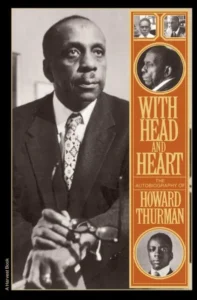
With Head and Heart: The Autobiography of Howard Thurman

Summary: Fascinating autobiography of a pathbreaking and important man.

Like many do, I learned about Howard Thurman through hearing about him in relation to Martin Luther King (Jr and Sr). He was a classmate with MLK Sr at Morehouse College. Then, during Thurman’s first year as Dean of the Boston College Chapel, Thurman overlapped with MLK Jr. as he finished his Ph.D. It is said that MLK Jr carried a copy of Jesus and the Disinherited with him during his Civil Rights years. Their relationship is probably not as formative to King as I had thought earlier, but there are many letters between them.

Regardless of his relationship with King, Howard Thurman is a path-breaking man. His father died young, and as the story at the beginning of the book says, “I said, ‘One thing is sure. When I grow up and become a man, I will never have anything to do with the church.'” His father died when he was seven, and because his father was not a member of the church, the pastor initially refused to allow a funeral at the church. After being pressured to permit the burial, the pastor refused to participate. A traveling evangelist agreed to do the funeral but turned it into a spectacle for evangelism instead of a memorial.

Despite the early negative relationship with the church, Thurman had an early mystical experience calling him to be a minister. Throughout his life, he was a mystic in orientation. I will not cover his whole career; you can read his Wikipedia page for a summary or the memoir for more details. After becoming a pastor, teaching, and serving as chaplain at Morehouse and Spelman, serving as a Dean at Howard University Chapel, and a faculty member, he left the academic world in 1944 to co-pastor an intentionally interracial church in San Francisco. It is one of the earliest intentionally interracial congregations, with Howard Thurman as co-pastor but the only paid pastor and primary lead for most of the time. After nine years, Thurman became the Dean of Boston College Chapel, the first Black man to have a similar position at a predominately White University. He remained there for 12 years until 1965, when he officially retired, and led the Howard Thurman Educational Trust until he died in 1981.

Read more

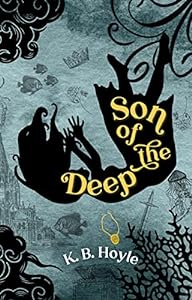
Son of the Deep by KB Hoyle

Summary: A reimagining of the Little Mermaid. 

We all need some lightness in our lives. I tend to read heavy books, and I do this because I like them. But we also need lighter books to balance and rest, especially amid a global pandemic.

Son of the Deep is the latest book by KB Hoyle. I have never met her in person, but I digitally met her in the Christ and Pop Culture Facebook member group years ago. Since then, I have read her ten previous books and now this one. (She is currently co-writing a novel with Project CoNarrative).

KB Hoyle’s books are all well developed, expertly plotted with depth to them that allows for real enjoyment by adults, even though they are pitched to middle grade or young adult readers. Despite her skill, her last publisher went under, and she reclaimed all of her books and has self-published newly edited versions of them over the past two years.

This latest book is only available (for now) at Swoonreads, a project of MacMillian that takes submissions from authors and gives the reader community free access to unpublished books for feedback and potential publishing. If I have just purchased a new ereader that allowed me to load the book, (you have to read via an app, so it has to be on a computer, or an iOS or Android device and my new reader is android based.)

Son of the Deep is a reimagining of the Little Mermaid. The human is a princess, the beloved only daughter of the King and a bedridden Queen. The merman is the youngest child and only son of the King. He is in line to be the King’s military right hand, but also to be the apprentice storyteller to his Grandmother.

Read more

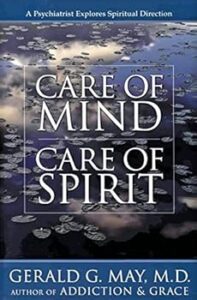
Care of Mind/Care of Spirit by Gerald May

Summary: A psychiatrist explores spiritual direction. 

This is another assigned book from my spiritual direction class. The focus of this semester’s class was spiritual direction and psychology. So assigning Care of Mind/Care of Spirit makes a lot of sense. Gerald May was a psychiatrist who became disillusioned with psychology and became a spiritual director.

My reading of Care of Mind/Care of Spirit was tainted by having his Addiction and Grace book assigned the same semester. I really did not like Addiction and Grace. My problem was mainly with his messy definition of addiction. However, my frustration with May in the Addiction and Grace book did not give me a lot of charity in reading Care of Mind/Care of Spirit.

There is value here. Because he was a psychiatrist, he understood that spiritual direction and psychology are different. There is a temptation for spiritual directors without much training in psychology to over-psychologize the spiritual direction.

…all of life’s experiences can appear legitimately in spiritual direction, but they need to be seen in the light of spiritual concern, and at all costs they should not be allowed to eclipse that light.

He also cautions the spiritual directors to understand their role. They are a facilitator of the work of the spirit; they are not the ones doing the work.

In spiritual direction however, the true healer, nurturer, sustainer, and liberator is the Lord, and the director and directee are seen as hopeful channels, beneficiaries, or expressions of grace for each other. This is a radical difference, and one that cannot be overemphasized.

One of the points that are most helpful is his distinguishing between psychology, which diagnoses a patient, and spiritual direction, which assists a person in discernment.

Read more

Paul: A Very Brief History by John MG Barclay

Paul: A Very Brief HistorySummary: A very brief intro to Paul.

These short guides are both really helpful and difficult to write and write about. They assume some, but not too much familiarity with a subject. If you have no understanding, they probably are too advanced. And if you have a lot of understanding, these types of books probably will not be all that interesting.

Mostly I picked this up because it was on sale and because I wanted to read Barclay’s Paul and the Gift, which yet again I heard some bible/theologian people on twitter talking about as one of the best books of theology of the past decade or so. (It is also on sale for Kindle and even a better deal at less than a penny a page.) I have a pretty good understanding of Paul, I read NT Wright’s biography of Paul fairly recently and I have read a number of other books as well. I thought this would help introduce me to how Barclay thought about Paul, and I think it did a bit.

Read more

Maigret and the Good People of Montparnasse by Georges Simeon

Summary: A good man is shot in his home and there does not seem to be any suspects.

I was first turned on to Georges Simeon’s Inspector Maigret by John Wilson during a not that long-lived Books and Culture Podcast episode. Simeon is a French mystery novelist that wrote around 500 books, short stories, or novellas. Nearly 150 of them involve Inspector Maigret. Penguin has commissioned new English translations of the whole set and they have been coming out at a very nice clip. I have read several, mostly in order from the start. I have been picking them up as they come on sale for kindle. I decided last week when I picked one up (it is still on sale as I write this) that I would go ahead and read it even if it is theoretically 58th in the series.

There is nothing about the book that really requires you to know the Inspector. And I do not think I missed too much by jumping to the middle of the series. It is brief, I read it in three not too long sittings. This is more of a psychological mystery (think Inspector Gamache rather than a whodunit like Agatha Christy or Sherlock Holmes.)

Read more

Howard Thurman: Sermons on the Parables

Summary: Collection of sermons on the parables, mostly from the 1950s.

This year I have been trying (with mixed success) to read a sermon a day. I have been alternating between Eugene Peterson, Fleming Rutledge, Howard Thurman, and in the past few days, Karl Barth.

Thurman’s Sermons on the Parables are faithful transcriptions of the full sermon with introductory material by the two editors. The commentary helpfully points out features and places the sermons in context. I have heard enough of Thruman’s voice in recordings that it was easy to hear Thurman’s voice as I was reading them. Thurman had a slow, deliberate style of speaking, and I think it would be helpful if you are not familiar with his speaking style to listen to the audio collection of his sermons on Audible or watch a few of the youtube video link this one.

The parables are very familiar territory for most Christians; there is little that can be said that is new. But I was surprised at how often Thurman was able to bring a fresh perspective to the parables while at the same time taking the text seriously; he was not just creating new.

I am not going to comment anymore but quote from an introduction to one of the sermons and then the sermon itself to give a sense of the book.

Read more