If Beale Street Could Talk by James Baldwin

If Beale Street Could Talk by James BaldwinSummary: A young woman recounts her relationship with her fiancee, while facing his imprisonment on trumped up charges and her pregnancy with their coming baby.

If Beale Street Could Talk is my fifth James Baldwin and third of his fiction books. It is by far my favorite of the fiction. James Baldwin is an incredible writer. There are so many lines in the book that just drip with beauty or truth or so clearly express real emotion. But his books are hard. Not that they are hard to understand but the themes are tragic.

If Beale Street Could Talk is a tragic romance. It is not that families are keeping the young couple apart like Romeo and Juliet, it is that society is keeping them apart through the systemic racism of the 1970s. Tish is only 19, but she and Fonny have been friends since childhood. As they realize that they really do love one another and want to get married they have to overcome the normal objections to young love.

Fonny is a sculptor. He works odd jobs to pay expenses but he is a sculptor. Tish is from a tightly knit family, one that Fonny has long been a part of because of the problems of his own family. Her family is supportive, but cautious. As the prepare for marriage and look for a place to live, they bang up against the prevalent racism of the world.

As is revealed slowly throughout the book, Fonny was set up by a racist cop. He was set up by the cop to take the fall for a rape. The system doesn’t have anything against him in particular, it is just designed to not particularly care for anyone.

Read more

Forward Me Back to You by Mitali Perkins

Forward Me Back to You by Mitali PerkinsSummary: Two teens meet in a church youth group and find friendship, healing, and purpose. 
I recently listened to Mitali Perkins interviewed on the Conversing Podcast. I borrowed her book You Bring the Distant Near from the library and loved it. When I saw Perkins had a new book coming out, I preordered it (it came out on Tuesday).

Forward Me Back to You is very different. You Bring the Distant Near was a multi-generational immigration story. A story of finding out what it means to be from India and in the US and how that experience is different across generations.

Forward Me Back is primarily a young adult book about Trauma. That is a heavy topic for a young adult book, and for one that I would probably classify as “˜Christian Fiction’ even though it is not published by either a Christian publisher or even a Christian focused imprint. But there are fully fleshed out Christian characters talking about God and faith and the world around them, while avoiding some of the traps that Christian fiction can fall into.

Katina King is the biracial child of a young White single mom. She works hard, not just at school, but in her jiu-jitsu (current northern California champ) and with a real vision for her future. She attends an elite private high school on scholarship. But after a sexual assault at her school that she was able to fight off, but was still traumatized by, her Mom sends her to Boston to heal with “˜Grandma Vee’. Grandma Vee is the aunt of her jiu-jitsu coach and an African refugee herself.

Read more

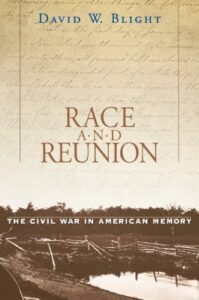
Race and Reunion: The Civil War in American Memory by David Blight

Race and Reunion: The Civil War in American Memory cover imageTakeaway: The resistance to remembering has implications for today.

I first found out about David Blight when I was introduced to the podcast of his Yale History of the Civil War and Reconstruction class. Nearly 30 hours later, I was much more familiar with both Blight and the history around reconstruction and the Civil War. Last year I read his new big biography of Frederick Douglass, likely my favorite book I read last year. Since starting Race and Reunion, I also found out that Blight directs the Gilder Lehrman Center for the Study of Slavery, Resistance, and Abolition. The center has a podcast interviewing fellows of the center, and Blight is involved in that podcast.

I have been aware of Race and Reunion for several years. It is an expensive book; small-release academic books usually are. But the book was released as an audiobook earlier this year, and when I found it as an audiobook, that was enough to make me pick it up. By the time I finished the introduction, I had also purchased the Kindle edition so I could alternate reading methods, and especially so I could highlight.

I cannot summarize his thesis better than Blight did:

Three overall visions of Civil War memory collided and combined over time: one, the reconciliationist vision, which took root in the process of dealing with the dead from so many battlefields, prisons, and hospitals and developed in many ways earlier than the history of Reconstruction has allowed us to believe; two, the white supremacist vision, which took many forms early, including terror and violence, locked arms with reconciliationists of many kinds, and by the turn of the century delivered the country a segregated memory of its Civil War on Southern terms; and three, the emancipationist vision, embodied in African Americans’ complex remembrance of their own freedom, in the politics of radical Reconstruction, and in conceptions of the war as the reinvention of the republic and the liberation of blacks to citizenship and Constitutional equality. In the end this is a story of how the forces of reconciliation overwhelmed the emancipationist vision in the national culture, how the inexorable drive for reunion both used and trumped race.

Race and Reunion is more than just an exploration of how the Lost Cause mythology was developed, although that is included. It is also about how memory shapes the future and how choices are consciously and unconsciously made about what is worth remembering. Historians talk about “usable memory,” the idea that history is not just history, but something that can give meaning or understanding for a current era. I do not think that Blight coined that term, but Race and Reunion spent a lot of time exploring how usable memory worked at the end of the Civil War.

Read more

Black and White: Disrupting Racism One Friendship at a Time by Teesha Hadra and John Hambrick

Black and White: Disrupting Racism One Friendship at a Time by Teesha Hadra and John HambrickSummary: Making the argument that racism is antithetical to the gospel and that the church needs to work to overcome it. With the primarily example that reaching out and building relationships as the best means to more fully understand and build coalitions within the church to overcome racism.

If I had not met John Hambrick a couple times (he is one of the pastors at my church), I do not think I would have picked up Black and White: Disrupting Racism One Friendship at a Time. I do not need to be convinced that racism is one of the evils that must be confronted in society and especially within the church. And I am highly skeptical about the structure of addressing racism from individual relationships instead of from a more systemic perspective.

But I have met John and we have previously talked about racial issues more generally and within our own church. So I was willing to give this book a try. While this is a book that talks about individual relationships as a means to gain understanding about the racial divide in our world, it does not present racism as a problem of individual animus based on skin color, but as a systematic cultural problem (as I believe that it is.)

The friendship framing is not about solving the problem of racism as a whole, but to gain understanding. I do still have a problem with White people seeking out minorities to be friends with out of purely utilitarian purposes and not an actual desire for friendship, but that is not what this book is advocating.

Instead this is a look at what racism is, why the church needs to deal with it and a number of the common issues that prevent Christians from really addressing race. I have read pretty widely in research about racism and around history and methods of addressing racism, and there is much to commend here. Many of the best books I have read on racism are not from a Christian perspective. In most ways, the Christians writing about race are at least a step behind at this point. But while Black and White is pitched to a more introductory level, the background of the content is on point and not simplistic.

Read more

Rethinking Incarceration: Advocating for Justice That Restores by Dominique DuBois Gilliard

Rethinking Incarceration: Advocating for Justice That Restores by Dominique DuBois GilliardSummary: Theological Reflection on the problems of mass incarceration, especially in regard to racism and poverty.

Rethinking Incarceration is a book well worth reading. I think the main problem of it is that it is trying to do too much. There is 199 pages of main content and in that, Dominique Gilliard tries to have shortened version of New Jim Crow, trace the (mixed bag) line of Christian reform movements within prison, make a theological argument for restorative model over retributive model, and convince people that systematic racism is a part of the whole history of the criminal justice system. The amount of content that is squeezed into the short book does leave him open to critiques in a few area where one aspect or another could have been fleshed out a bit more.

I glanced around at negative reviews last night and many of them seem to focus on three areas. First, Gilliard takes aim at Penal Substitutionary Atonement (PSA) theory. I think he make a good point at why he is targeting PSA, but I think he also falls into the trap that many PSA proponents have of thinking of atonement theories as the actual work of Christ’s death and resurrection instead of metaphors and mental maps of what is going on with the atonement. If he had kept a tighter focus on PSA as one of many facets of the atonement, he could have pointed out the way that PSA lends itself toward justification of punishment, and God as judge metaphors, and how that influences how we think of criminal justice system theologically. I also think he would benefit from interacting with Fleming Rutledge’s book Crucifixion (I am currently reading this). She does not dismiss PSA as a model but believes that it is over emphasized and her corrective, without dismissal, would be a helpful model.

Read more

Faith: A Journey for All by Jimmy Carter

Summary: A short, but wide ranging book about not only Jimmy Carter’s faith, but his approach to Christianity, culture, how his faith impacts his politics and how his Christianity influences his work and life.

Many people think that Jimmy Carter has had the most influential post Presidency of all of the United States presidents. Just a few days ago, Jimmy Carter became the oldest President in history. Faith is Carter’s 30th book and I think the fourth of his that I have read.

I picked up Faith for two reasons, first I picked up President Carter: The White House Years when it was on sale a few weeks ago and I wanted to read another short book by Carter before I started a fairly long and detailed history of his presidency. I also picked up Faith as an audiobook because he won a Grammy for the book, his third win and fourth nomination.

As much as I like Carter, and appreciate what he was trying to do here, this was not his best book. A Full Life: Reflections at Ninety I think was a much better and more balanced book.

Faith is trying to do too many things, and too often repeats what he already said in previous books. It is not that there are not interesting parts, but Carter spends too much time in areas where I think he is not at his best. I like Cater’s stories and his recounting of what he is passionate about. It is not that he is not passionate about his faith, but his social action, not his theology is where I most want to hear from him.

Read more

Why Are All the Black Kids Sitting Together in the Cafeteria?: And Other Conversations About Race By Beverly Tatum

Why Are All the Black Kids Sitting Together in the Cafeteria?: And Other Conversations About Race By Beverly TatumSummary: Good summary on racial issues especially focusing on child and adolescent racial identity development and many educational issues related to child development or psychology.

I continue to be amazed at how many different aspects of racial issues that I have not considered or explored even in basic areas of race as I continue to explore the impacts of race on modern society.

I have known about the title Why Are All The Black Kids Sitting Together in the Cafeteria for years, but have not picked it up, both because I knew that the book was a bit dated and because I did not really understand what the book was about.

Primarily, although not entirely, this is a psychology book on child and teen racial identity development. There is more than that, but the focus on both child development and how race impact identity development are very good reasons to pick this book up. If you are a White parent that wants to help your children think clearly about racism and racial dynamics, but are concerned about how to do that in a developmentally appropriate way, there are lots of hints here on how to do that well.

But there are also all kinds of additional subjects that are introduced well that make Why Are All The Black Kids Sitting Together in the Cafeteria a very good introduction to racial issues today. First, this is a 20th anniversary edition and there is a 71 page prologue that in a relatively quick overview gives context for what has changed over those 20 years. In the introduction Beverly Daniel Tatum details what parts of the book has been updated and what parts have been largely left alone. But after reading it, it feels very current with recent research and recent examples. I do not know what the original version was like, but this is a book that feels current.

Read more

Their Eyes Were Watching God by Zora Neale Hurston

Their Eyes Were Watching God by Zora Neale HurstonSummary: A classic story of a Black woman’s life in Jim Crow era.

Their Eyes Were Watching God is a classic African American novel. Like many other books, I think I need to read it again to fully appreciate the skill of the novel now that I have the initial overview. I listened to the novel  and I think that was a good idea because of the use of dialect. But I think I probably missed some of the skill of the novel because I listened and did not read it.

I watched the Crash Course Literature episode on Their Eyes Were Watching God and John Green detailed several aspects of the book and Hurston’s biography that I did not know (for instance that she grew up in a town that the town in the book is based on.) But he also highlighted the difference between the authorial voice and Janie’s voice (the protagonist) and I think I probably missed parts of that because I was listening.

(Spoiler Alert) Because this book is now over 75 years old, I am going to discuss content. Janie has been raised by her grandmother, a former slave. Both Janie’s grandmother and mother were raped and conceived children. So when Janie’s grandmother catches Janie kissing a local boy, the grandmother in an effort to protect Janie in the only way she can, marries Janie off to a much older man, a well off farmer, Logan. (The wikipedia summary is pretty good.)

Read more

How the Bible Actually Works by Peter Enns

Subtitle: In Which I Explain How An Ancient, Ambiguous, and Diverse Book Leads Us to Wisdom Rather Than Answers–and Why That’s Great News 

I first read Peter Enns in 2011 as part of a discussion of his Inspiration and Incarnation. I was very frustrated with the book. But after processing and in the context of spending about a year reading about and thinking about hermeneutics, I basically agree with his main points. The three follow-up books to that, all more focused on the lay reader than the academic reader, have been helpful.

I think How The Bible Actually Works is where I suggest most people start with Enns and his project. In an overly simplistic summary, Enns suggests that the best way to read the Bible is to pay attention to how it works internally and historically and how early readers read it. That means we acknowledge that the Bible speaks with diverse voices, that it is often ambiguous and sometimes contradictory, and that the point is not to give us clear rules of life but to help teach us wisdom.

“Reading the situation–not simply the Bible” is what wisdom is all about. It’s also, as we’ll see, what the life of faith is about. Sometimes it’s best to answer a fool, sometimes not. Which option is best at this unscripted moment depends on all sorts of factors that are impossible to anticipate, and so each time I read a nasty comment, I have to decide in the moment what the best way forward is in this situation.”

Like Enns’ other books, I think How the Bible Actually Works is going to be misread by many. First, the title is tongue-in-cheek. There is a lot of humor in the book. Enns’ podcast is called “The Bible for Normal People” with the tagline, “The only God ordained podcast”.

Second, while Enns is trying to help the reader think about the Bible differently, he is not reducing the Bible to only wisdom literature or, as in the quote below, reducing Jesus to just a sage. He is introducing those ideas, not reducing them to only those ideas.

Read more