
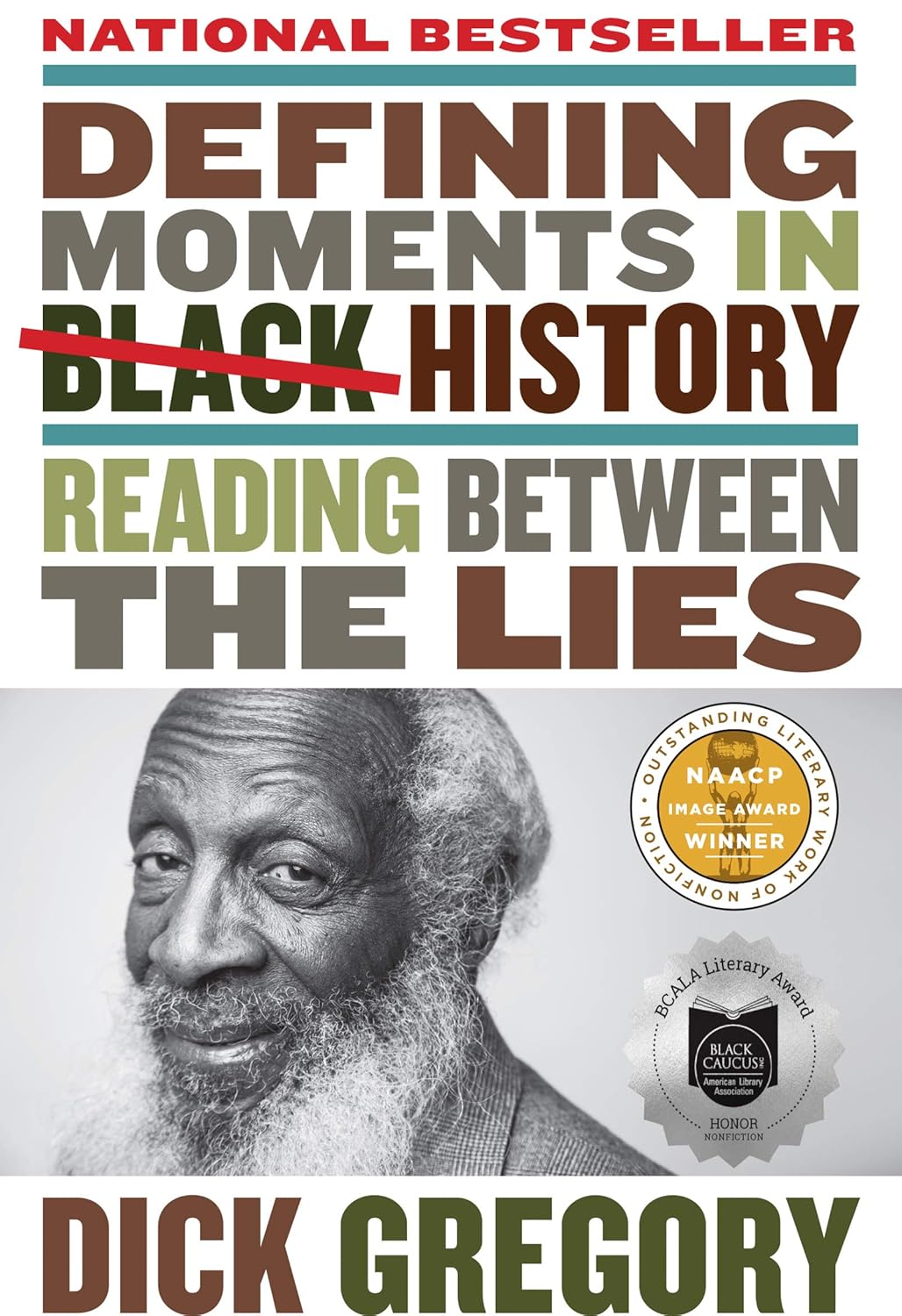
 Summary: How we tell stories matters to how we see the world.
Just a little over a year ago Dick Gregory passed away. Defining Moments in Black History was his last book. Dick Gregory was most well known as a comedian. His comedy albums in the 1960s and 1970s as well as his comedy tours and TV appearances made him nationally known. But Gregory was also a political activist. He ran for Chicago mayor against Richard J Daley in 1967. He was signficantly involved in the Civil Rights movement.
And as you hear throughout this book, he was at or participated in or knew personally many of the people or events that he is talking about.
I have no idea how to really talk about this book. Much of it is just standard recounting of the parts of history that are routinely ignored or white washed. But other parts are just crazy town conspiracy theories. I think that is part of what Gregory is known for. What is hard to talk about is that not all of the conspiracy theories he is talking about are simply theories. Plots against MLK by the FBI are not conspiracy theories. Cointelpro and the Tuskegee Syphilis Experiment are not conspiracy theories.
And then there are the parts that may have some validity, but are unlikely. Coretta Scott King and many others believe that there was a broader conspiracy to kill Martin Luther King Jr. From what I can tell, there is circumstantial evidence, but not definitive proof that the FBI, the Memphis Police or other government agencies played a role in MLK’s assassination. But there is enough evidence for the discussion.
 Takeaway: Well-crafted stories are a joy!
 Summary: “A lot of people want to skip ahead to the finish line of racial harmony. Past all this unpleasantness to a place where all wounds are healed and the past is laid to rest.” (Page 140)
 Takeaway: Education as virtue development has been on the horizon for a while.
 Summary: She gets married. Finally.
 Takeaway: I have no idea.
 Summary: A mix of “˜read this instead of that’ guide to Great Books, with half of the time devoted to great book outside of the cannon.