 Summary: Context to the why of Black Liberation Theology.
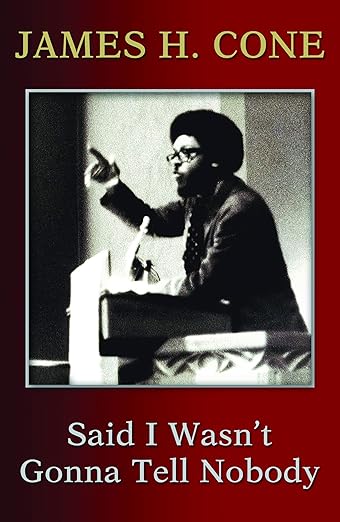
A few months ago I generally stopped referring to my posts as reviews. I am not really reviewing these books, I am trying to respond to them, give some thoughts and talk about what I have learned. That is especially true for a book like Said I Wasn’t Gonna Tell Nobody: The Making of a Black Theologian by James H Cone. Almost exactly a year ago I read Cone’s 1985 memoir, My Soul Looks Back. That memoir was a mid-career memoir. And of course there are some overlapping memories and reflections, but it is interesting to me how different they are. The passing of more than 40 years does matter.
I could make this a post of just quotes from Said I Wasn’t Gonna Tell Nobody. I have 20 that you can read on my Goodreads review. But the important part of reading a memoir like this is that it gives context for his other writing. I read his The Cross and the Lynching Tree (which he says was his favorite book) this summer. And I have previously read a couple of his other books. Many reduce Cone to just a “˜liberal theologian’ as if he has nothing to say to most of us. But Cone has much to say to us and reading his story I think matters to how we receive the rest of his work.
Cone was an academic theologian. His dissertation was on Barth. He was strongly influenced by Reinhold Niebuhr. As a Black theologian, he felt he had to respond to the civil rights movement, especially after the death of MLK and the rise of urban riots in the US. His question, “What, if anything, is theology worth in the black struggle in America?”, mattered not just in 1967 but also today.
Where many will disagree with Cone is his adoption of Malcom X’s statement, “œWe are black first and everything else second” and that discussion has continue today. But Cone was not rejecting finding his identity in Christ or was he implicitly condemning Whites and others by embracing his created Blackness. He was, in a not dissimilar way, embracing the concept of Black Lives Matters 50 years early.
Cone was frustrated by his theological training (and I still hear this from many minority theology students today).
The real historical Jesus, whom scholars have been seeking since the eighteenth century, was not white. That much I knew. When it became clear to me that Jesus was not biologically white and that white scholars actually lied by not telling people who he really was, I stopped trusting anything they said. It was ideologically tainted. I began to trust my own black experience as a better source for knowledge about God and Jesus. The black religious experience was less ideologically tainted because blacks were powerless and could not impose their view of Jesus on anybody. (Kindle Location 378)
 Summary: An imperfect prodigal returns home to an imperfect father.
 Summary: Brief graphic novel about Bonhoeffer with a very good understanding of the German context and Hitler’s rise to power.
 Takeaway: As Christians who believe in embodiment, we are Christians in a place, not just abstractly.
 Takeaway: Spiritual practices are not magic bullets.